
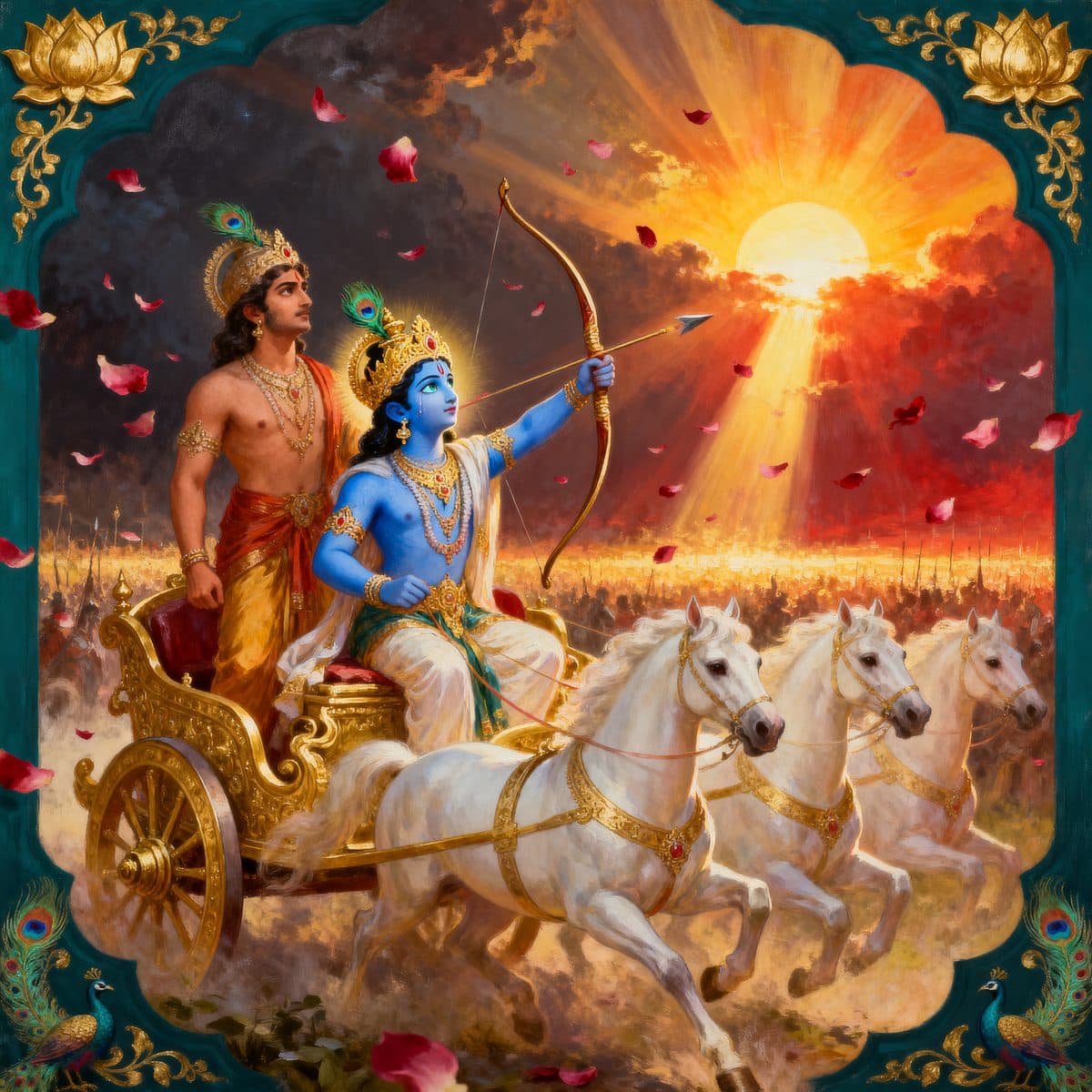
मोक्ष संन्यास योग
The Yoga of Liberation through Renunciation
78 VersesDescription
In this final chapter, Krishna summarizes the entire teachings of the Gita. He distinguishes between true renunciation (giving up attachment to results) and false renunciation (giving up duties). He discusses the influence of the Gunas on human life, the four varnas based on qualities, and the importance of performing one's duty. He concludes with the famous verse asking Arjuna to abandon all dharmas and surrender to him alone for liberation.
Location
Kurukshetra Battlefield
Characters


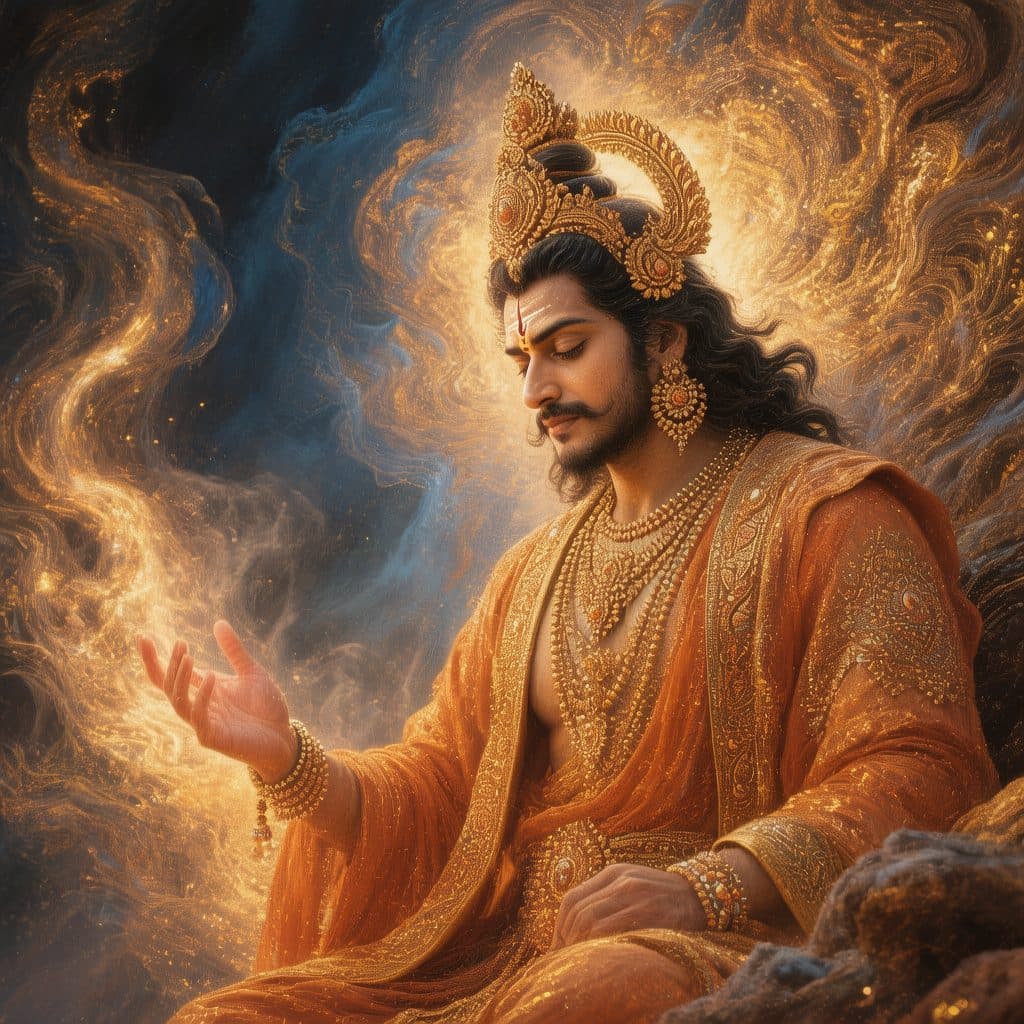
Watch Chapter Discourse
Video coming soon
Add a YouTube URL to the videoUrl field in chapters.ts
Chapter 18 — The Yoga of Liberation through Renunciation
Read Verses
78 of 78 availableArjuna said: O mighty-armed one, I desire to know the truth of renunciation (sannyasa) and of relinquishment (tyaga) separately, O Hrishikesha, O slayer of Keshi.
Arjuna opens the final chapter with a precise philosophical question that has been implicit throughout the entire Gita: what is the difference between sannyasa — the complete renunciation of action itself — and tyaga — the relinquishment of the fruits of action? This distinction is not academic. It determines whether a person living in the world, performing duties, raising a family, fighting battles, can truly walk a spiritual path — or whether liberation requires physical withdrawal from all activity. Arjuna addresses Krishna with three names here: Mahābāhu (mighty-armed), Hrishikesha (master of the senses), and Keshinishudana (slayer of the demon Keshi). Each name is chosen with care — the question is about action and its renunciation, and it is posed to the one who is simultaneously the greatest actor in the cosmos and its supreme master.
The Supreme Lord said: The sages know sannyasa as the giving up of action motivated by desire. The wise call tyaga the relinquishment of the fruits of all actions.
Krishna opens his final discourse by defining his terms with precision. Sannyasa, as understood by the sages (kavayo), means giving up kāmya-karma — actions performed out of personal desire for specific results: the desire for wealth, pleasure, prestige, or even heaven. Tyāga, as understood by the wise (vicakṣaṇāḥ), means something broader and more radical: giving up the fruits of all actions — not just the obviously self-motivated ones, but every action, including duties performed in one's given role. These two definitions are not contradictory but complementary. Sannyasa purifies the motivation for action; tyāga purifies the relationship to results. Together they describe the inner architecture of the liberated actor — one who acts out of dharma rather than desire, and who releases outcomes to God rather than clutching them as personal property.
Some thoughtful people declare that all action is to be given up as evil; while others say that acts of sacrifice, charity, and austerity are not to be abandoned.
Krishna acknowledges a genuine debate among spiritual teachers. One school holds that all action is inherently flawed — it creates karma, entangles the soul, and therefore the truly wise person should abandon action altogether. The other school holds that certain categories of action — yajna (sacrifice), dāna (charity), and tapas (austerity) — are so purifying and dharmic that they should never be abandoned, regardless of one's stage of spiritual development. This is not a trivial disagreement. It reflects the perennial tension between the via negativa of radical renunciation and the via positiva of sacred action. Krishna does not dismiss either view — he is about to offer the resolution that preserves what is true in both while transcending the limitation of each.
Hear my conclusion about relinquishment, O best of the Bharatas. Relinquishment, O tiger among men, has been declared to be of three kinds.
Krishna signals that he will now deliver a definitive teaching rather than a survey of opinions. He addresses Arjuna as Bharatasattama (best of the Bharata clan) and Puruṣavyāghra (tiger among men) — two honorifics that invoke Arjuna's nobility and strength. This is not a gentle suggestion but a resolution handed down with the authority of one who has seen both the question and the answer from their ultimate vantage point. The announcement that tyāga is threefold places it immediately within the framework of the three Gunas that has structured Krishna's analysis throughout the previous chapters. The listener is prepared: what follows will be a detailed map of the inner landscape of renunciation.
Acts of sacrifice, charity, and austerity should not be abandoned — they must be performed. Sacrifice, charity, and austerity are indeed purifiers for the wise.
Krishna begins his three-part analysis of tyāga by immediately siding with those who hold that certain actions must never be abandoned. Yajna, dāna, and tapas — sacrifice, charity, and austerity — are pāvanāni: purifiers. They are not optional extras for the spiritually advanced but necessary disciplines for anyone walking the path. This is a critical teaching for those who mistake spiritual advancement for the progressive withdrawal from all engagement. The wise person does not abandon these practices; they deepen them. The question is not whether to perform them but how — with what motivation, what attitude, what quality of renunciation of results.
But even these actions should be performed, O Partha, giving up attachment and the fruits. This is my definite and highest opinion.
The pivot of the entire teaching on tyāga is contained here: even the highest actions — yajna, dāna, tapas — must be performed with the relinquishment of saṅga (attachment) and phala (fruit). The actions themselves are not abandoned; the ego's grip on them is abandoned. This is the surgical precision of true renunciation: it does not operate on the action but on the actor's relationship to the action. The word uttamam — highest — marks this as Krishna's supreme position on the question. It unifies both schools cited in verse 3: actions of purification must be performed (answering the second school) but must be performed without attachment to their fruits (incorporating the spirit of the first school's concern about karma-bondage).
The abandonment of prescribed duty is not proper. Its relinquishment out of delusion is declared to be tamasic.
Krishna now describes tamasic tyāga — the false renunciation born of delusion (moha). This is the person who abandons their prescribed duties, their dharmic responsibilities, not out of spiritual clarity but out of laziness, fear, confusion, or the delusion that inaction is the same as transcendence. The Gita has consistently rejected this pseudo-renunciation throughout: abandoning one's duties while calling it spirituality is not liberation but its counterfeit. The word niyatasya — prescribed, regulated — refers to duties that are given by one's nature, role, and dharma. These are not optional. To abandon them under the guise of spiritual renunciation is to fall into tamas — the quality of darkness, inertia, and delusion.
If one abandons action because it is painful or out of fear of bodily suffering, such a person performs rajasic renunciation and does not obtain the fruit of renunciation.
The second type of false renunciation is rajasic: the person who gives up their duties not because of delusion but because of discomfort, aversion to pain, or fear of difficulty. This is closer to self-preservation than to spiritual aspiration. The one who abandons their post because the work is hard, who stops their spiritual practice because it is demanding, who withdraws from their responsibilities because they are exhausting — this person performs a rajasic renunciation that yields no spiritual fruit. They have mistaken comfort for liberation. True renunciation requires the willingness to do what is difficult, uncomfortable, and demanding — without attachment to ease.
That renunciation is considered sattvic, O Arjuna, when one performs prescribed action as a duty, giving up attachment and the fruit.
Here is the sattvic tyāga — the genuine renunciation that the Gita has been pointing toward throughout. It has three characteristics: the action is niyata (prescribed by one's duty), it is performed kāryam iti — simply because it ought to be done, as a matter of dharmic necessity — and it is performed with both saṅga (attachment to the process) and phala (desire for the fruit) fully released. The simplicity of this formulation is radical: do your duty because it is your duty, neither clinging to how it goes nor grasping at what comes from it. This is the posture of the liberated actor — fully engaged in the world, fully free from the world.
The renouncer who is pervaded by sattva, who is intelligent and free from doubt, does not hate disagreeable action nor cling to agreeable action.
The sattvic renouncer is described here with beautiful precision. They do not dveṣṭi — hate, avoid, or resent — the actions that are disagreeable, difficult, or unpleasant. Nor do they anusajjate — become attached to, cling to, or addicted to — actions that are pleasant and rewarding. This equanimity is not indifference but perfect spiritual balance: the full engagement of intelligence and will without the distortions of aversion and desire. They are medhāvī (wise, of sharp discernment) and chinna-saṃśayaḥ (free from doubt, their doubts cut through). The resolution of doubt comes not from information but from the direct experience of sattva — the clarity that sees action as action, result as result, neither welcoming nor dreading either.
Indeed, it is not possible for an embodied being to give up actions entirely. But one who gives up the fruits of action — that person is truly called a renouncer.
This verse offers perhaps the most practical resolution to the entire debate about sannyasa and tyāga. For an embodied being — anyone living in a body — complete cessation of action is impossible. Breathing is action; thinking is action; digestion is action. The demand for total actionlessness mistakes a metaphysical truth (the Self is actionless) for a practical instruction (therefore stop acting). Krishna cuts through this confusion: the true renouncer is not defined by what they don't do but by their inner relationship to what they do. Giving up the fruits of action — not demanding personal return, not clutching the results — makes one a tyāgī in the genuine sense. This is the definition the entire chapter has been building toward.
For those who do not renounce, the threefold fruits of action — desirable, undesirable, and mixed — accrue after death. But for renouncers, there is none whatsoever.
The stakes of the teaching are made explicit. For those who act with attachment to fruits — the atyāginas, the non-renouncers — the karma generated by action follows them beyond death: pleasant results (iṣṭa), unpleasant results (aniṣṭa), and mixed results (miśra). These three become the forces that shape future births, future circumstances, future suffering and joy. For the true saṃnyāsī — the one who has genuinely given up attachment to outcomes — none of this accrues. The action happens; its fruit is released; no residue remains in the soul. This is the liberation the Gita has been pointing toward: not freedom from action but freedom in action, achieved through the radical relinquishment of personal ownership of results.
Learn from me, O mighty-armed one, the five causes for the accomplishment of all actions as declared in the Samkhya philosophy, which teaches the end of all action.
Krishna now pivots to a different register of analysis — the philosophical framework of Samkhya — to explain the mechanics of action itself. He is about to offer Arjuna a teaching that will dissolve the fundamental misidentification at the root of all suffering: the belief that "I am the doer." The five causes he will enumerate are drawn from Samkhya — the school of philosophical analysis — and they serve the Gita's purpose of siddhi: the completion and perfection of all action through the understanding of what action actually is. Mahābāhu — mighty-armed — is invoked here because the teaching requires a certain strength of mind to receive and integrate.
The body, the doer, the various organs, the manifold activities of different kinds, and the presiding deity — these are the five factors here.
The five causes of all action are: adhiṣṭhāna (the body — the field in which action occurs), kartā (the apparent doer — the ego-sense that claims agency), karaṇa (the instruments — the senses, both cognitive and active), ceṣṭā (the various vital activities — the prāṇic forces that animate the body), and daiva (fate or the divine ordering — the fifth factor that acknowledges what lies beyond all of these: the unseen laws, the accumulated karma, the mysterious dispensation of existence). By enumerating these five, Krishna is showing that what we call "my action" is in reality a confluence of many forces — very few of which are under the ego's control. The "doer" is one factor among five, and not the most powerful one.
Whatever action a person performs with body, speech, or mind — whether right or wrong — these five are its causes.
The scope of this teaching is total: every action — whether righteous or unrighteous, beneficial or harmful — whether performed through body, speech, or mind — has these five causes. This is a philosophically liberating statement because it means that no single action can be fully attributed to the ego alone. This does not eliminate moral responsibility — the ego is one of the five causes — but it relativises the ego's claim to be the sole author of what happens. The great value of this understanding is not as an excuse but as a corrective to the inflation of ego-identity: the one who says "I did this great thing" and the one who says "I did this terrible thing" are both making the same fundamental error of identification.
Since this is so, one who sees the pure Self as the sole doer — that person, of impure intellect, does not truly see.
This verse is one of the most philosophically precise in the entire Gita. Given that action arises from five causes, anyone who sees the pure Self (ātmān) as the sole doer (kevalaṃ kartāram) is making a category error — they are applying the concept of agency to the one thing in existence that is by nature beyond agency. The Self is the witness, not the actor. To mistake the Self for the actor is akṛta-buddhitva — immature, uncultivated intellect — and the person who does so is durmati, of confused mind. Note that this is the opposite of the usual mistake: usually we warn against forgetting the Self. Here Krishna warns against a subtler error — applying the attributes of ego-agency to the Self. Both errors prevent clear seeing.
One who has no sense of "I am the doer," whose intellect is not tainted — even if they slay these worlds, they do not kill, nor are they bound.
This is one of the most striking and radical verses in the Gita — one that has caused controversy and deep reflection across centuries of commentary. Krishna says: if your ego-sense as doer is absent, and your intellect is untainted by desire, attachment, and identification — then even if you kill everyone in these worlds, you have not killed, and you are not bound by that action. This is not a licence for violence or a dispensation for arbitrary destruction. It is a precise statement about the metaphysics of action: karma accrues not to the action but to the actor's identification. The untainted actor who has no ahaṃkāra-sense acts as an instrument of the divine order — and like a knife used by a surgeon, the instrument bears no moral residue from what it cuts.
Knowledge, the object of knowledge, and the knower — these are the threefold impulses to action. The instrument, the action itself, and the agent — these are the threefold basis of action.
Krishna now shifts to a more technical analysis, laying out the complete structure of action. Any action has two triplets at its foundation: the epistemic triplet (the knower, the known, and the knowing) and the operative triplet (the actor, the instrument, and the action). These six elements constitute the complete field of any action whatsoever. By mapping them explicitly, Krishna is preparing Arjuna — and the reader — to understand how the quality of the Gunas permeates every element. What follows (verses 19-40) will be a systematic analysis of how sattva, rajas, and tamas colour knowledge, action, and the agent. This preparatory verse is the structural key to that entire analysis.
Knowledge, action, and the agent are each declared to be of three kinds only, according to the distinction of Gunas in the Guna-analysis. Hear about these also.
The systematic guna-based analysis of the entire field of action begins here. Krishna announces that knowledge (jñāna), action (karma), and the agent (kartā) each divide into three types according to the three Gunas. This means there is sattvic knowledge, rajasic knowledge, and tamasic knowledge; sattvic action, rajasic action, and tamasic action; a sattvic agent, a rajasic agent, and a tamasic agent. The same structure will extend to intellect, fortitude, and happiness (covered in subsequent verses). This is one of the most comprehensive and practically useful frameworks in the Gita — a complete diagnostic tool for understanding one's inner state and orienting oneself toward sattva and beyond.
That knowledge by which one sees the single imperishable reality in all beings — undivided in the divided — know that knowledge to be sattvic.
Sattvic knowledge is defined by its capacity to see through multiplicity to unity: one sees the single imperishable essence (ekam bhāvam avyayam) in all beings, undivided (avibhaktam) in what appears to be divided (vibhakteṣu). This is the knowledge that the Gita has been cultivating throughout — the recognition that the same ātman, the same consciousness, the same divine presence animates every apparently separate being. This is not a belief or a philosophical position but a mode of direct perception — a way of seeing the world in which the One shines through the many without contradiction. The sattvic person sees this; the rajasic and tamasic do not.
That knowledge which sees in all beings separately various different realities of different kinds — know that knowledge to be rajasic.
Rajasic knowledge perceives reality through the lens of radical separateness: it sees beings as fundamentally different from each other, each with its own entirely distinct nature. This is not entirely wrong — there are genuine differences between things — but it is a partial truth that, when taken as the whole truth, becomes a source of division, conflict, and the endless clash of competing interests. Rajasic knowledge sees competition where sattvic knowledge sees complementarity, sees foreign where sattvic knowledge sees family. It generates the energy and ambition characteristic of rajas but also its characteristic tendency toward fragmentation, rivalry, and the reduction of the world to an arena of separate forces in contest.
But that which clings to a single effect as if it were the whole, which is without rational basis, trivial, and not concerned with truth — that is declared to be tamasic.
Tamasic knowledge is the most contracted form of knowing: it takes one limited object and treats it as the whole of reality. It is akaitukam — without proper cause or rational foundation — and atattvārthavat — not concerned with truth, indifferent to what is real. It is alpa — small, petty, limited in scope. This is the knowledge of superstition, of blind routine, of the person whose entire horizon has collapsed to one immediate and narrow concern. It is also the knowledge of the ideologue who has taken one partial truth and made it absolute — or the addict who has reduced the entire field of value to one object of craving. Tamasic knowledge does not see; it is a form of not-seeing dressed in the clothing of knowledge.
Action that is prescribed, free from attachment, performed without love or hatred, by one who desires no fruit — that is called sattvic.
The characteristics of sattvic action are now laid out with precision. It is niyata — in accordance with one's duty and the order of dharma. It is free from saṅga — the sticky quality of attachment, the clinging that makes action about "me." It is performed without rāga (love-craving) or dveṣa (aversion-hatred) — without the distortions of personal attraction and repulsion. And it is done by one who is aphalaprepsunā — who does not seek the fruit. These five qualities together describe the action of a liberated person — engaged fully in what must be done, undistorted by any personal agenda, free in the very act of acting.
But action performed with desire for results, or with ego, or with great strain — that is called rajasic.
Rajasic action has three telltale signatures: it is kāmepsunā — performed with desire for results, with an eye on the payoff; it is sāhaṅkāreṇa — performed with ego-investment, with "I" at the centre of the action making it about the actor's pride, status, or self-image; and it involves bahulāyāsa — excessive strain, great effort, the grinding quality of action pushed by ambition and resistance. Rajasic action is not necessarily harmful in its external form — it may accomplish great things in the world — but it creates enormous karmic residue because every action is loaded with desire and ego. The doer of rajasic action is exhausted precisely because they are carrying so much of themselves into everything they do.
That action which is undertaken out of delusion, without regard for consequences, loss, harm to others, or one's own capacity — that is called tamasic.
Tamasic action is defined by its fundamental unconsciousness: it begins from moha (delusion) and proceeds without consideration of consequences (anubandha), without awareness of destruction (kṣaya), without concern for harm to others (hiṃsā), and without honest assessment of one's own capacity (pauruṣam). This is the action of the person who acts without thinking, who plunges into situations without understanding what they are getting into, who harms others through carelessness rather than intention, and who consistently overestimates or underestimates their own resources. Tamasic action is not evil in intent — it is asleep. Its damage comes from unawareness.
Free from attachment, free from the language of "I," endowed with steadiness and enthusiasm, unaltered in success and failure — such an agent is called sattvic.
The sattvic agent (kartā) embodies four qualities: muktasaṅga — free from the clinging of attachment; anahaṃvādī — not speaking in terms of "I did this," without ego-speech; dhṛtyutsāha-samanvita — endowed with both steadiness (dhṛti) and enthusiasm (utsāha), a remarkable combination that shows engagement without desperation; and nirvikāra in success and failure — unchanged, unshaken, equally present through both outcomes. This portrait of the sattvic agent is the Gita's description of the spiritually mature person as they appear in action — not a passive ascetic but an engaged, enthusiastic, and utterly equanimous doer.
Passionate, desiring the fruits of action, greedy, violent in nature, impure, moved by joy and grief — such an agent is declared to be rajasic.
The rajasic agent is characterised by a cluster of qualities that form a recognisable psychological type: rāgī (passionate, driven by desire), karmaphala-prepsuh (constantly seeking the fruits of action), lubdha (greedy), hiṃsātmaka (prone to violence in nature — not necessarily physical violence but the inner aggression of ego that hurts others in the pursuit of its goals), aśuci (impure — allowing any means to justify the desired end), and swinging between harṣa (elation at success) and śoka (grief at failure). The rajasic agent is the person trapped in the drama of their own results — up when things go well, down when they don't, never at rest, always in motion between hope and disappointment.
Undisciplined, vulgar, stubborn, deceitful, malicious, lazy, despondent, and procrastinating — such an agent is called tamasic.
The tamasic agent is described through eight qualities that together paint a portrait of deep spiritual inertia: ayukta (lacking discipline or mental control), prākṛta (crude, vulgar — operating at the lowest level of natural impulse without refinement), stabdha (stubborn, immovable — unable to learn or change), śaṭha (deceitful, crooked), naiṣkṛtika (malicious, harmful to others), alasa (lazy), viṣādī (despondent, prone to despair), and dīrghasūtrī (procrastinating — beginning nothing, finishing nothing). This is not a condemnation of persons but a diagnosis of states: these qualities are the manifestations of tamas in the human personality, and they can be recognised, named, and worked against.
Hear now the threefold distinction of intellect (buddhi) and also of fortitude (dhrti), according to the Gunas, expounded separately and completely, O Dhananjaya.
The guna-analysis now extends to two more inner faculties: buddhi (the intellect — the capacity for discernment, judgment, and understanding) and dhṛti (fortitude — the quality of inner strength that sustains one through challenges). These are among the most important faculties in the Gita's psychology: buddhi is the instrument of right discrimination between the real and the unreal, the eternal and the transient; dhṛti is what allows one to hold to what is good when everything else pulls against it. To understand how sattva, rajas, and tamas express themselves through these faculties is to gain a precise diagnostic tool for one's inner condition.
That intellect which knows the paths of action and renunciation, what is to be done and what is not to be done, what is to be feared and what is not — bondage and liberation — that intellect, O Partha, is sattvic.
The sattvic buddhi is characterised by its capacity for correct discrimination across six fundamental polarities: pravṛtti (the path of engagement in the world) and nivṛtti (the path of withdrawal from the world) — knowing when each is appropriate; kārya (what must be done) and akārya (what must not be done); bhaya (what is genuinely to be feared — the things that truly bind the soul) and abhaya (what need not be feared — the things that only appear threatening to the ego); and bandha (bondage) and mokṣa (liberation). The sattvic intellect knows these distinctions clearly and acts accordingly. This is practical wisdom in its fullest form.
That intellect which incorrectly understands dharma and adharma, what is to be done and what is not — that intellect, O Partha, is rajasic.
The rajasic intellect is characterised by ayathāvat — incorrect, distorted understanding. It knows the categories — dharma and adharma, what should and should not be done — but it gets them wrong. This wrong understanding is not random but systematic: it is shaped by the desires, fears, and ego-investments of the rajasic mind. The rajasic intellect rationalises: it finds reasons why what is convenient is also righteous, why what is uncomfortable is really not obligatory, why one's own advantage happens to align with what is good. It is not stupid but it is self-serving — and its self-serving nature distorts its perception of moral reality.
That intellect which, enveloped in darkness, regards adharma as dharma and sees all things perverted — that intellect, O Partha, is tamasic.
The tamasic intellect does not merely get dharma and adharma subtly wrong (as the rajasic does) — it actively inverts them, calling adharma by the name of dharma. Enveloped in tamas (tamasāvṛtā), it sees all things perverted (viparīta): up is down, right is wrong, the harmful is called beneficial, the beneficial is called harmful. This is the intellect of the deeply deluded person — not simply confused but systematically inverted in their moral perception. This degree of distortion is the result of accumulated tamas and is the hardest condition to escape, precisely because the tamasic intellect cannot recognise its own error — it believes it sees clearly while it sees nothing accurately.
The fortitude by which one sustains the activities of mind, vital breath, and senses through unwavering yoga — that fortitude, O Partha, is sattvic.
Sattvic dhṛti (fortitude) is the inner strength that holds the entire instrument — mind, prāṇa (vital energy), and senses — in alignment through the practice of yoga. The word avyabhicāriṇī is crucial: this fortitude is unwavering, not promiscuous, not dispersed across many objects and concerns. It is the fortitude of single-pointed commitment. This is not grimness or suppression but the natural steadiness that comes when the instrument of body-mind is aligned with a purpose larger than itself. The sattvic person holds their faculties together in the service of liberation, and this holding is experienced not as effort but as integrity — as wholeness.
But that fortitude by which one holds on to dharma, pleasure, and wealth, O Arjuna, with attachment and desire for the fruits — that fortitude, O Partha, is rajasic.
Rajasic dhṛti is the fortitude that sustains the pursuit of the three worldly goals — dharma (righteous conduct), kāma (pleasure), and artha (wealth) — but does so with prasaṅga (attachment) and phalākāṅkṣā (desire for the fruits of each pursuit). This is the fortitude of the driven person: the ambitious professional who works tirelessly, the seeker who practices discipline but always with an eye on what they will get for it. This is not a trivial quality — it produces real results in the world — but it is bound. The person who holds on with rajasic dhṛti exhausts themselves through the very quality that sustains them, because desire-driven fortitude cannot be truly satisfied. The satisfaction always requires another round of effort.
That fortitude by which a dull-witted person does not give up sleep, fear, grief, depression, and pride — that fortitude, O Partha, is tamasic.
The bitter irony of tamasic dhṛti is that its "fortitude" is actually a tenacious clinging to the very states that enslave: svapna (sleep — excessive sleeping, the escape of consciousness into unconsciousness), bhaya (fear — the chronic low-grade fear that governs the tamasic life), śoka (grief), viṣāda (depression, despondency), and mada (pride — the coarse ego-inflation of the unreflective person). The durmedhā — the dull-witted person — does not release these states. Their "holding on" is the holding on of the self-destructive habit, the inability to let go of suffering. This is the deepest form of bondage: the fortitude that sustains one's own prison.
Now hear from me, O best of the Bharatas, about the three kinds of happiness. That happiness in which one delights through practice, and by which one reaches the end of suffering —
Krishna now turns to happiness — sukha — and applies the same threefold Guna-analysis. This transitional verse introduces the analysis with a key characteristic of the highest form of happiness: it comes through abhyāsa (practice, repeated engagement) and it leads to the end of suffering (duḥkhānta). This is a crucial pointer: the deepest happiness is not available to the beginner, not immediately pleasurable, requires cultivation — and it dissolves suffering at the root rather than temporarily relieving it. This description already tells us that the highest sukha will not look like what we ordinarily call pleasure.
That which is like poison at first but like nectar at the end — that happiness, born of the clarity of the Self and intellect, is declared sattvic.
The most perfect verse in the Gita's analysis of happiness describes the sattvic experience with a paradox that every serious spiritual practitioner recognises: what begins as poison — difficult, demanding, uncomfortable, even painful — becomes nectar at the end. The spiritual life begins with the dissolution of the ego's familiar pleasures, the disruption of comfortable routines, the confrontation with one's own shadow. This is "poison at first." But the end is amṛta — nectar, the immortal. This happiness is ātmabuddhi-prasādajam — born of the clarity (prasāda, literally "grace" or "purity") of the Self and intellect. It comes not from outside but from within, as the natural radiance of awareness when it comes to rest in its own nature.
That happiness which arises from the contact of senses and sense-objects, which seems like nectar at first but is like poison in the end — that is called rajasic.
The sattvic happiness is exactly inverted in its temporal structure: it is nectar at the end. Rajasic happiness — the happiness of sensory pleasure, of getting what we desire — is the reverse: nectar at first, poison at the end. This is one of the most practically important teachings in the Gita. Every person who has experienced the pattern of desire, gratification, and the subsequent emptiness or craving knows this structure. The pleasure is real; so is the subsequent suffering. The rajasic happiness arises from viṣayendriya-saṃyoga — the contact of senses with their objects — and it is inherently impermanent because the contact cannot be maintained and the hunger returns stronger than before.
That happiness which deludes the self at first and in the end, arising from sleep, laziness, and heedlessness — that is called tamasic.
Tamasic happiness is the strangest of the three: it is deluding (mohana) both at first and in the end. It arises from nidrā (excessive sleep), ālasya (laziness), and pramāda (heedlessness, negligence). This is the "happiness" of unconsciousness — the relief of not having to be awake to one's life, the comfort of not engaging, the pleasure of avoidance and escape. Unlike rajasic pleasure, which at least offers genuine pleasure before its destructive consequences, tamasic pleasure doesn't even deliver: it is merely the absence of the discomfort of awareness. It is the happiness of the person who says "at least I'm not suffering" while remaining entirely asleep to the possibility of genuine joy.
There is no being on earth or in the heavens among the gods who is free from these three Gunas born of material nature.
This is one of the most sweeping statements in the entire Gita: the three Gunas operate throughout the entire range of existence — from the densest material reality on earth to the most refined spiritual realms of the gods. No being — human, animal, divine — exists outside the field of sattva, rajas, and tamas. This universality serves two purposes: it prevents spiritual pride (even the most refined spiritual practitioner operates within the Gunas) and it points toward what must lie beyond them — the witness-consciousness that is not itself a Guna-state but the aware space in which all Guna-states arise and pass. Liberation is not the attainment of pure sattva; it is the recognition of what one has always been beyond all three.
The duties of Brahmins, Kshatriyas, Vaishyas, and Shudras, O scorcher of foes, are distributed according to the Gunas arising from their own nature.
Krishna now applies the Guna-analysis to the social order — the four varnas. This is a crucial passage that has been widely debated: it grounds the varna system not in birth but in svabhāva — one's own inherent nature, the particular configuration of Gunas that defines a person's natural capacities and inclinations. The Gita's vision of social order is thus meritocratic in the deepest sense: roles are distributed according to what one is, not who one's parents were. The Brahmin's qualities, the Kshatriya's qualities, the Vaishya's qualities, and the Shudra's qualities are all equally necessary expressions of the divine order, and all paths lead — through the proper performance of their respective duties — to the highest liberation.
Serenity, self-restraint, austerity, purity, forbearance, uprightness, knowledge, direct experience of truth, and faith in God — these are the natural duties of the Brahmin.
The nine qualities of the Brahmin are a portrait of the contemplative and intellectual path: śama (serenity of mind), dama (restraint of the senses), tapas (austerity — disciplined cultivation of spiritual capacity), śauca (purity — inner and outer), kṣānti (forbearance — the patient endurance that does not strike back), ārjava (uprightness, moral directness), jñāna (knowledge — theoretical, scriptural), vijñāna (direct experiential knowing — the wisdom that comes from lived practice), and āstikyam (faith in God, in the scriptures, and in the liberation they promise). Together these describe the qualities needed for the life of enquiry and teaching — the service that keeps wisdom alive and available for every generation.
Valour, radiance, fortitude, skill, not fleeing in battle, generosity, and the capacity to govern — these are the natural duties of the Kshatriya.
The seven qualities of the Kshatriya describe the path of courageous, honourable leadership in the world: śaurya (valour — physical and moral courage), tejas (radiance — the natural authority that commands respect), dhṛti (fortitude — the steadiness that holds through difficulty and danger), dākṣya (skill — practical competence in one's domain), not fleeing in battle (appalāyanam — the refusal to abandon one's post), dāna (generosity — the characteristic of the one who has the power to protect and give), and īśvarabhāva (the capacity to govern — the quality of natural authority and leadership). These are the gifts of the warrior-leader, and when exercised as dharmic duty without ego, they serve the highest purpose.
Agriculture, cattle-keeping, and trade are the natural duties of the Vaishya; service is the natural duty of the Shudra.
The duties of the remaining two varnas are stated with characteristic concision. The Vaishya path involves the stewardship of the material resources of the community — agriculture (kṛṣi), cattle-keeping (gaurakṣya), and trade (vāṇijya). These are the activities through which the earth's abundance is cultivated, preserved, and distributed. The Shudra's path is paricaryā — service, the direct offering of one's energy and capacity in support of others. In the Gita's vision, service is not a lesser calling: it is the path of love expressed through action, and it has its own dignity and its own route to liberation. The person who serves with full heart and without ego is as near to God as the greatest philosopher.
A person attains perfection by being devoted to their own duty. Hear how one finds perfection by being intent on one's own duty.
The profound and democratising teaching of this verse is that perfection (saṃsiddhi) is available through any path — through any person's own duty, faithfully performed. The path does not have to be the same for everyone; in fact, it cannot be. What matters is the quality of devotion brought to one's own particular duty. The philosopher, the warrior, the merchant, the servant — each can attain the highest perfection through their own svadharma. This is the Gita's answer to the question of spiritual democracy: not everyone meditates, not everyone reads scripture, not everyone goes on pilgrimage — but everyone can perform their duty with love, skill, and the spirit of offering.
By worshipping through one's own duty the One from whom all beings proceed and by whom all this is pervaded, a person finds perfection.
This verse transforms duty into worship with a single syntactic move: performing one's own duty (svakarmana) is the means of abhyarcya — of worshipping the divine (tam) from whom all beings spring and by whom the entire creation is pervaded. The artisan worships God by making excellent things with full attention and love; the farmer worships God by tending the earth with care and gratitude; the healer worships God by bringing skill and compassion to the suffering. When this understanding is alive, every form of work becomes a liturgy, every workplace a temple, every moment of skilled and loving action a prayer. This is the Gita's most practical and universal spiritual teaching.
Better is one's own duty, though imperfectly performed, than the duty of another well performed. Performing the duty ordained by one's own nature, one does not incur sin.
This principle appeared earlier in the Gita (chapter 3, verse 35) and returns here with greater resonance because of the full context now built around it. The teaching challenges the human temptation to abandon one's own path in favour of someone else's that appears more glorious, more spiritual, more impressive. The imperfect performance of one's own authentic duty — the path that corresponds to one's genuine nature — is spiritually more valuable than the perfect performance of a borrowed one. When one acts from one's own nature (svabhāva-niyatam), there is authenticity, an absence of pretence, a natural alignment — and this authenticity is itself a form of integrity that prevents the accumulation of spiritual harm (kilbiṣa).
One should not abandon one's innate duty, O son of Kunti, even if it has faults. All undertakings are enveloped by faults as fire is by smoke.
The practical wisdom of this verse is bracing: every path has its faults. There is no perfect duty, no unblemished profession, no action that is entirely without shadow. To seek a faultless path is to seek something that does not exist. The image of fire enveloped by smoke captures the spiritual reality perfectly: fire and smoke are inseparable in ordinary combustion; the fire does not become un-fire because of the smoke. The solution is not to seek a smokeless fire (an illusion) but to tend the fire with such skill and purity of intention that the smoke is minimised. Likewise, one performs one's duty with the highest care and consciousness, accepting its inherent limitations without using them as an excuse to abandon it.
One whose intellect is unattached everywhere, who has conquered the self, from whom all longings have departed — through renunciation such a person attains the supreme perfection of transcendence from action.
This verse describes the culminating state that the entire preceding teaching has been preparing: naiṣkarmya-siddhi — the supreme perfection of transcendence from action, the state in which action no longer binds. It is attained through saṃnyāsa — renunciation — but renunciation as defined throughout this chapter: the inner condition of asaktabuddhiḥ (intellect unattached everywhere), jitātmā (self-mastery — the self has been brought under the governance of the higher Self), and vigataspr̥ha (free from all longing, all grasping after any particular outcome). This is not a physical renunciation of the world but the radical inner freedom that can coexist with any external condition.
Learn from me briefly, O son of Kunti, how one who has attained perfection also attains Brahman — the supreme culmination of knowledge.
Having described the attainment of naiṣkarmya-siddhi (transcendence from action), Krishna now describes the further journey: from siddhi (perfection) to Brahman (the absolute reality). This progression is important: perfection in the practice of yoga is not the final end — it is the doorway to Brahman. Krishna promises a concise teaching (samāsena — in brief) of the supreme culmination of knowledge (jñānasya yā parā niṣṭhā). The transition from practice to realisation, from the attainment of inner freedom to the recognition of absolute reality — this is what the next several verses will sketch.
Endowed with a purified intellect, restraining oneself with fortitude, abandoning sound and other sense-objects, casting away attraction and aversion —
This verse begins a sequence (continuing through verse 53) describing the prerequisites for the attainment of Brahman. The first cluster of conditions: viśuddhā buddhi (purified intellect — refined by knowledge, practice, and sattva cultivation), dhṛti (fortitude — the inner stability that holds through difficulty), the abandonment of sense-objects beginning with sound, and the casting away of rāga (attraction) and dveṣa (aversion). These are the conditions of the purified seeker — not someone who has achieved Brahman but someone whose inner instrument is prepared to receive it. The inner work must precede the realisation.
Dwelling in solitude, eating lightly, controlling speech, body, and mind, always devoted to meditation-yoga, taking refuge in dispassion —
The second cluster of conditions for Brahman-realisation: vivikta-sevī (frequenting solitude, giving the mind the space of quietude away from constant social stimulation), laghvāśī (eating lightly — the discipline of diet that supports clear awareness), yata-vāk-kāya-mānasaḥ (controlling speech, body, and mind — the threefold discipline of outer and inner conduct), dhyāna-yoga-para nityam (always devoted to the practice of meditation-yoga), and vairāgya (dispassion — the genuine and deepening freedom from the pull of sense-objects and worldly attachments). These are the marks of the mature spiritual practitioner in the midst of their path.
Freed from ego, force, arrogance, desire, anger, and possessiveness; without the sense of "mine"; peaceful — one becomes fit for union with Brahman.
The third and culminating cluster of conditions: freedom from ahaṅkāra (ego-sense), bala (the aggressive assertion of personal power), darpa (arrogance — the ego's pride in its own accomplishments), kāma (desire), krodha (anger — the ego's reaction when desire is frustrated), parigraha (possessiveness, grasping), nirmama (the absence of the "mine" sense — the "my" that turns everything into personal property), and śānta (peaceful — the natural condition of the mind freed from all these agitations). When all of these are genuinely released, one becomes fit (kalpate) for brahmabhūya — union with, or recognition of, Brahman. This is the preparation complete; realisation can now dawn.
Becoming Brahman, with a joyful self, one neither grieves nor desires; equal to all beings, one attains supreme devotion to me.
This verse describes a remarkable movement: the one who has become Brahman — who has realised their identity with the absolute — does not remain at a distance from devotion. Instead, from the platform of Brahman-realisation, they attain parā bhakti — supreme devotion. This is the Gita's reconciliation of the path of knowledge and the path of devotion: Brahman-realisation is not the end but the precondition for the highest love. The prasannātmā (joyful self), the one who neither grieves nor desires, the one who sees all beings with sameness — this person has the inner freedom required for love in its purest and most universal form. Devotion without this freedom is always coloured by personal need; devotion with this freedom is pure offering.
Through devotion one comes to know me in truth — who and how great I am. Then, knowing me in truth, one enters into me immediately.
The final movement: it is through bhakti — devotion — that the ultimate truth of the divine is known. Not through logic alone, not through scriptural study alone, not through meditation technique alone — but through bhakti. This is the Gita's most definitive claim about the epistemology of divine knowledge: God is known through love. The knowledge here is tattvatah — in truth, in reality — not a conceptual approximation but direct knowing. And having known thus, one enters (viśate) immediately: the knowledge and the entry are not separated by any further process. This is the promise of the entire Gita expressed in two lines: know through devotion; enter through knowing.
Always performing all actions, taking refuge in me — through my grace one attains the eternal, imperishable state.
The teaching reaches a new level of generosity here: sarvakarmāṇyapi — all actions, even all of them. There is no action that needs to be excluded from the devotional life. The householder performing worldly duties, the warrior fighting, the merchant trading, the servant serving — all of these, if performed with mad-vyapāśrayaḥ (taking refuge in God), lead through divine grace to the śāśvata pada avyayam — the eternal, imperishable state. This is the grace of the personal God: not the impersonal law that says "if you do this, you will get that," but the living love that meets the sincere devotee wherever they are and carries them to where they could never carry themselves.
Mentally renouncing all actions into me, making me the supreme goal, taking refuge in the yoga of discernment — always keep your mind in me.
Krishna now gives Arjuna a specific practical instruction. Cetasā — through the mind — surrender all actions into God. This is the inner act that complements and completes the external performance of duty: mentally, in each moment, the action is released into the divine. Mat-paraḥ — making God the supreme goal, the ultimate orientation. Buddhi-yogam upāśritya — taking refuge in the yoga of discernment, using the purified intellect to navigate each situation. Mac-cittaḥ satataṃ bhava — always keep your mind in me. This is not a part-time practice but a constant orientation of consciousness. The mind that is always in God is the mind that has found its natural home.
With your mind in me, you will cross over all difficulties through my grace. But if out of ego you do not listen, you will perish.
The stakes of the teaching are stated with unusual directness. The mind anchored in God crosses all difficulties (sarvadurgāṇi — all hardships, every difficult passage) through divine grace. But the mind that refuses out of ego — ahaṅkārāt — and does not listen, will vinaṅkṣyasi: perish, be destroyed. This is not a threat but a statement of natural law. The ego's refusal to surrender to the divine order is not freedom but the deepest form of bondage — and bondage pursued long enough leads to destruction. Arjuna at the start of the Gita was on the verge of this kind of ego-driven destruction; the entire Gita has been the offering of the alternative: surrender, trust, and liberation through grace.
If, taking refuge in ego, you think "I will not fight," your resolve is vain. Your own nature will compel you.
Krishna speaks with complete directness to Arjuna's actual situation: the decision "I will not fight" made from ego is mithyā — false, vain, an illusion. Nature itself will compel the action. This is not a warning but a description of reality: Arjuna is a warrior by nature (svabhāva), and the warrior's nature will express itself regardless of what the ego resolves in a moment of sentimental confusion. The profound teaching here is that the ego cannot actually override nature — it can only add suffering to the inevitable. The alternative to acting under compulsion of nature is acting consciously, with knowledge, from a place of choice. This is what the entire Gita has been preparing Arjuna to do.
Bound by your own action born of your own nature, O son of Kunti, what you do not wish to do out of delusion, you will do even helplessly.
The teaching of verse 59 is here deepened with a note of compassionate honesty: Arjuna is nibaddha — bound — by his own nature-born action. What he now wishes to avoid out of moha (delusion) he will eventually do avaśaḥ — helplessly, without real choice. The word avaśa is stark: the person who does not act consciously will act unconsciously, driven by nature rather than guided by wisdom. The Gita has been offering Arjuna the choice between these two modes of acting: compelled by nature's forces, or aligned with nature while guided by knowledge. One is bondage even in action; the other is freedom in action.
The Lord dwells in the hearts of all beings, O Arjuna, causing all beings to revolve by his power of illusion, as if mounted on a machine.
One of the most profound images in the entire Gita: God dwelling in the heart of every being, while simultaneously being the force that causes them to revolve — to move through the cycles of existence — as if they were mounted on a machine (yantra) powered by maya. The machine image is not reductive but illuminating: it shows the interplay of divine presence and natural law. God does not override nature's mechanism — he dwells within it, sustaining it, pervading it — while each being rides their particular yantra of body-mind-nature, spinning through the pattern that their own nature and karma have shaped. The invitation is to turn toward the one who dwells within.
Take refuge in him alone with your whole being, O Bharata. By his grace you will attain supreme peace and the eternal abode.
The instruction could not be simpler or more complete: go to refuge in God — tam eva śaraṇaṃ gaccha — with sarvabhāvena, with your whole being. Not a part of yourself, not with conditions or reservations, not with one eye still on personal advantage — but wholly. This total refuge is both the path and the destination: by his grace (tatprasādāt), one attains parā śānti — supreme peace — and the eternal abode. The eternal abode is not a place elsewhere but the recognition of the ground of one's own being — which is always peace, always free, always home. Grace is what makes this recognition possible when the seeker has prepared through practice and genuinely surrendered.
Thus I have declared to you the knowledge that is more secret than all secrets. Reflect on this completely, then do as you wish.
A remarkable moment: having delivered the most secret and sacred knowledge — guhyād guhyataram — Krishna does not command. He says: reflect on this completely, and then do as you wish. This is the Gita's most explicit statement of the primacy of human freedom. The teaching has been given in its fullness; the understanding has been offered. But the choice belongs entirely to Arjuna. This is not indifference — Krishna cares profoundly about what Arjuna chooses. It is respect: the highest teaching can be given, can be shared with infinite love and clarity — but it cannot be imposed. Each person must receive it freely, reflect on it genuinely, and choose from that reflection.
Hear again My most confidential word, the supreme teaching of all. Because you are My dearly beloved friend, I will tell you what is most beneficial for you.
Having given Arjuna his freedom to choose, Krishna does not step back — he steps closer. He calls this next teaching the most secret of all secrets, sarva-guhyatamam. And the reason he gives it is not Arjuna's rank, learning, or ritual purity. It is love: iṣṭo'si me — you are dear to Me, firmly, without question. This is the most personal moment in the entire Gita. The Lord of the Universe speaks not as a teacher to a student but as a friend to a friend, opening his heart to share what is most precious. What follows is the climax the entire scripture has been building toward.
Fix your mind on Me, be My devotee, worship Me, bow down to Me. You will come to Me without fail. I promise you this in truth — for you are dear to Me.
Four simple practices: fix the mind on the Lord, be his devotee, offer worship, bow in reverence. These are not extraordinary disciplines requiring retreat from life — they are the textures of a life lived in constant remembrance. And the promise is absolute: mām evaiṣyasi — you will come to Me, to Me alone, not to a lesser destination. Krishna seals it with satyaṃ te pratijāne — I promise you this truthfully — and adds the reason: priyo'si me, you are dear to Me. The Lord who cannot be bound by any external force binds himself with a promise, freely given out of love.
Abandon all varieties of dharma and surrender unto Me alone. I shall liberate you from all sinful reactions — do not fear.
This is the charama-shloka — the ultimate verse, the verse to which all 700 verses of the Gita have been leading. Three movements: the complete letting go (sarva-dharmān parityajya — abandon all), the complete turning toward (mām ekaṃ śaraṇaṃ vraja — come to Me alone), and the complete assurance (ahaṃ tvāṃ sarva-pāpebhyo mokṣayiṣyāmi mā śucaḥ — I will free you from all sins; do not be afraid). The path is total surrender — not the abandonment of righteous living but the abandonment of self-reliance as the foundation. Every other support is released so that the Lord alone is the ground. And from that ground, the Lord himself acts: I will free you. Not you will free yourself; not effort will free you. I will. The closing words — mā śucaḥ, do not fear — are among the most tender in all of scripture. After the enormity of the instruction, the Lord adds: do not be afraid.
This most confidential knowledge should never be spoken to one who is not austere, not devoted, unwilling to serve, or envious of Me.
Having given the supreme gift, Krishna places one condition on its sharing — not to protect the teaching from impurity but to protect the recipient. The Gita's deepest teachings, given without preparation, can be misunderstood, distorted, or dismissed. The four qualities of an unfit recipient are given: lacking in tapas (discipline), lacking in bhakti (devotion), unwilling to listen in a spirit of service, and envious of the Divine. These are not gatekeeping criteria but diagnostic ones — they describe a mind that is not yet ready to receive what it would be given. The same knowledge that liberates a prepared heart can confuse or harden an unprepared one. Sacred knowledge is given in love; sharing it wisely is also love.
One who shares this supreme secret with My devotees, offering to Me the highest devotion, will without doubt come to Me.
The one who shares this teaching among devotees — who transmits this sacred knowledge in the spirit of devotion — performs the highest act of service. And the Lord's promise is total: asaṃśayaḥ, without any doubt, such a person comes to the Lord. The sharing of sacred wisdom in the right spirit is itself a supreme act of bhakti — perhaps the most direct one, because it multiplies devotion rather than containing it. The teacher who serves the sacred text serves the Lord directly.
Among all human beings, none is more dear to Me than such a person — nor will anyone on this earth ever be more beloved to Me.
The Lord's declaration is without qualification: the one who transmits this sacred wisdom to devotees is the most dear of all human beings to Krishna — not just dear, but the dearest of all (priya-kṛttamaḥ), now and in the future. This is the Lord's own assessment of the highest service a human being can render. It places the sacred teacher — the one who carries divine wisdom with love — at the apex of human possibility. Not the richest, not the most powerful, not even the most learned: but the one whose life becomes a vessel for the living transmission of the Gita.
And whoever studies this sacred conversation between us, I consider that person to have worshipped Me through the sacrifice of knowledge.
The circle of grace expands further: not only those who realise, not only those who teach — but also those who simply study this sacred dialogue are considered by the Lord to have worshipped him. Study itself — sincere, attentive engagement with this conversation between Krishna and Arjuna — is a yajna, a sacrifice, a form of the highest worship. The Gita is not merely a text about devotion; it is itself an object of devotion. To read it carefully is to stand in the presence of the Lord.
And even the person who simply hears this with faith and without envy becomes free, and attains the radiant realms of those whose actions are pure.
The Lord's compassion reaches even those who can only listen. Two qualities suffice: faith (śraddhā) and the absence of envy (anasūyā). No great learning, no long practice, no exceptional tapas — just an open, trusting, non-hostile reception of this sacred teaching. Such a listener is liberated (muktaḥ) and attains the auspicious worlds of the righteous. This is the Gita's most accessible promise: even to simply hear it with a receptive heart is already a transformative act of devotion.
O son of Pritha, O conqueror of wealth — have you heard all of this with a focused mind? Has the confusion born of ignorance now been destroyed?
Krishna's final question to Arjuna is one of the most tender moments in the Gita. After 700 verses of teaching, the Lord does not declare victory or demand compliance. He asks: did you hear? Is the delusion gone? The two questions together are an act of love — checking in, making sure the medicine has reached the heart and not just the ear. Ekāgreṇa cetasā — with a one-pointed mind — is both a description of the quality of listening required and a gentle probe: were you present? The use of both of Arjuna's names — Pārtha (son of Pritha, evoking his lineage and humanity) and Dhanañjaya (conqueror of wealth, evoking his greatness) — is an embrace. The teacher who has given everything asks only: did you receive it?
Arjuna said: My delusion is destroyed, and my memory is restored — by Your grace, O Achyuta, O infallible one. I stand firm, free from all doubt. I will act according to Your word.
These are among the most important words in the Gita — Arjuna's answer. Not a promise of philosophical agreement but a declaration of transformation: naṣṭo mohaḥ — the delusion is gone. Smṛtir labdhā — memory is regained. Not new knowledge acquired but original clarity recovered. Arjuna does not say "I now understand" — he says "I remember." The teaching did not add something external; it removed the covering over what was always already known. Tvatprasādāt — by your grace — places the source correctly: it was not Arjuna's effort or intelligence that cleared the clouds. It was the Lord's gift. And the result: sthito'smi gata-sandehaḥ kariṣye vacanaṃ tava — I stand firm, free from doubt, I will act on your word. The Gita ends not with renunciation but with decisive, joyful readiness to engage.
Thus I have heard this wondrous conversation between Vasudeva and the great-souled Arjuna — a dialogue that makes every hair stand on end.
Sanjaya, who has witnessed everything, now speaks for the first time in his own voice since the opening of the Gita. The word he chooses — romaharṣaṇam, hair-raising — is the Gita's own description of the effect of this sacred dialogue on a prepared heart. What Arjuna heard as a warrior on a battlefield, what Sanjaya transmitted in real time to a blind king, now arrives to us through the ages. The fact that it still produces that same effect of awe — across millennia, in readers of every background and culture — is its own testament to the living power of these words.
By the grace of Vyasa, I heard this supreme and most secret Yoga directly from Krishna himself — the master of all yoga — as he himself declared it.
Sanjaya names his own source of grace: it was Vyasa who gave him the divine vision through which he could hear and see everything on the battlefield as if present. And what he heard was not a second-hand report but the living teaching: sākṣāt kathayataḥ svayam — declared directly, by the Lord himself, in person. The chain of transmission is complete: Lord to Arjuna on the battlefield, Arjuna to all seekers through the text, Sanjaya to Dhritarashtra across the distance, Vyasa to all ages through the Mahabharata. Every link in the chain is an act of grace.
O King, again and again recalling this most wonderful and holy dialogue between Keshava and Arjuna, I rejoice — again and again and again.
Sanjaya cannot contain his joy. Saṃsmṛtya saṃsmṛtya — remembering again, and again. Muhur muhuḥ — again and again. The repetition in the verse is not stylistic excess; it is the honest expression of what sacred remembrance does to a prepared heart. The Gita does not exhaust itself. Each time Sanjaya returns to this dialogue in his memory, it gives more. This is the nature of shabda pramana — the living word of the Lord: it deepens with each encounter, reveals more of itself the more sincerely one approaches it. Sanjaya's recurring joy is the promise made to every devotee who returns to the Gita again and again throughout a lifetime.
And recalling again and again that most wondrous form of Hari, great is my amazement, O King — and I rejoice again and again.
From the dialogue, Sanjaya turns to the vision — the Vishvarupa, the cosmic form that Arjuna beheld in Chapter 11. Even in memory, even in recollection, the vision overwhelms. Vismayo me mahān — great, great is my wonder. The Vishvarupa was given to Arjuna directly; Sanjaya received it through Vyasa's divine gift. Both were undone by it. Both were remade by it. Wonder — not analysis, not intellectual satisfaction, but pure, reverent astonishment — is the heart's proper response to the sight of the infinite. And in Sanjaya's awe, every devotee who has ever been silenced by a glimpse of the sacred finds their own experience honoured.
Wherever there is Krishna, the Lord of all Yoga — wherever there is Arjuna, the supreme archer — there, I am certain, will be prosperity, victory, power, and righteousness. That is my conviction.
The Bhagavad Gita ends not with renunciation, not with silence, not with withdrawal from the world — but with a declaration of victory. Wherever the Divine and the devoted are together, wherever the Lord's wisdom meets the human heart that is ready to receive it, there is: śrī (beauty, prosperity, auspiciousness), vijaya (victory), bhūti (extraordinary power and expansion), and dhruvā nīti (unshakeable righteousness). These are not guarantees for those who remain passive — they are the fruits of the union of divine grace and human courage. The Gita's final word is an unqualified affirmation: life lived in alignment with the Lord is a life of victory. This is Sanjaya's conviction — matir mama — formed from the most extraordinary experience of witnessing that has ever been given to a human being. And now it passes to every reader who has made it this far: wherever you carry Krishna's wisdom and Arjuna's readiness to act, you carry the Gita's promise with you.
Key Teachings
- •True renunciation is detachment, not inaction
- •Perform your duty according to your nature
- •Surrender to God brings liberation