
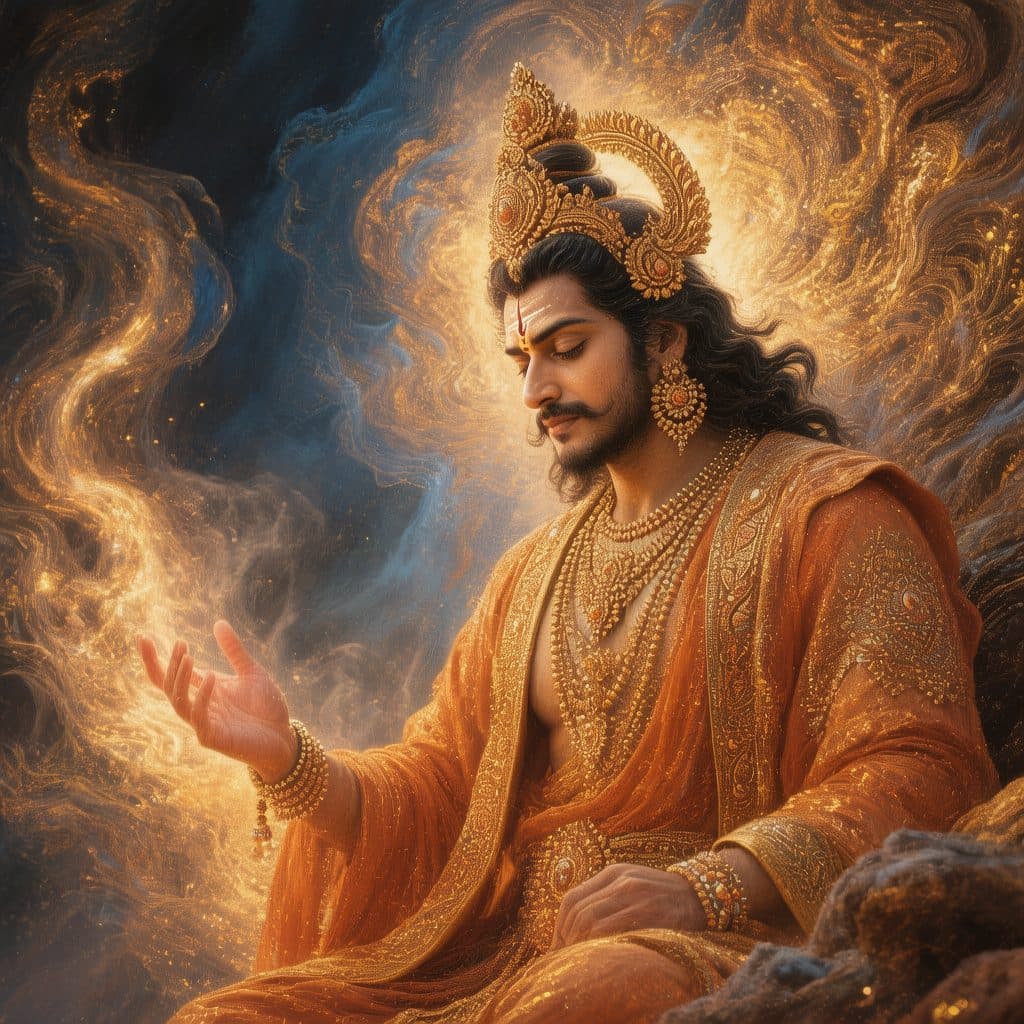
Sanjaya
Divine NarratorMinister and charioteer of King Dhritarashtra, blessed by the sage Vyasa with divine vision to witness and narrate the entirety of the Kurukshetra war. His faithful narration carries the words of the Gita to the world.
Speaking: Chapter 18, Verse 78
Verse 78
The Yoga of Liberation through Renunciation
Wherever there is Krishna, the Lord of all Yoga — wherever there is Arjuna, the supreme archer — there, I am certain, will be prosperity, victory, power, and righteousness. That is my conviction.
Context & Meaning
The Bhagavad Gita ends not with renunciation, not with silence, not with withdrawal from the world — but with a declaration of victory. Wherever the Divine and the devoted are together, wherever the Lord's wisdom meets the human heart that is ready to receive it, there is: śrī (beauty, prosperity, auspiciousness), vijaya (victory), bhūti (extraordinary power and expansion), and dhruvā nīti (unshakeable righteousness). These are not guarantees for those who remain passive — they are the fruits of the union of divine grace and human courage. The Gita's final word is an unqualified affirmation: life lived in alignment with the Lord is a life of victory. This is Sanjaya's conviction — matir mama — formed from the most extraordinary experience of witnessing that has ever been given to a human being. And now it passes to every reader who has made it this far: wherever you carry Krishna's wisdom and Arjuna's readiness to act, you carry the Gita's promise with you.
Scholar Commentaries
2 commentaries · Public domainRamanujacharya
VishishtadvaitaYatra yogeśvaraḥ kṛṣṇo yatra pārtho dhanur-dharaḥ — wherever the Lord of Yoga and the archer of devotion are found together. The Vishishtadvaita tradition sees this final verse as the complete statement of the relationship between the Lord and the devotee. Krishna is the yogeśvara — the master of all yoga, the source of all capacity, the ground of all aspiration. Arjuna is the dhanur-dhara — the one whose hands are ready, whose courage has been restored, whose bow is raised in service rather than ego. When these two are together — divine grace and human surrender, Lord and devoted servant — nothing is impossible. Śrī, vijaya, bhūti, nīti: all the goods of life and liberation flow from this sacred meeting. This is the Gita's final promise and its eternal teaching.
Adi Shankaracharya
AdvaitaTatra śrīr vijayo bhūtir dhruvā nītiḥ — there abide prosperity, victory, power, and righteousness. The Advaita reading sees the final verse as pointing to the inner landscape: wherever the Self (represented by Krishna, the yogeśvara) is recognized and the discriminative wisdom (represented by Arjuna, the archer whose bow of discernment is raised) is fully active, there the fruits of self-realisation naturally manifest. Victory is the victory over ignorance. Prosperity is the inexhaustible richness of the Self. Power is the effortless sovereignty of the one who lives from the ground of being. Righteousness is the natural dharma of the one who acts from truth. These are not rewards granted from outside — they are the inner qualities that flower when the Self is known.