
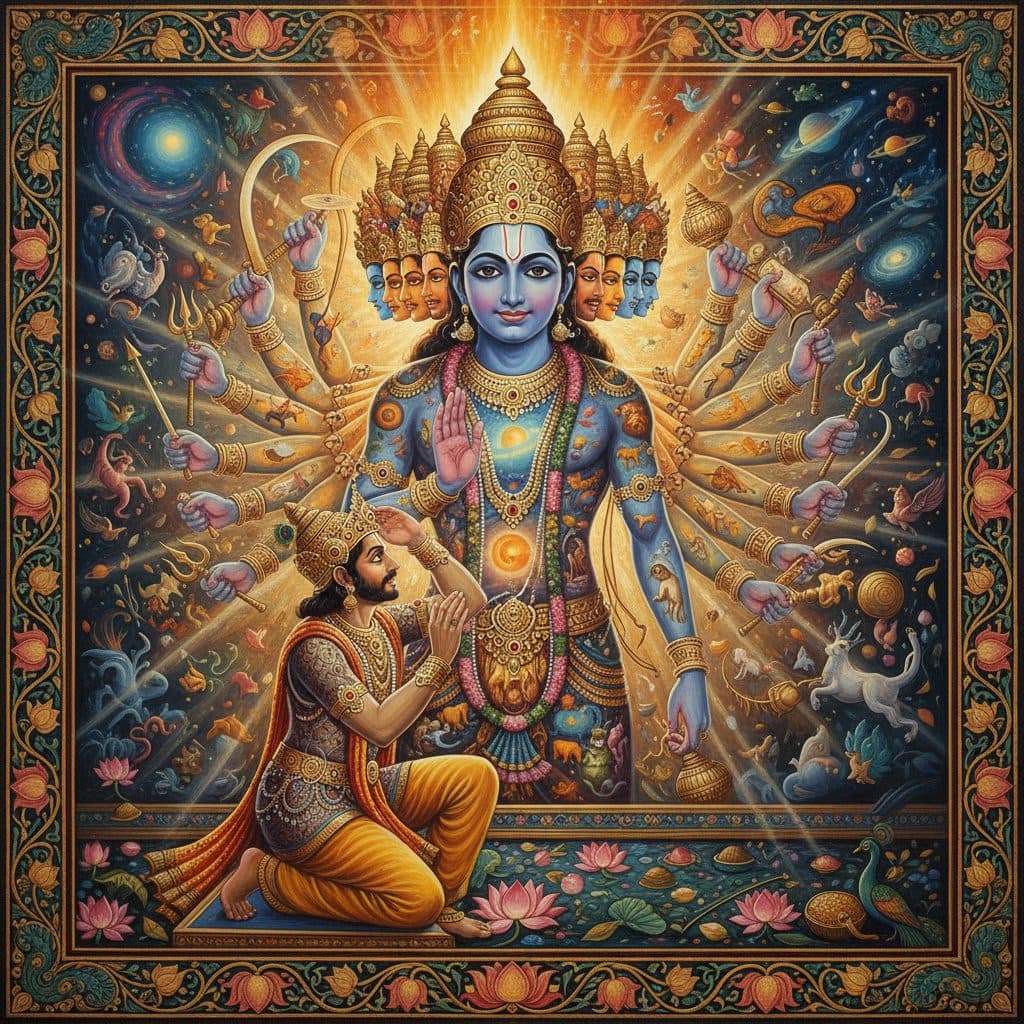
विश्वरूप दर्शन योग
The Yoga of the Vision of the Cosmic Form
55 VersesDescription
Krishna grants Arjuna the divine vision to see his cosmic form (Vishvarupa). Arjuna sees the entire universe with all its beings, gods, and celestial beings in the body of Krishna. Overwhelmed by this terrifying and magnificent vision, Arjuna prays for forgiveness for treating Krishna as a friend. Krishna reveals that this form cannot be seen by anyone except through exclusive devotion.
Location
Kurukshetra Battlefield
Characters
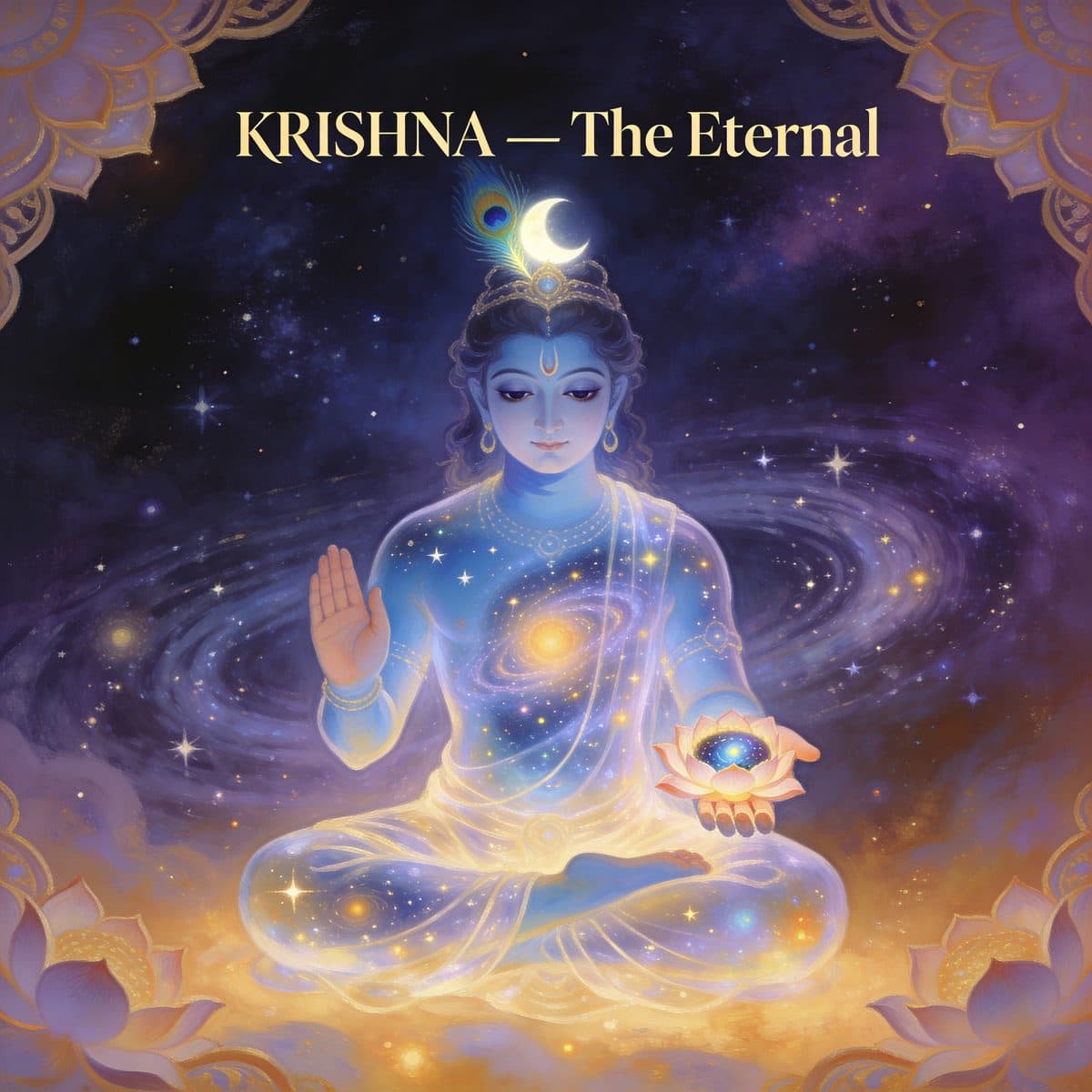
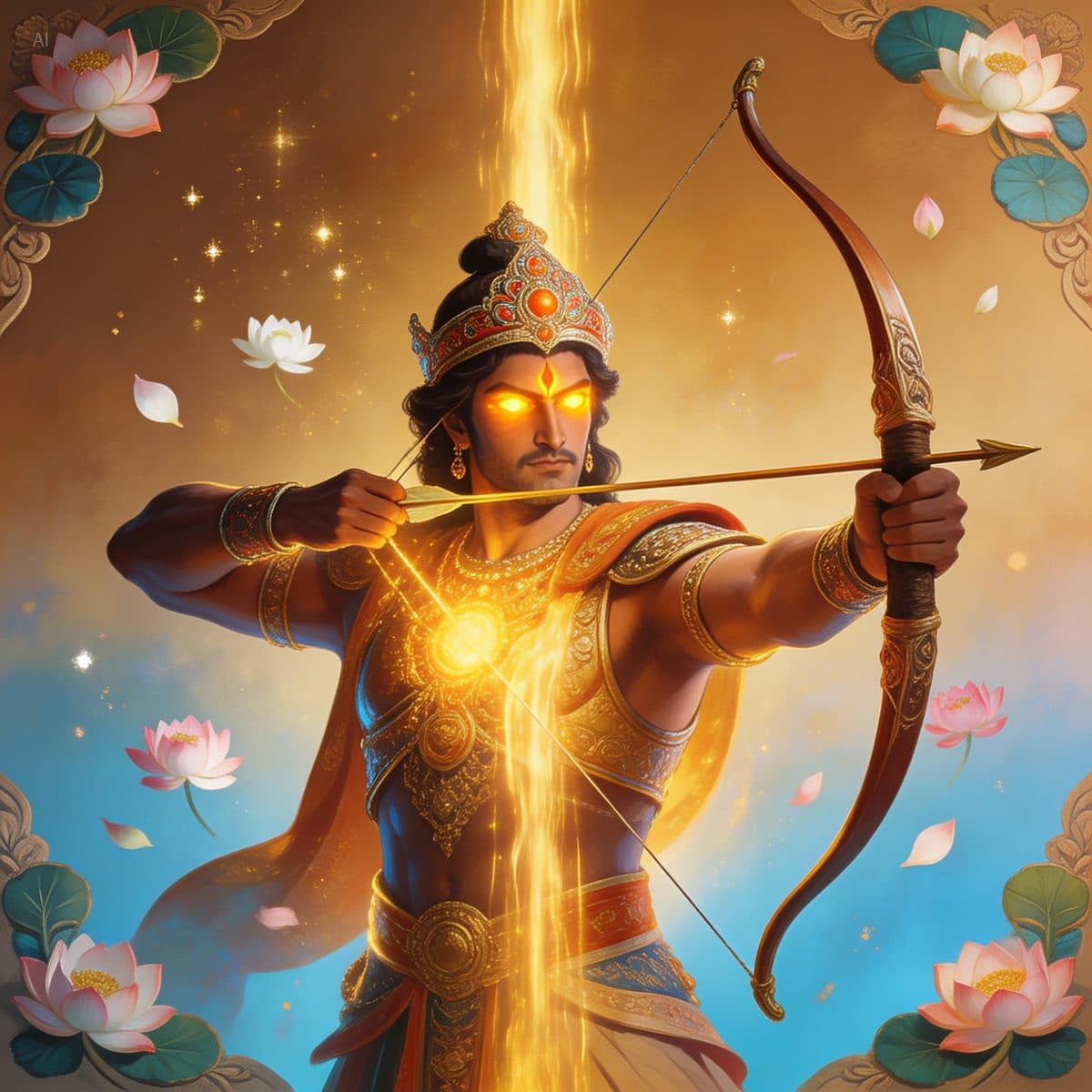
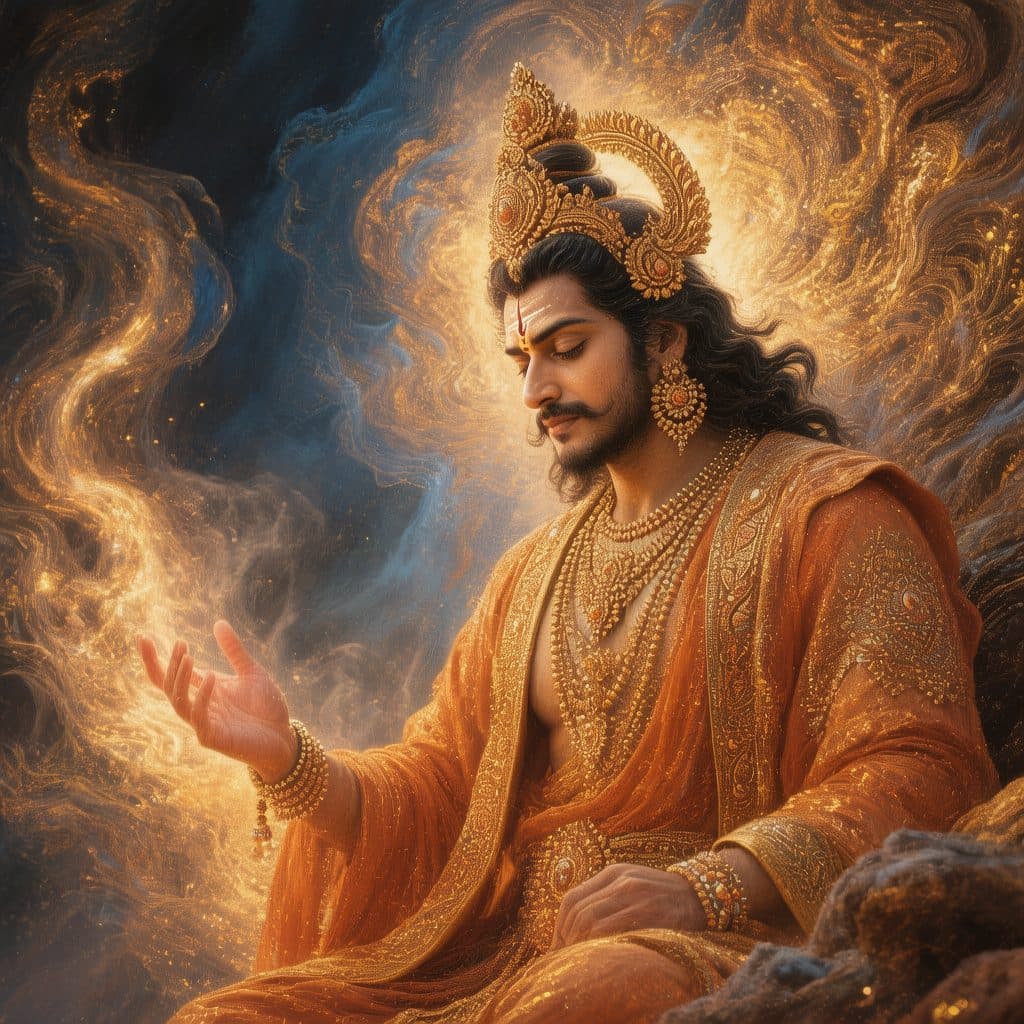
Watch Chapter Discourse
Video coming soon
Add a YouTube URL to the videoUrl field in chapters.ts
Chapter 11 — The Yoga of the Vision of the Cosmic Form
Read Verses
55 of 55 availableArjuna said: By my hearing the instructions You have kindly given me about these most confidential spiritual subjects, my illusion has now been dispelled.
Arjuna opens with gratitude and a report of inner transformation. The teachings of chapters 7 through 10 — the nature of the Divine, the divine glories, the secret knowledge — have worked. His illusion has been dispelled. This is the sign that genuine teaching has occurred: the student is changed.
O lotus-eyed one, I have heard from You in detail about the appearance and disappearance of all living entities, as well as Your inexhaustible glories.
Arjuna acknowledges the cosmic sweep of what he has received: creation and dissolution, the origin and end of all beings, and the inexhaustible glories catalogued in Chapter 10. He addresses Krishna as "lotus-eyed" — a term of deepest tenderness. But now, having heard, he wants to see.
O greatest of all persons, O supreme form, though I see You here before me in Your actual position, as You have described Yourself, I wish to see how You have entered into this cosmic manifestation. I want to see that form of Yours.
The request that sets the entire chapter in motion. Arjuna believes everything Krishna has said — but he wants direct perception, not just verbal testimony. "Show me." This is the leap from faith to vision, from the heard to the seen. It is one of the most pivotal requests in all of world scripture.
If You think that I am able to behold Your cosmic form, O my Lord, O master of all mystic power, then kindly show me that unlimited universal Self.
Arjuna adds a humble qualification: "if you think I can bear it." He senses the enormity of what he is asking. He knows he is requesting something that might overwhelm him — and he asks for it anyway. This combination of humility and courage is the posture of the true seeker.
The Supreme Personality of Godhead said: My dear Arjuna, O son of Pritha, see now My opulences, hundreds of thousands of varied divine forms, multicolored like the sea.
Krishna's response is immediate and magnificent: "Look." He does not deliberate, does not warn of danger — He simply opens the vision. Hundreds of thousands of divine forms, infinite colors and shapes. The revelation begins not with a gradual unveiling but with total immensity.
O best of the Bharatas, see here the different manifestations of Adityas, Vasus, Rudras, Ashvini-kumaras and all the other demigods. Behold the many wonderful things which no one has ever seen or heard of before.
All the gods, all the cosmic beings, all the wonders of the heavens — present simultaneously in one vision. What Arjuna is about to see has never been seen before and will never be seen again in this way. The uniqueness of the moment is staggering. He is the only human being ever to receive this darśan in the full form.
O Arjuna, whatever you wish to see, behold at once in this body of Mine! This universal form can show you whatever you now desire to see and whatever you may want to see in the future. Everything — moving and nonmoving — is here completely, in one place.
The entire universe — everything that moves and everything that does not — contained in a single body, available for direct perception. This is the answer to every question ever asked about the nature of reality: it is all here, it is all one, it is all the Divine Body. Past, present, and future are simultaneously present.
But you cannot see Me with your present eyes. Therefore I give you divine eyes. Behold My mystic opulence!
A moment of supreme grace. The human eye cannot bear the cosmic form — so Krishna gives Arjuna a divine eye. The instrument of perception must be transformed before the perception is possible. This is the principle of all spiritual practice: ordinary faculties cannot see the extraordinary; the seer must be elevated to meet the Seen.
Sanjaya said: O King, speaking thus, the Supreme, the Lord of all mystic power, the Personality of Godhead, displayed His universal form to Arjuna.
Sanjaya — the narrator who has been granted divine vision by Vyasa — now reports to the blind king Dhritarashtra what he is seeing at a distance. The pivot point of the chapter: the description of what follows is transmitted through two layers of divine grace — Arjuna's divine eye and Sanjaya's far sight. The revelation is about to begin.
Arjuna saw in that universal form unlimited mouths, unlimited eyes, unlimited wonderful visions. The form was decorated with many celestial ornaments and bore many divine upraised weapons.
Aneka — countless, unlimited — is the word that repeats. Unlimited mouths. Unlimited eyes. Unlimited wonders. Unlimited divine ornaments. Unlimited weapons upraised. The vision cannot be counted or bounded. It is a form that exceeds all categories of number and scale.
He wore celestial garlands and garments, and many divine scents were smeared over His body. All was wondrous, brilliant, unlimited and all-expanding.
The cosmic form is adorned with celestial garlands, divine fragrances, radiant garments — simultaneously terrifying and beautiful. All-wondrous, all-expanding, facing all directions simultaneously. The form has no single face because it faces everything at once. It is the universe personified.
If hundreds of thousands of suns were to rise at once into the sky, their radiance might resemble the effulgence of the Supreme Person in that universal form.
One of the most famous similes in all of scripture — later recalled by J. Robert Oppenheimer at the first nuclear test. A thousand suns rising simultaneously: this is the closest human imagination can come to describing the radiance of the viśvarūpa. And even this falls short. The light of the cosmos is a single flash of the Divine.
At that time Arjuna could see in the universal form of the Lord the unlimited expansions of the universe situated in one place, although divided into many, many thousands.
The paradox of the vision made visible: the many and the One simultaneously. The entire universe, divided into countless distinct parts, yet residing as a single unified whole in one Divine body. This is not metaphor — Arjuna sees it directly. The multiplicity of the world and the unity of the Divine are revealed as the same thing.
Then, bewildered and astonished, his hair standing on end, Arjuna bowed his head to offer obeisances and with folded hands began to pray to the Supreme Lord.
The body speaks what words cannot. Arjuna's hair stands on end — the classic sign of overwhelming awe in Indian tradition. He is struck dumb with wonder. He bows. His hands fold in spontaneous reverence. Before a single word is spoken, the entire being prostrates before what it has seen. This is the natural response of a human soul confronting the Infinite.
Arjuna said: My dear Lord Krishna, I see assembled in Your body all the demigods and various other living entities. I see Brahma sitting on the lotus flower, as well as Lord Shiva and all the sages and divine serpents.
Arjuna begins to describe what he sees: Brahma on his lotus, Shiva, all the sages, all the divine serpents — the entire hierarchy of cosmic existence visible within one form. He is not reciting theology; he is reporting direct perception. The student who was once confused about his duty now sees the totality of existence arranged before him.
O Lord of the universe, O universal form, I see in Your body many, many arms, bellies, mouths and eyes, expanded everywhere, without limit. I see in You no end, no middle and no beginning.
No beginning, no middle, no end. Arjuna cannot find an edge to what he sees. The cosmic form is literally infinite — not poetically infinite, not metaphorically vast, but without boundary in any direction. The ordinary mind finds no purchase, no reference point. This is the experience of the truly boundless.
Your form is difficult to see because of its glaring effulgence, spreading on all sides, like blazing fire or the immeasurable radiance of the sun. Yet I see this glowing form everywhere, adorned with various crowns, clubs and discs.
The form is almost impossible to look at directly — like staring into the sun, but more intense. Arjuna strains to see through the blinding radiance. The crowns, clubs, and discus are barely visible through the overwhelming light. The Divine is not merely beautiful — it is also overwhelming, almost annihilating to the perceiving eye.
You are the imperishable, the supreme being to be known. You are the ultimate refuge of this universe. You are the inexhaustible source of what eternally protects the laws of the universe, the Eternal Person. This is my conviction.
Confronted by the overwhelming vision, Arjuna's theology clarifies into certainty. Not argument, not deduction — but direct recognition in the midst of the vision. You are the imperishable. You are the supreme refuge. You are the eternal guardian of dharma. This is my conviction (mato me) — and now it is not faith but sight.
You are without origin, middle or end. Your glory is unlimited. You have numberless arms, and the sun and moon are Your eyes. I see You with blazing fire coming forth from Your mouth, burning this entire universe by Your own radiance.
The sun and moon are Krishna's eyes — all of cosmic light is the Divine's vision. Fire pours from his mouth — creation and destruction proceeding from a single point of origin. And the form's own radiance scorches the universe. This is not the friendly deity of the earlier chapters but the awesome, terrifying totality of all forces.
Although You are one, You spread throughout the sky and the planets and all space between. O great one, seeing this wondrous and terrible form, all the planetary systems are perturbed.
The space between heaven and earth — the entire three-dimensional universe — is filled by this single form. And all three worlds (the heavens, the earth, the underworld) are trembling with fear. The cosmos itself recoils at the full revelation of its own source. When the Divine removes its veil, creation shudders.
All the hosts of demigods are surrendering before You and entering into You. Some of them, very much afraid, are offering prayers with folded hands. Hosts of great sages and perfected beings, crying "All peace," are praying to You by singing the Vedic hymns.
The gods themselves are afraid. Even the demigods, the great sages, the perfected beings — all are overwhelmed. Some enter the form in surrender. Others fold their hands in terrified prayer, crying for peace. The greatest beings in the cosmos are rendered small before this vision. If the gods tremble, what is Arjuna, an ordinary human, to do?
All the various manifestations of Lord Shiva, the Adityas, the Vasus, the Sadhyas, the Visvadevas, the two Ashvins, the Maruts, the forefathers, the Gandharvas, the Yakshas, the Asuras, and the perfected demigods are beholding You in amazement.
A complete roll-call of the divine hierarchy — Rudras, Adityas, Vasus, Sadhyas, the Ashvin twins, the Maruts, ancestors, Gandharvas, Yakshas, Asuras, and the Siddhas — and every single one of them is staring in amazement. The entire spectrum of cosmic beings, from the highest to the most fierce, is struck with wonder. None of them has seen this before.
O mighty-armed one, all the planets with their inhabitants are disturbed at seeing Your great form, with its many faces, eyes, arms, thighs, feet, bellies and terrible teeth; and as they are disturbed, so am I.
Arjuna now includes himself in the fear. He has tried to be the calm observer, the student reporting what he sees — but the vision has broken through all distance. He is disturbed. The many faces, the terrible teeth, the overwhelming scale — all the worlds are shaken, and so is he. He is not exempt from the terror that grips all creation.
O all-pervading Vishnu, seeing You with Your many radiant colors touching the sky, Your gaping mouths, and Your great glowing eyes, my mind is perturbed with fear. I can neither maintain my steadiness nor my mental equilibrium.
The inner collapse: Arjuna cannot maintain his balance. He cannot find steadiness (dhṛti) or calm (śama). The mind that has been schooled in equanimity through eighteen chapters of teaching is undone in an instant by the direct vision of the Divine in its total form. Some truths cannot be approached philosophically — they must be met directly, and they are overwhelming.
O Lord of lords, O refuge of the worlds, please be gracious to me. I cannot keep my balance seeing thus Your blazing, deathlike faces and awful teeth. I am bewildered in all directions.
Arjuna loses his directions — literally and spiritually disoriented. He doesn't know where to look, where to turn. The faces burning like the fires of cosmic dissolution are too much. And so he does the only thing left: he begs for grace. "Please be gracious to me." When all capacity is exceeded, surrender is the only movement possible.
All the sons of Dhritarashtra, along with their allied kings, and Bhishma, Drona, Karna — and our chief soldiers also —
Arjuna now sees, in the cosmic form, the people he came to the battlefield to fight — and something even more terrible. He names them: Dhritarashtra's sons, the allied kings, Bhishma, Drona, Karna. He sees them there, in the mouths of the cosmic form. He is about to understand something he cannot yet fully articulate.
I see them rushing headlong into Your terrible mouths, some caught between Your teeth with their heads crushed to powder.
The vision turns nightmarish: the warriors Arjuna has known all his life — teachers, uncles, cousins, heroes — are rushing into the blazing mouths of the cosmic form and being ground to nothing. This is not a vision of victory or defeat in battle. It is a vision of the cosmic inevitability of death. Everyone will enter these mouths. Everyone.
As the many waves of the rivers flow into the ocean, so do all these great warriors enter blazing into Your mouths.
One of the most sublime images in the Gita: rivers rushing inevitably to the ocean. The warriors — all the heroes of the battlefield — are like rivers, and the cosmic mouth is the ocean they have always been flowing toward. Death is not an interruption of life's journey; it is its destination. All rivers end in the sea. All lives end in the Divine.
I see all people rushing full speed into Your mouths, as moths dash to destruction in a blazing fire.
Moths rushing into flame — a second devastating image. Not reluctantly, not unknowingly, but at full speed. This is the nature of conditioned beings: rushing toward the very thing that will consume them, driven by forces they cannot see or resist. The vision reveals the tragedy and beauty of existence simultaneously: drawn toward the light that destroys.
O Vishnu, I see You devouring all people from all sides with Your flaming mouths. Covering all the universe with Your effulgence, You are manifest with terrible, scorching rays.
The vision climaxes in total dissolution: all worlds being consumed, the universe filled with scorching radiance, all of existence entering those flaming mouths. Arjuna has gone from a confused warrior to a witness of the final dissolution of all things. He cannot look away. He can barely speak.
O Lord of lords, so fierce of form, please tell me who You are. I offer my obeisances unto You; please be gracious to me. You are the primal Lord. I want to know about You, for I do not know what Your mission is.
The question that breaks through the terror: Who are you? Even after the teachings of ten chapters, even after the vision of divine glories, even after recognizing Krishna as the Supreme — face to face with the all-devouring form, Arjuna must ask again. The question is not ignorance but awe: what is your mission? Why this consuming?
The Blessed Lord said: Time I am, the great destroyer of the worlds, and I have come here to destroy all people. With the exception of you, all the soldiers here on both sides will be slain.
The most famous self-declaration in the Gita — later quoted by Oppenheimer. "Time I am." Not a god in time, not a lord over time — Time itself, the great destroyer, the force that consumes all worlds. The battle is already over. All those warriors are already dead. Arjuna's fighting or not fighting changes nothing about their fate. He is not the agent of this destruction. Time is.
Therefore get up. Prepare to fight and win glory. Conquer your enemies and enjoy a flourishing kingdom. They are already put to death by My arrangement, and you, O Savyasacin, can be but an instrument in the fight.
Nimittamātram — merely an instrument. This single phrase resolves Arjuna's entire dilemma. The outcome is already determined by the cosmic order. He need not carry the burden of being the cause of death — he is simply the instrument through which a destined event will play out. Act, but know you are not the ultimate doer. This is the highest teaching on karma yoga.
The Blessed Lord said: Do not be distressed by these men. Fight, and you will conquer your enemies. Drona, Bhishma, Jayadratha, Karna, and the other great warriors have already been destroyed by Me. You just destroy them and do not fear. Simply fight, and you will vanquish your enemies in battle.
Krishna names the greatest warriors Arjuna feared — Drona, Bhishma, Jayadratha, Karna — and says: they are already slain by Me. Arjuna only needs to complete what the cosmic order has already decided. Do not grieve. Do not fear. This is not callousness — it is the liberating truth that the weight of the outcome does not rest on human shoulders.
Sanjaya said to Dhritarashtra: O King, after hearing these words from the Supreme Personality of Godhead, the trembling Arjuna offered obeisances with folded hands again and again. He spoke to Krishna in a faltering voice, overwhelmed with fear.
Sanjaya's narration captures the physical reality: Arjuna is trembling, overwhelmed, faltering. He bows again and again. His voice breaks. This is not weakness — this is the authentic response of a human being face to face with the totality. Emotional devastation before the Absolute is the appropriate reaction. Arjuna is completely broken open.
Arjuna said: O master of the senses, the world becomes joyful upon hearing Your name, and thus everyone becomes attached to You. Although the perfected beings offer You their respectful homage, the demons are afraid, and they flee here and there. All this is rightly done.
Even in his terror, Arjuna finds ground for praise. He sees the justice of it: the universe rejoices at the Divine name. The perfected beings bow in devotion. The demons flee in fear. Everything is as it should be — each being responding to the Divine according to its own nature. This is the cosmic order that Arjuna is being asked to serve.
O great one, greater even than Brahma, You are the original creator. Why then should they not offer their respectful obeisances unto You? O limitless one, O God of gods, O refuge of the universe! You are the invincible source, the cause of all causes, transcendental to this material manifestation.
Arjuna reaches for theological clarity in the midst of overwhelming vision: You are greater than Brahma, the creator. You are the cause of all causes. You are transcendent even to the categories of being (sat) and non-being (asat). Why would anything not bow to you? The question is rhetorical — it is an expression of the wonder that there was ever any doubt.
You are the original Personality of Godhead, the oldest, the ultimate sanctuary of this manifested cosmic world. You are the knower of everything, and You are all that is knowable. You are the supreme refuge, above the material modes. O limitless form! This whole cosmic manifestation is pervaded by You.
Arjuna's recognition becomes complete: You are the first and oldest, the refuge of the universe, the knower and the known, the ultimate support beyond all qualities, pervading everything. The student who began Chapter 1 in despair, dropping his bow, now sees the full truth of who he has been sitting beside all along.
You are Vayu, Yama, Agni, Varuna, the moon, and Brahma and the great-grandfather. Therefore I offer my respects to You a thousand times, and again and yet again!
Arjuna names the great cosmic forces — wind, death, fire, cosmic ocean, moon, creation — and bows to all of them simultaneously as manifestations of the one he is addressing. A thousand prostrations, and then again more. The prayer cannot be ended because the greatness it is responding to cannot be exhausted.
Obeisances to You from the front, from behind and from all sides! O unbounded power, You are the master of limitless might! You are all-pervading, and thus You are everything!
Bowing from every direction — front, back, all sides — because there is no direction in which the Divine is not present. You pervade all, therefore You are all. This is the culmination of Arjuna's recognition: the Divine is not one thing among many. It is the substance of all things. There is no place to stand outside it from which to bow — so one bows from everywhere.
Thinking of You as my friend, I have rashly addressed You as "O Krishna," "O Yadava," "O my friend," not knowing Your glories. Please forgive whatever I may have done in madness or in love.
One of the most tender moments in all of scripture. Arjuna begs forgiveness for the familiarity with which he has spoken to Krishna — calling him by name, addressing him casually as a friend. "I didn't know. I called you by name without knowing who you are." And yet he adds: or perhaps it was pramāda (carelessness) or praṇaya (love). Both are forgiven in the eyes of the Divine.
I have in the past dishonored You in jest while at play, while resting, sitting, or at meals, either alone or in front of many friends. O infallible one, please excuse me for all those offenses.
The confession deepens: not just the words of address, but all the casual disrespect — the jokes, the teasing at meals and games, the casual companionship without reverence. All the ordinary moments of their friendship, which Arjuna now sees from the other side. He knew God and treated him like a friend. And yet — the Gita teaches — God chose to be treated that way, out of love.
You are the father of this complete cosmic manifestation, of the moving and the nonmoving. You are its worshipable chief, the supreme spiritual master. No one is equal to You, nor can anyone be one with You. How then could there be anyone greater than You within the three worlds, O Lord of incomparable power?
The confession of unworthiness transforms into recognition of supreme greatness. You are the father of all creation. You are the highest guru. There is none equal to you, none greater — in all three worlds. And in this recognition, the relationship between Arjuna and Krishna is reborn: not as equals, but as the creature before its creator, the student before the teacher, the son before the father.
You are the Supreme Lord, to be worshiped by every living being. Thus I fall down to offer You my respects and ask Your mercy. As a father tolerates the impudence of his son, or a friend tolerates the impertinence of a friend, or a wife tolerates the familiarity of her partner, please tolerate the wrongs I may have done You.
A prayer of extraordinary beauty: please tolerate me as a father tolerates a son, as a friend forgives a friend, as a spouse accepts a beloved. Arjuna is asking not for justice but for grace — the forgiveness that comes from love, not from merit. And in doing so, he names three of the five great relationships of devotion in Vaishnava theology.
After seeing this universal form, which I have never seen before, I am gladdened, but at the same time my mind is disturbed with fear. Therefore please bestow Your grace upon me and reveal again Your form as the Personality of Godhead, O Lord of lords, O abode of the universe.
The request that completes the arc: show me your original form. I am glad I saw the cosmic form — and I am terrified by it. Both are true. But now I ask for the face I know, the form I love. This is the devotee's deepest truth: the cosmic absolute is awe-inspiring but the personal face of God is what the heart longs for.
O universal form, O thousand-armed Lord, I wish to see You in Your four-armed form, with helmeted head, with club, wheel, conch and lotus flower in Your hands. I long to see You in that form.
Arjuna asks for the familiar four-armed form of Vishnu/Krishna — the form with crown, mace, discus, and lotus. Not the thousand-armed terror. The specific, recognizable, beloved form. After the overwhelming immensity of the viśvarūpa, the human heart longs for the intimate and particular. Love requires a face it can see.
The Supreme Personality of Godhead said: My dear Arjuna, being pleased with you I have shown you, by My internal potency, this supreme universal form within the material world. No one before you has ever seen this primeval form, unlimited and full of glowing effulgence.
Krishna clarifies the nature of the gift: this was done out of pleasure, not obligation — prasannena, out of delight in Arjuna. The cosmic vision was not a spectacle but an act of love. And it was unique — no one has seen this form before. Arjuna is the one human being in all of history to receive this complete darśan of the viśvarūpa.
O best of the Kuru warriors, no one before you has ever seen this universal form of Mine, for neither by studying the Vedas, nor by performing sacrifices, nor by charity, nor by pious activities, nor by severe penances can this form be seen in the world of men.
No Vedic study, no sacrifice, no charity, no pious deeds, no severe austerities — none of these can produce the vision Arjuna has just received. It cannot be earned, cannot be achieved through any practice. It can only be given. This is the ultimate teaching on grace: the highest vision is not the reward of merit but the gift of the Beloved to the beloved.
You have been perturbed and bewildered by seeing this horrible feature of Mine. Now let it be finished. My devotee, be free from all disturbance. With a peaceful mind you can now see the form you desire.
The most tender verse in the chapter. "Let it be finished. Be free from fear. See the form you love." The terrifying cosmic vision ends not with thunder but with gentleness. The Divine who appeared as the all-devouring destroyer now speaks with the quiet voice of a parent soothing a frightened child. Come back. Look at me. I am still here.
Sanjaya said to Dhritarashtra: The Supreme Personality of Godhead, Krishna, while speaking thus to Arjuna, displayed His real four-armed form and at last showed His two-armed form, thus encouraging the fearful Arjuna.
The restoration: Krishna withdraws the cosmic form and returns to His gentle two-armed human appearance. The same person who was the all-devouring cosmic destroyer is now the friend sitting in the chariot. The terrifying and the intimate are one. This is the mystery of the Gita's theology: God is simultaneously the destroyer of worlds and the friend who drives your chariot.
When Arjuna thus saw Krishna in His original form, he said: O Janardana, seeing this humanlike form, so very beautiful, I am now composed in mind, and I am restored to my original nature.
The return to composure: Arjuna sees the human face of Krishna — saumya, gentle and beautiful — and is restored. Sacetāḥ: his mind returns. Prakṛtiṃ gataḥ: he is back to his own nature. The overwhelming vision has passed and the beloved is simply there. This is the great exhale after the great breathlessness.
The Supreme Personality of Godhead said: My dear Arjuna, this form of Mine you are now seeing is very difficult to behold. Even the gods are ever seeking the opportunity to see this form.
Krishna names the rarity of what Arjuna has experienced: even the gods constantly long to see this form and rarely receive it. The human being who has just seen what no god can easily attain is now returning to the realm of ordinary perception. But he has been changed by what he has seen. Some visions cannot be un-seen.
The form you are seeing with your transcendental eyes cannot be understood simply by studying the Vedas, nor by undergoing serious penances, nor by charity, nor by worship. It is not by these means that one can see Me as I am.
The principle is stated twice in two consecutive verses: neither the Vedas, nor tapas, nor charity, nor worship can produce what Arjuna has received. This is the absolute supremacy of grace. No accumulation of merit, no matter how vast, guarantees the vision. The highest seeing is always a gift.
My dear Arjuna, only by undivided devotional service can I be understood as I am, standing before you, and can thus be seen directly. Only in this way can you enter into the mysteries of My understanding.
The answer to the question of how. Not the Vedas, not austerity — but ananyā bhakti: undivided, exclusive devotion. This single path does what nothing else can: it allows one to truly know God, to truly see God, and to truly enter into God. The chapter's cosmic terror concludes with the quietest and most available of all spiritual paths: love.
My dear Arjuna, he who engages in My pure devotional service, free from the contaminations of fruitive activities and mental speculation, he who works for Me, who makes Me the supreme goal of his life, and who is friendly to every living being — he certainly comes to Me.
The final verse of the most dramatic chapter in the Gita, and it ends with five simple qualities: doing work as service to God, making God the supreme goal, practicing pure devotion, being free from attachment, and being without enmity toward any being. After the terrifying vision of cosmic destruction, after the overwhelming glory of the viśvarūpa — the path home is not austerity or fear. It is love, work, and kindness to all living beings.
Key Teachings
- •God's true form encompasses the entire universe
- •Only through single-minded devotion can one see God
- •Fear and reverence are natural responses to the Divine