
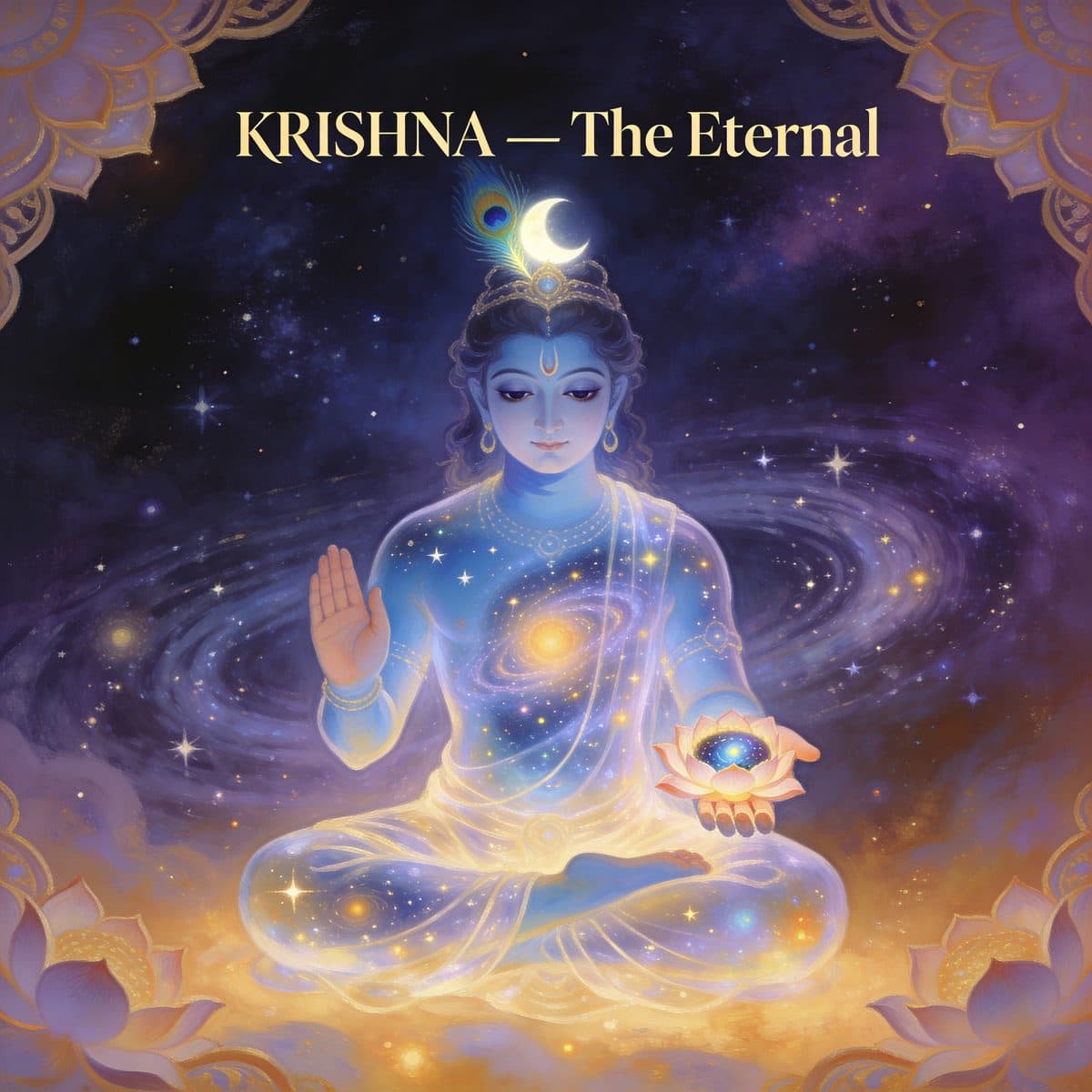
Lord Krishna
Divine TeacherThe Supreme Lord, the charioteer and divine guide of Arjuna. Krishna delivers the eternal wisdom of the Gita, revealing the nature of the soul, duty, and the path to liberation.
Speaking: Chapter 18, Verse 16
Verse 16
The Yoga of Liberation through Renunciation
Since this is so, one who sees the pure Self as the sole doer — that person, of impure intellect, does not truly see.
Context & Meaning
This verse is one of the most philosophically precise in the entire Gita. Given that action arises from five causes, anyone who sees the pure Self (ātmān) as the sole doer (kevalaṃ kartāram) is making a category error — they are applying the concept of agency to the one thing in existence that is by nature beyond agency. The Self is the witness, not the actor. To mistake the Self for the actor is akṛta-buddhitva — immature, uncultivated intellect — and the person who does so is durmati, of confused mind. Note that this is the opposite of the usual mistake: usually we warn against forgetting the Self. Here Krishna warns against a subtler error — applying the attributes of ego-agency to the Self. Both errors prevent clear seeing.
Scholar Commentaries
1 commentary · Public domainAdi Shankaracharya
AdvaitaĀtmānaṃ kevalaṃ tu yaḥ paśyati kartāram — who sees the Self alone as the doer. The Advaita reading finds in this verse its central insight: the pure Self (ātman) is never the doer. Action belongs to Prakriti; the Self is the pure witness. The person who says "My Self did this" is making a fundamental philosophical error — they have confused the seer with the seen, the witness with what it witnesses. This error is the root of ego-bondage. The correction is not to say "I don't do anything" but to understand that the "I" which is the Self has nothing to do with the "doing" — which belongs to the field of matter.