
सांख्य योग
Sānkhya Yoga — The Yoga of Discernment
72 VersesDescription
This chapter is considered the essence of the entire Gita. Krishna addresses Arjuna's grief by teaching him about the eternal nature of the soul (Atman), which is indestructible and transcends the physical body. He introduces the concepts of Sankhya (knowledge) and Karma Yoga (the yoga of selfless action), explaining that one must perform their duty without attachment to results. Krishna describes the qualities of a person of steady wisdom (Sthita-prajna), setting the ideal for spiritual aspirants.
Location
Kurukshetra Battlefield
Characters
Watch Chapter Discourse
Video coming soon
Add a YouTube URL to the videoUrl field in chapters.ts
Chapter 2 — Sānkhya Yoga — The Yoga of Discernment
Read Verses
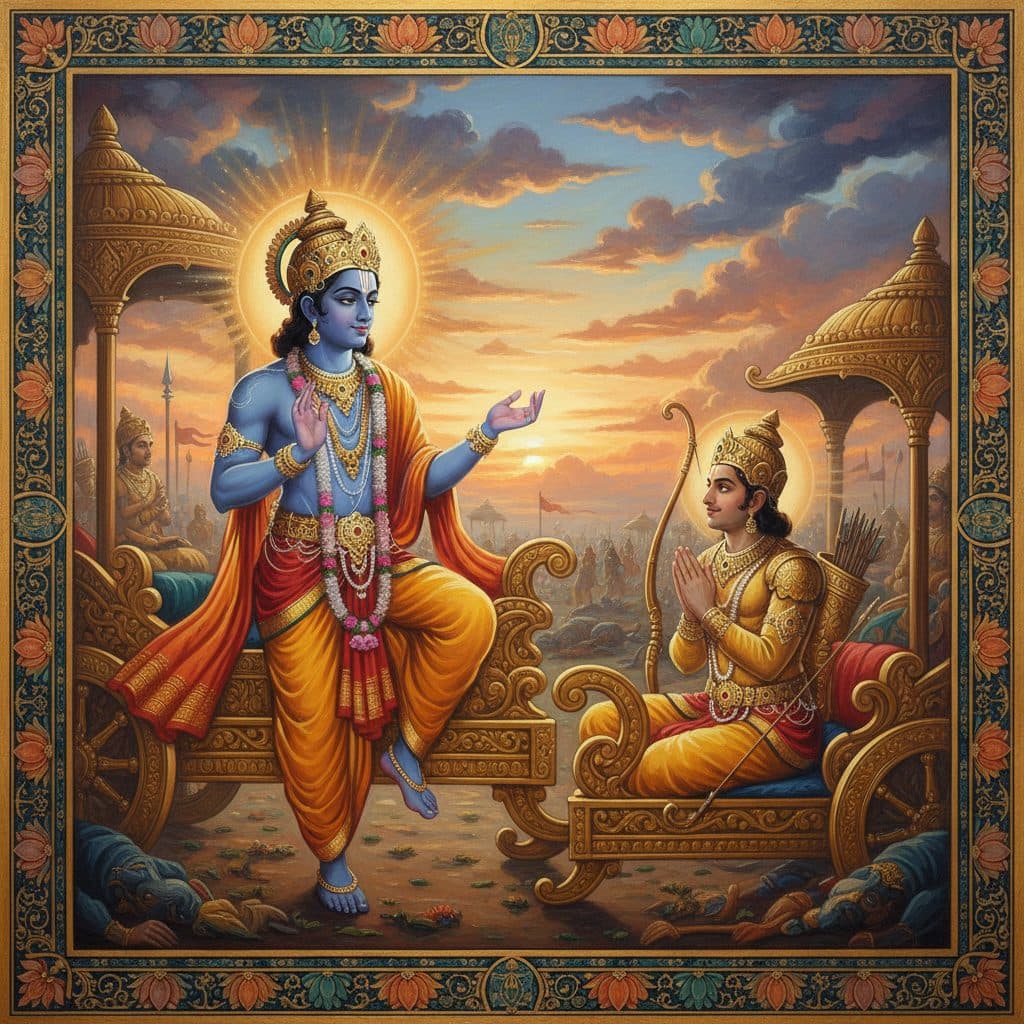
72 of 72 availableSanjaya said: To him who was thus overcome with pity and sorrow, his eyes filled with tears and despondent, Madhusudana (Krishna) spoke these words.
Krishna begins his divine discourse to the grieving Arjuna.
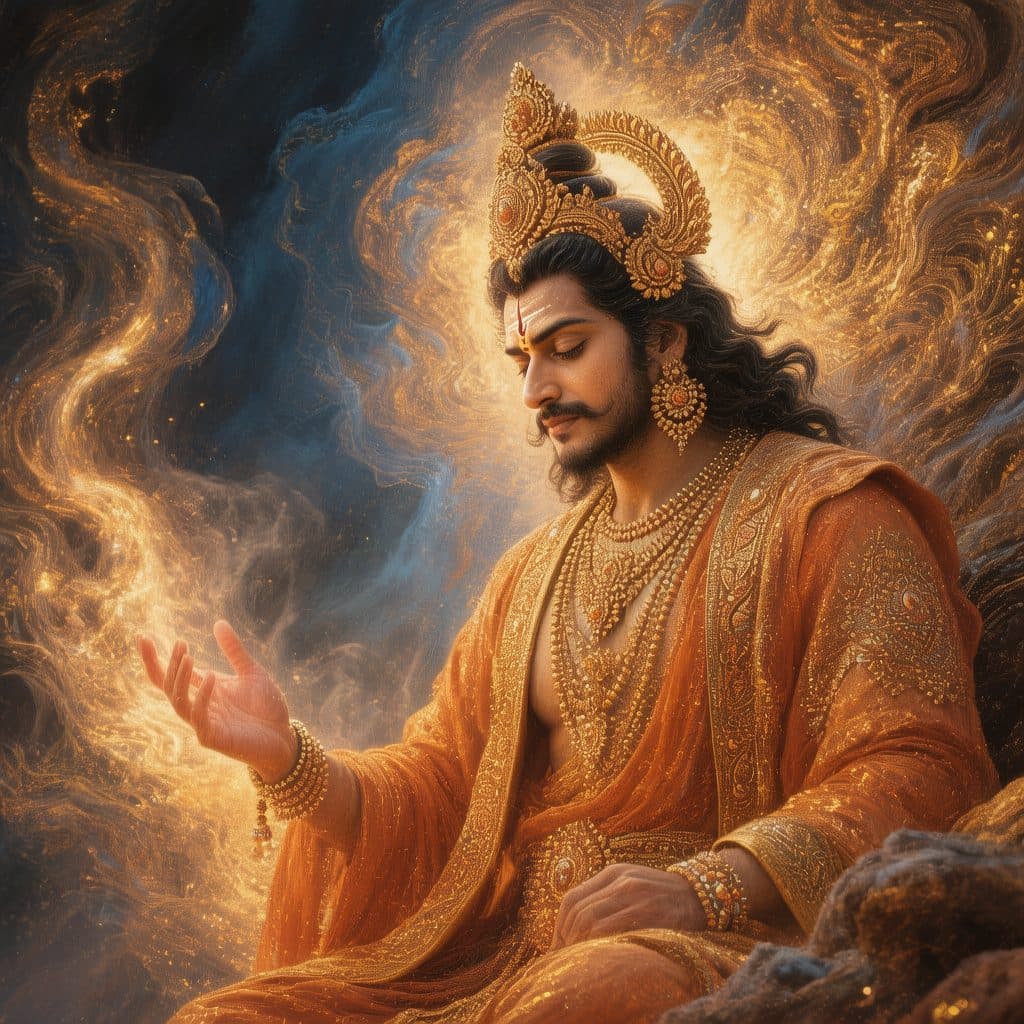
The Supreme Lord said: My dear Arjuna, how have these impurities come upon you? They are not at all befitting a man who knows the value of life. They lead not to higher planets but to infamy.
Krishna questions Arjuna about his unmanly behavior, which does not befit a noble person and leads to disgrace.
O Partha, do not yield to this impotence. It does not become you. Cast off this faint-heartedness and arise, O scorcher of enemies!
Krishna urges Arjuna to cast off his weakness and stand up to fight.
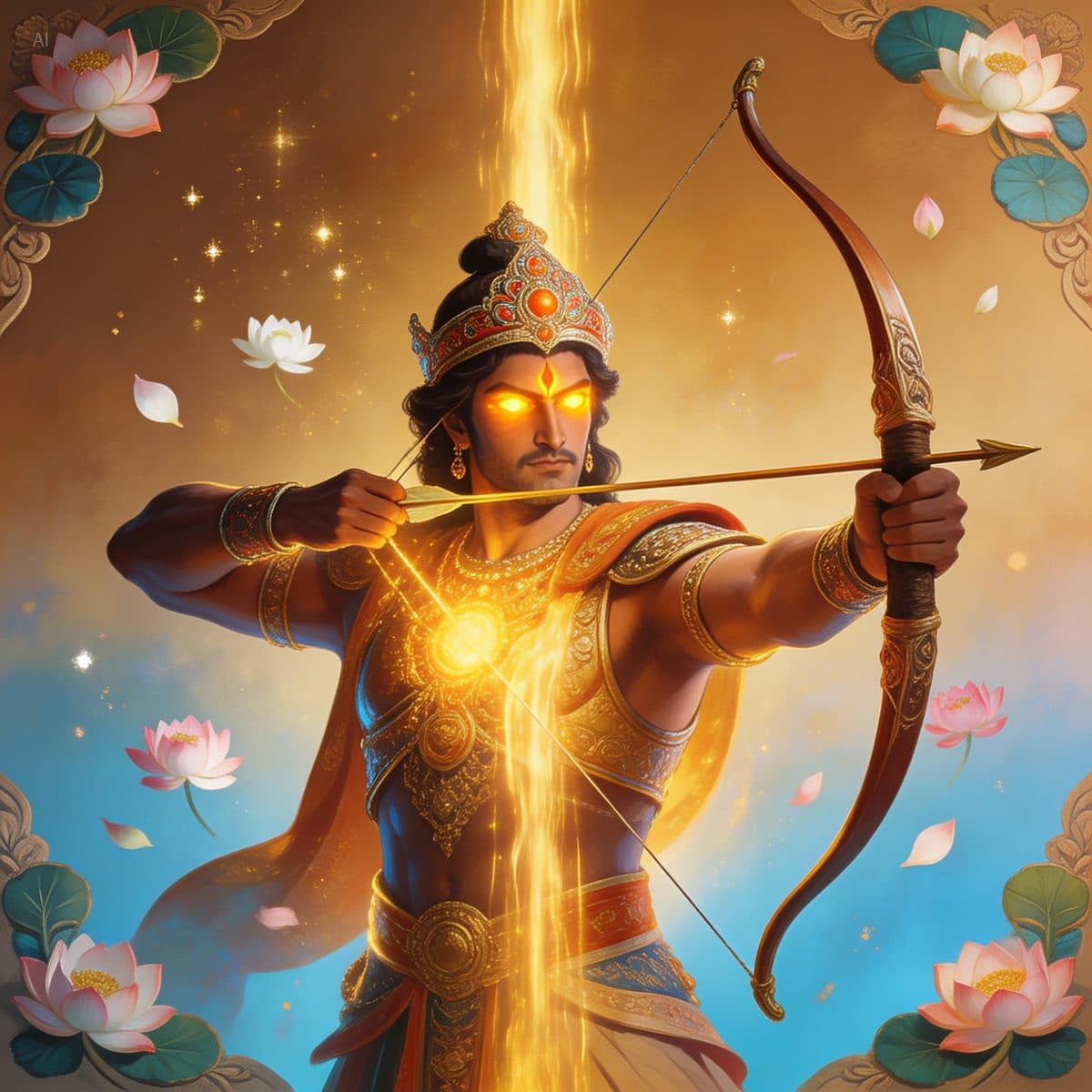
Arjuna said: O Madhusudana, how can I counterattack with arrows in battle Bhishma and Drona, who are worthy of my worship?
Arjuna asks how he can fight against his revered teachers Bhishma and Drona.
It would be better to live in this world by begging than to live at the cost of the lives of great souls who are my teachers. Even if they are desirous of worldly gain, they are superiors. If we kill them, we shall enjoy only blood-stained pleasures in this life.
Arjuna says it is better to beg than to kill his teachers and enjoy bloodstained pleasures.
Nor do we know which is better for us—to conquer them or to be conquered by them. The sons of Dhritarashtra, whom if we killed we would not care to live, are standing before us on the battlefield.
Arjuna is confused about whether victory or defeat is better, as the enemies are his own relatives.
My heart is overcome with weakness, and my mind is confused about dharma. I ask You: tell me what is truly good for me. I am Your disciple. Teach me, for I have surrendered to You.
Arjuna surrenders to Krishna as his disciple and asks for guidance about what is truly good.
I do not see how I can dispel this grief that is withering my senses, even if I were to obtain an unrivaled and prosperous kingdom on earth or even the sovereignty of the gods.
Arjuna cannot see how even obtaining a kingdom or godhood would relieve his grief.
Sanjaya said: Having thus spoken to Govinda, Arjuna said, "I will not fight," and fell silent.
Arjuna declared he would not fight and fell silent.
O descendant of Bharata, Hrishikesha, smiling, spoke these words to the grieving Arjuna in the midst of both armies.
Krishna, smiling, began to speak to the grieving Arjuna.
The Supreme Lord said: You are grieving for those who are not worthy of grief, and yet you speak words of wisdom. The wise grieve neither for the living nor for the dead.
Krishna tells Arjuna that the wise do not grieve for the living or the dead.
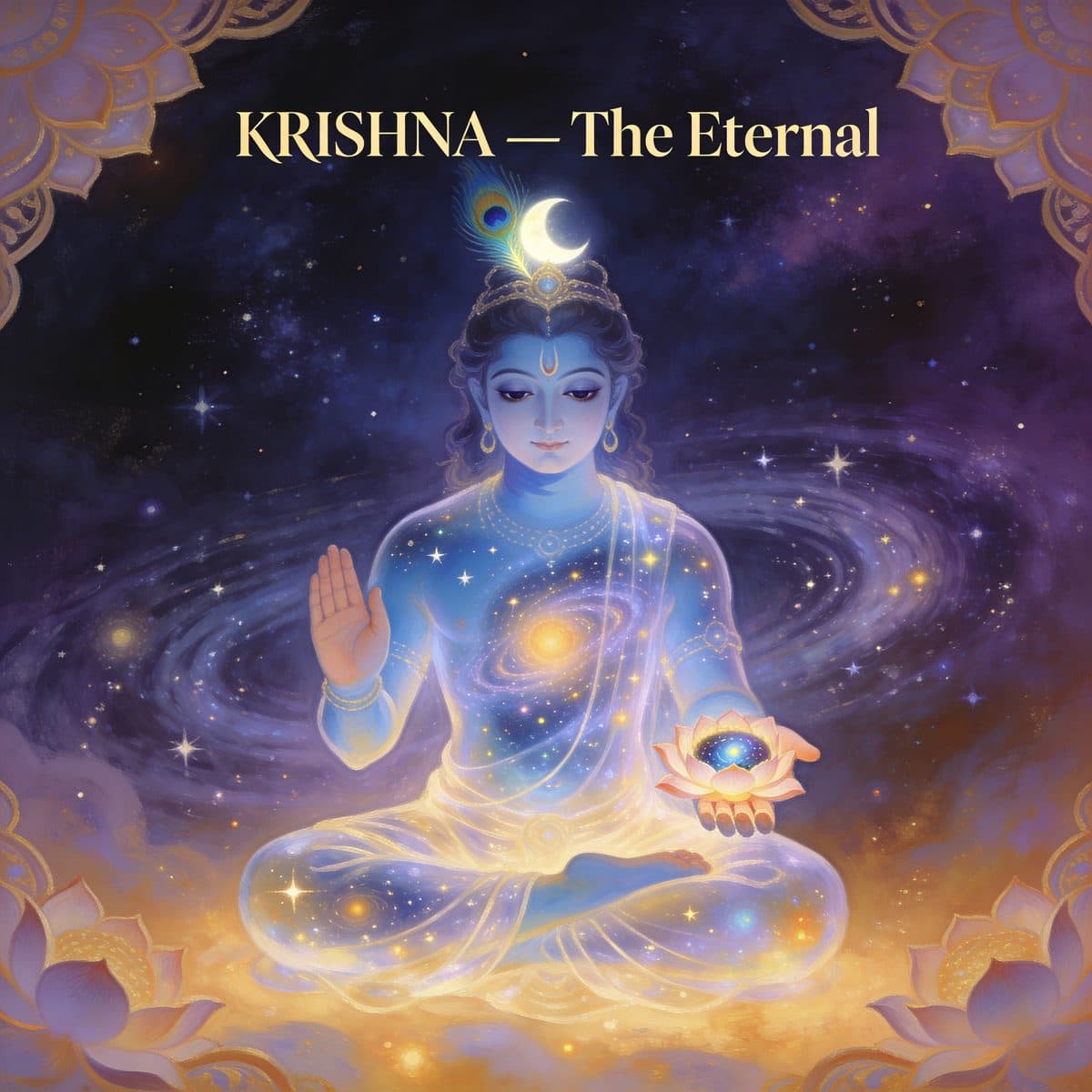
Never was there a time when I did not exist, nor you, nor all these kings; nor in the future shall any of us cease to be.
Krishna explains that the soul is eternal; all beings have always existed and will continue to exist.
As the embodied soul continuously passes, in this body, from boyhood to youth to old age, the soul similarly passes into another body at death. A self-realized person is not bewildered by such a change.
Just as the soul passes through childhood, youth and old age in this body, it passes to another body at death. The wise are not deluded by this.
O son of Kunti, the contact between the senses and the sense objects gives rise to fleeting perceptions of happiness and distress. These are non-permanent, and come and go like the winter and summer seasons. O descendent of Bharat, one must learn to tolerate them without being disturbed.
Sense perceptions of happiness and distress are temporary like seasons. One must learn to tolerate them.
O best among men, the person who is not disturbed by happiness and distress and is steady in both is certainly eligible for liberation.
The person who remains undisturbed by happiness and distress is eligible for liberation.
Those who are seers of the truth have concluded that of the nonexistent there is no endurance, and of the existent there is no cessation. This seers have concluded by studying the nature of both.
The unreal has no existence, and the real never ceases to exist. The truth about both has been realized by seers.
Know that which pervades the entire body is indestructible. No one is able to destroy the imperishable soul.
That which pervades the whole body is indestructible. No one can destroy the imperishable soul.
Only the material body of the indestructible, immeasurable and eternal living entity is subject to destruction; therefore, fight, O descendant of Bharata.
The body is perishable but the soul is indestructible. Therefore, fight!
Neither of them is in knowledge—the one who thinks the soul can slay and the one who thinks the soul can be slain. For truly, the soul neither kills nor can be killed.
The soul neither kills nor can be killed. Those who think it does are in ignorance.
For the soul there is never birth nor death. Nor, having once been, does he ever cease to be. He is unborn, eternal, ever-existing, undying and primeval. He is not slain when the body is slain.
The soul is never born nor does it ever die. It is eternal, unborn, and undying.
O Partha, how can a person who knows that the soul is indestructible, unborn, eternal and immutable, kill anyone or cause anyone to kill?
One who knows the soul is indestructible cannot kill or cause killing.
As a person casts off worn-out garments and puts on new ones, so the embodied soul casts off worn-out bodies and enters into new ones.
As a person discards old clothes and wears new ones, the soul discards old bodies and takes new ones.
The soul can never be cut into pieces by any weapon, nor can he be burned by fire, nor moistened by water, nor withered by the wind.
Weapons cannot cut the soul, fire cannot burn it, water cannot moisten it, wind cannot dry it.
This individual soul is unbreakable and insoluble, and can be neither burned nor dried. He is everlasting, all-pervading, unchangeable, immovable and eternally the same.
The soul is unbreakable, insoluble, unburnable, unwitherable, eternal, all-pervading and unchangeable.
It is said that the soul is invisible, inconceivable, and immutable. Knowing this, you should not grieve for the body.
The soul is invisible, inconceivable and unchangeable. Knowing this, you should not grieve.
If, however, you think that the soul is perpetually born and always dies, still you have no reason to lament, O mighty-armed one.
Even if you think the soul is born and dies, there is still no cause for grief.
One who has taken his birth is sure to die, and after death one is sure to take birth again. Therefore, in the unavoidable discharge of your duty, you should not lament.
Death is certain for one who is born, and birth is certain for one who has died. Therefore, do not grieve.
All created beings are unmanifest in their beginning, manifest in their interim state, and unmanifest again when annihilated. So what need is there for lamentation?
Beings are unmanifest in the beginning, manifest in the middle, and unmanifest at the end. Why lament?
Some look at the soul as amazing, some describe him as amazing, and some hear of him as amazing, while others, even after hearing about him, cannot understand him at all.
The soul is amazing—some see it as wonderful, some speak of it as wonderful, some hear of it as wonderful, and some cannot understand it even after hearing.
O descendant of Bharata, he who dwells in the physical body can never be slain. Therefore you need not grieve for any living being.
The soul in the body can never be killed. Therefore do not grieve for any being.
Considering your specific duty as a Kshatriya, you should know that there is no better engagement for you than fighting on religious principles; and so there is no need for hesitation.
Considering your duty as a warrior, there is nothing better for a Kshatriya than a righteous war.
O Partha, happy are the Kshatriyas to whom such fighting opportunities come unsought, opening for them the doors of the heavenly planets.
Fortunate are the warriors who get such an opportunity to fight, which opens the doors to heaven.
If, however, you do not fight this religious war, then you will certainly incur sins for neglecting your duties and thus lose your reputation as a fighter.
If you do not fight this righteous war, you will incur sin and lose your reputation.
People will always speak of your infamy, and for one who has been honored, dishonor is worse than death.
People will speak of your disgrace, and for a respected person, dishonor is worse than death.
The great generals who have highly esteemed your name and fame will think that you have left the battlefield out of fear, and thus they will consider you insignificant.
Great warriors who respected you will think you fled from fear and will despise you.
Your enemies will speak many unmentionable words against your abilities. What could be more painful than this?
Your enemies will insult you and mock your abilities. What could be more painful?
O son of Kunti, either you will be killed on the battlefield and attain the heavenly planets, or you will conquer and enjoy the earthly kingdom. Therefore get up and fight with determination.
If killed, you will attain heaven; if victorious, you will enjoy the earth. Therefore, fight with determination!
Do thou fight for the sake of fighting, without considering happiness or distress, loss or gain, victory or defeat—and, by so doing, you shall never incur sin.
Fight, treating alike happiness and distress, loss and gain, victory and defeat. You will not incur sin.
Thus far I have described this knowledge to you through analytical study. Now listen as I explain it in terms of working without fruitive results. O son of Prtha, when you act by such intelligence, you can free yourself from the bondage of works.
This knowledge has been explained through analysis. Now hear about yoga, by which you can free yourself from the bondage of karma.
In this endeavor there is no loss or diminution, and a little advancement on this path can protect one from the most dangerous type of fear.
In this path, there is no loss. Even a little progress protects from great danger.
Those who are on this path are resolute in purpose, and their aim is one. O beloved child of the Kurus, the intelligence of those who are irresolute is many-branched.
The resolute have one goal; the irresolute have many branches of intelligence.
Men of small knowledge are very much attached to the flowery words of the Vedas, which recommend various fruitive activities for elevation to heavenly planets, resultant good birth, power, and so forth. Being desirous of sense gratification and opulent life, they say that there is nothing more than this.
The ignorant, attached to Vedic rituals, speak flowery words promising heavenly pleasures and say there is nothing beyond.
Being full of desires, holding heaven as their goal, they engage in specific rituals for attaining sense gratification and kingdom, which results in birth as the fruit of their actions.
Desiring pleasure and power, they perform rituals for heaven, rebirth, and enjoyment.
In the minds of those who are too attached to sense enjoyment and material opulence, and who are bewildered by such things, the resolute determination for devotional service to the Supreme Lord does not take place.
Those attached to pleasure and wealth have no fixed intelligence for spiritual realization.
The Vedas deal mainly with the subject of the three modes of material nature. O Arjuna, become transcendental to these three modes. Be free from all dualities and from all anxieties for gain and safety, and be established in the Self.
The Vedas deal with the three gunas. Rise above them, free from duality, anxiety, and established in the self.
All purposes served by a small well can at once be served by a great reservoir of water. Similarly, all the purposes of the Vedas can be served to one who knows the Supreme Lord.
A small well serves limited purposes, but a great lake serves all. Similarly, the Vedas serve limited purposes for one who knows the Supreme.
You have the right to perform your prescribed duty, but you are not entitled to the fruits of your actions. Never consider yourself the cause of the results of your activities, nor be attached to inaction.
You have a right to perform your duty, but not to its fruits. Do not be attached to results nor to inaction.
Perform your duty equipoised, O Arjuna, abandoning all attachment to success or failure. Such equanimity is called yoga.
Perform your duty, abandoning attachment, remaining equipoised in success or failure. Such equanimity is yoga.
O Dhananjaya, keep all abominable activities far distant by devotional service, and in that consciousness surrender unto the Lord. Those who want to enjoy the fruits of their work are misers.
Fruitive action is far inferior to yoga. Take shelter of buddhi-yoga. Those who seek fruits are misers.
A man engaged in devotional service rids himself of both good and bad reactions even in this life. Therefore strive for yoga, which is the art of all work.
One on the path of yoga transcends both good and bad karma. Yoga is skill in action.
By thus engaging in devotional service to the Lord, great sages or devotees free themselves from the results of work in the material world. In this way they become free from the cycle of birth and death and attain the state beyond all miseries.
The wise, giving up the fruits of action, become free from the bondage of birth and attain the sorrowless state.
When your intelligence has passed out of the dense forest of delusion, you shall become indifferent to all that has been heard and all that is to be heard.
When your intelligence transcends the forest of delusion, you will become indifferent to what has been heard and what will be heard.
When your mind is no longer disturbed by the flowery language of the Vedas, and when it remains fixed in the trance of self-realization, then you will have attained the divine consciousness.
When your mind, though hearing Vedic words, remains steady in samadhi, then you will attain yoga.
Arjuna said: O Krishna, what are the symptoms of one whose consciousness is thus merged in transcendence? How does he speak, and what is his language? How does he sit, and how does he walk?
Arjuna asks about the characteristics of a person of steady wisdom - how they speak, sit, and walk.
The Supreme Lord said: O Partha, when a man gives up all varieties of desire for sense gratification, which arise from mental concoction, and when his mind, thus purified, finds satisfaction in the self alone, then he is said to be in pure transcendental consciousness.
When one gives up all desires for sense gratification and is satisfied in the self, one is called sthita-prajna.
One who is not disturbed in mind even amidst the threefold miseries or elated when there is happiness, and who is free from attachment, fear and anger, is called a sage of steady mind.
One who is undisturbed in misery, not elated in happiness, free from attachment, fear and anger, is called a sage of steady mind.
In the material world, one who is unaffected by whatever good or evil he may obtain, neither praising it nor despising it, is firmly fixed in perfect knowledge.
One who is without attachment, who neither rejoices nor hates upon obtaining good or evil, has steady wisdom.
One who is able to withdraw his senses from sense objects, as the tortoise draws his limbs within the shell, is firmly fixed in perfect knowledge.
As a tortoise withdraws its limbs, one who can withdraw senses from objects has steady wisdom.
The embodied soul may be restricted from sense enjoyment, though the taste for sense objects remains. But, ceasing such engagements by experiencing a higher taste, he is firmly fixed in consciousness.
The senses may abstain from objects, but the taste remains. However, experiencing the higher taste, even that taste ceases.
The senses are so strong and impetuous, O Arjuna, that they forcibly carry away the mind even of a man of discrimination who is endeavoring to control them.
The senses are so strong they can forcibly carry away the mind of even a wise person trying to control them.
One who restrains his senses, keeping them under full control, and fixes his consciousness upon Me alone, is known as a man of steady intelligence.
Controlling all senses and fixing the mind on Me, one has steady wisdom.
While contemplating the objects of the senses, a person develops attachment for them, and from such attachment lust develops, and from lust anger arises.
By contemplating sense objects, attachment arises; from attachment comes desire, from desire comes anger.
From anger, complete delusion arises, and from delusion bewilderment of memory. When memory is bewildered, intelligence is lost, and when intelligence is lost one falls down again into the material pool.
From anger comes delusion; delusion confuses memory; loss of memory destroys intelligence; without intelligence, one perishes.
But one who controls the senses by regulative principles and engages his organs of action in work without attachment, such a person is elevated.
One who controls senses, free from attachment and aversion, attains inner peace.
For one thus satisfied, the threefold miseries of material existence exist no longer; in such satisfied consciousness, one's intelligence is soon well established.
In inner peace, all sorrows end; the intelligence of the peaceful becomes steady.
There is no intelligence for one who is not connected with the Supreme, and there is no meditation for one who is not connected with the Supreme. For one not in meditation, there is no peace; and how can there be any happiness without peace?
Without connection to the Supreme, there is no wisdom, no meditation, no peace, and no happiness.
As a strong wind sweeps away a boat on the water, even one of the roaming senses on which the mind focuses can carry away a man's intelligence.
As wind carries away a boat on water, even one wandering sense can carry away wisdom.
Therefore, O mighty-armed, one whose senses are restrained from their objects is certainly of steady intelligence.
One who has fully controlled the senses has steady intelligence.
What is night for all beings is the time of awakening for the self-controlled; and the time of awakening for all beings is night for the introspective sage.
What is night to beings is day for the sage; what is day to beings is night to the sage.
A person who is not disturbed by the incessant flow of desires—that enter like rivers into the ocean, which is ever being filled but is always still—can alone achieve peace, and not the man who runs after satisfying such desires.
As rivers enter the ocean without disturbing it, one whom desires enter without disturbance attains peace, not the one who seeks desires.
A person who has given up all desires for sense gratification, who lives free from desires, who has given up all sense of proprietorship and is devoid of false ego—he alone can attain real peace.
Giving up all desires, free from longing, without mine-ness or ego, one attains peace.
That is the way of the spiritual and godly life, after attaining which a man is not bewildered. If one is thus situated even at the hour of death, one can enter into the kingdom of God.
This is the Brahmic state. Attaining it, one is no longer deluded. Even at death, one attains Brahmanirvana.
Key Teachings
- •The soul is eternal and indestructible
- •Perform duty without attachment to results
- •The qualities of a person of steady wisdom