
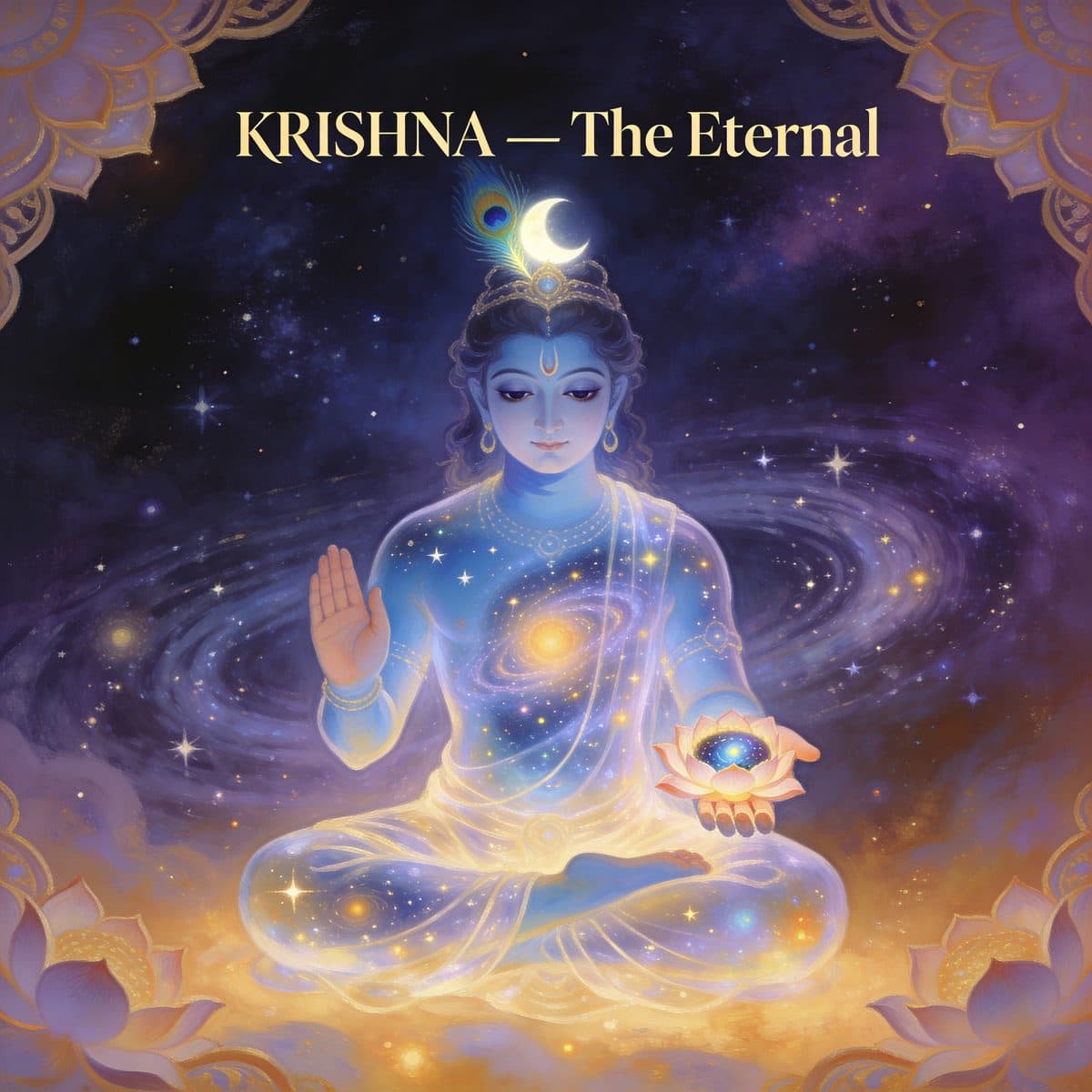
Lord Krishna
Divine TeacherThe Supreme Lord, the charioteer and divine guide of Arjuna. Krishna delivers the eternal wisdom of the Gita, revealing the nature of the soul, duty, and the path to liberation.
Speaking: Chapter 18, Verse 26
Verse 26
The Yoga of Liberation through Renunciation
Free from attachment, free from the language of "I," endowed with steadiness and enthusiasm, unaltered in success and failure — such an agent is called sattvic.
Context & Meaning
The sattvic agent (kartā) embodies four qualities: muktasaṅga — free from the clinging of attachment; anahaṃvādī — not speaking in terms of "I did this," without ego-speech; dhṛtyutsāha-samanvita — endowed with both steadiness (dhṛti) and enthusiasm (utsāha), a remarkable combination that shows engagement without desperation; and nirvikāra in success and failure — unchanged, unshaken, equally present through both outcomes. This portrait of the sattvic agent is the Gita's description of the spiritually mature person as they appear in action — not a passive ascetic but an engaged, enthusiastic, and utterly equanimous doer.
Scholar Commentaries
1 commentary · Public domainRamanujacharya
VishishtadvaitaDhṛtyutsāhasamanvitaḥ — endowed with steadiness and enthusiasm. The Vishishtadvaita reading finds in this combination the signature of genuine devotion-in-action: the devotee who loves Bhagavān brings both the steadiness of deep faith (which does not waver with circumstances) and the enthusiasm of love (which brings joy and energy to every act of service). This is not the grim determination of the person forcing themselves through their duties; it is the freely given energy of one who acts for the sake of the Beloved. Nirvikāraḥ in success and failure: because the work is an offering, every outcome is accepted as Bhagavān's response. Nothing is "mine" to succeed or fail at.