
कर्म योग
The Yoga of Action
43 VersesDescription
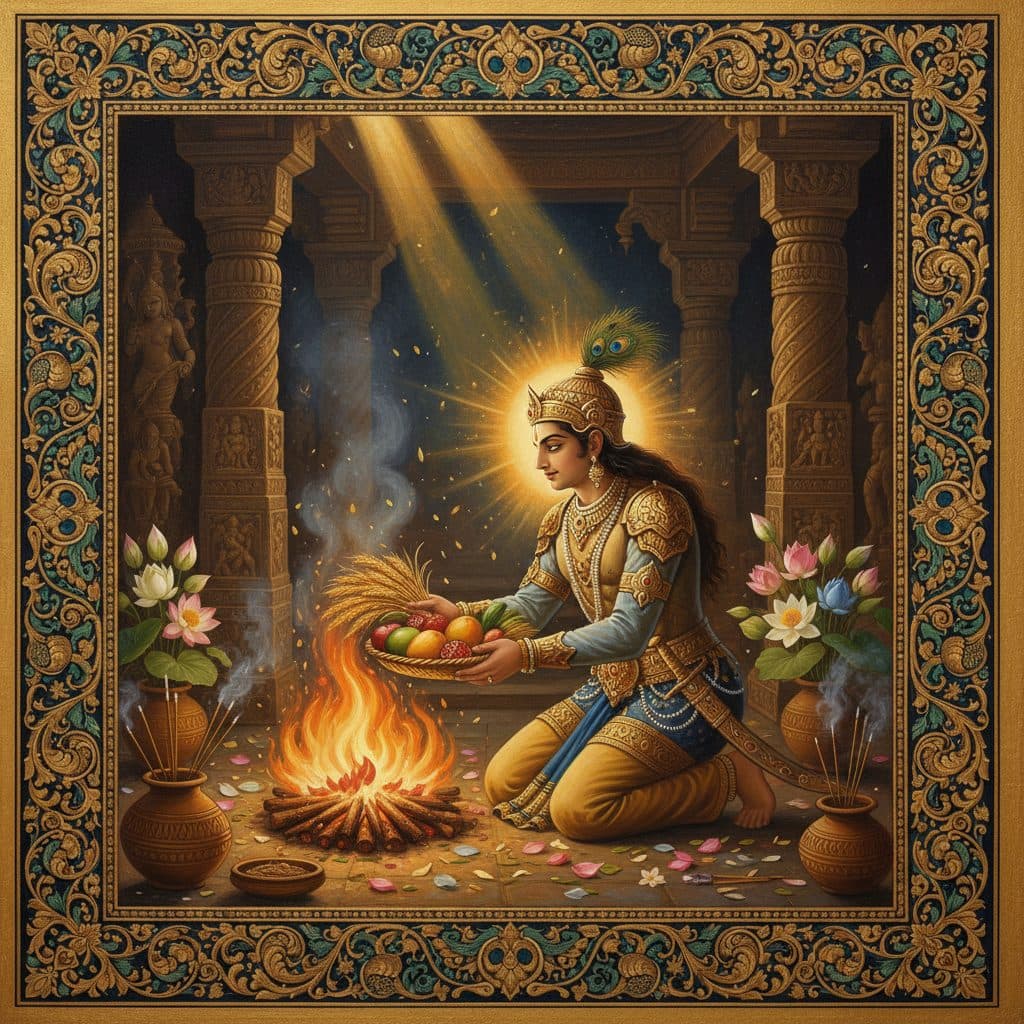
Krishna explains the path of Karma Yoga—the yoga of selfless action. He teaches that one cannot avoid action, as it is the nature of life itself. The key is to perform one's duties without attachment to the fruits of action. He explains the concept of Yajna (sacrifice) and how all actions should be offered to the Divine. Krishna emphasizes that selfless action purifies the heart and leads to liberation.
Location
Kurukshetra Battlefield
Characters


Watch Chapter Discourse
Video coming soon
Add a YouTube URL to the videoUrl field in chapters.ts
Chapter 3 — The Yoga of Action
Read Verses
43 of 43 availableArjuna said: O Janardana, O Keshava, if You consider that intelligence is better than fruitive work, then why do You want to engage me in this ghastly warfare?
Arjuna is confused: if knowledge is superior to action, why does Krishna urge him to fight? He questions the apparent contradiction.
My intelligence is bewildered by Your equivocal instructions. Therefore, please tell me decisively which will be most beneficial for me.
Arjuna feels confused by seemingly contradictory instructions and asks Krishna to give one clear, decisive path.
The Supreme Personality of Godhead said: O sinless Arjuna, I have already explained that there are two classes of men who try to realize the Self. Some are inclined to understand it by empirical, philosophical speculation (jnana yoga), and others by devotional service (karma yoga).
Krishna clarifies: there are two paths — the path of knowledge (Jnana Yoga) for contemplative minds, and the path of action (Karma Yoga) for active ones. Both lead to the same goal.
Not by merely abstaining from work can one achieve freedom from reaction, nor by renunciation alone can one attain perfection.
One cannot achieve actionlessness by simply not acting, nor can perfection be reached by mere renunciation. Action is inescapable.
Everyone is forced to act helplessly according to the qualities he has acquired from the modes of material nature; therefore no one can refrain from doing something, not even for a moment.
No one can remain without action even for a moment. The three gunas (qualities of nature) compel every being to act constantly.
One who restrains the senses of action but whose mind dwells on sense objects certainly deludes himself and is called a pretender.
One who outwardly restrains actions but mentally dwells on sense pleasures is a hypocrite — a false renunciant.
On the other hand, if a sincere person tries to control the active senses by the mind and begins karma yoga (in Krishna consciousness) without attachment, he is by far superior.
One who controls the senses with the mind and engages in Karma Yoga without attachment is far superior to the false renunciant.
Perform your prescribed duty, for doing so is better than not working. One cannot even maintain one's physical body without work.
Prescribed duty must be performed. Action is superior to inaction — even bodily sustenance requires action.
Work done as a sacrifice for Vishnu has to be performed; otherwise work causes bondage in this material world. Therefore, O son of Kunti, perform your prescribed duties for His satisfaction, and in that way you will always remain free from bondage.
All actions done as an offering (yajna) to the Divine free one from bondage. Actions done for selfish ends bind the doer.
In the beginning of creation, the Lord of all creatures sent forth generations of men and demigods, along with sacrifices for Vishnu, and blessed them by saying, "Be thou happy by this yajna (sacrifice) because its performance will bestow upon you everything desirable for living happily and achieving liberation."
At creation, Brahma created humans together with the principle of sacrifice, saying that through mutual giving, both humans and gods would flourish.
The demigods, being pleased by sacrifices, will also please you; thus nourishing one another, there will reign general prosperity for all.
By pleasing the gods through sacrifice, the gods in turn bless humans. This mutual nourishment creates universal prosperity.
In charge of the various necessities of life, the demigods, being satisfied by the performance of yajna, will supply all necessities to you. But he who enjoys such gifts without offering them to the demigods in return is certainly a thief.
The gods grant abundance to those who perform sacrifice. One who enjoys their gifts without giving back is a thief.
The devotees of the Lord are released from all kinds of sins because they eat food which is offered first for sacrifice. Others, who prepare food for personal sense enjoyment, verily eat only sin.
Those who eat food offered first as sacrifice are freed from sin. Those who cook only for themselves consume only sin.
All living bodies subsist on food grains, which are produced from rains. Rains are produced by performance of yajna (sacrifice), and yajna is born of prescribed duties.
Living beings depend on food; food comes from rain; rain comes from sacrifice; and sacrifice arises from righteous action. This is the sacred cycle of life.
Regulated activities are prescribed in the Vedas, and the Vedas are directly manifested from the Supreme Personality of Godhead. Consequently, the all-pervading Transcendence is eternally situated in acts of sacrifice.
Action arises from the Vedas; the Vedas arise from the eternal Brahman. Therefore, the all-pervading Brahman is always present in sacrifice.
My dear Arjuna, one who does not follow in human life the cycle of sacrifice thus established by the Vedas certainly leads a life full of sin. Living only for the satisfaction of the senses, such a person lives in vain.
One who does not follow the cycle of sacrifice lives sinfully and in vain, existing only for sense pleasure.
But for one who takes pleasure in the Self, who is illuminated in the Self, who rejoices in and is satisfied with the Self only, there is no duty to do.
For one who delights in, is satisfied with, and rejoices only in the Self, no prescribed duties remain. They are beyond obligation.
A self-realized man has no purpose to fulfill in the discharge of his prescribed duties, nor has he any reason not to perform such work. Nor has he any need to depend on any other living being.
The Self-realized person has nothing to gain by action and nothing to lose by inaction. They are independent of all beings.
Therefore, without being attached to the fruits of activities, one should act as a matter of duty; for by working without attachment, one attains the Supreme.
Therefore, always perform prescribed duties without attachment. By acting without attachment, one attains the Supreme.
Kings such as Janaka attained perfection solely by performance of prescribed duties. Therefore, just for the sake of educating the people in general, you should perform your work.
King Janaka and others attained perfection through action alone. Arjuna should act also for the welfare and instruction of society.
Whatever action a great man performs, common men follow in his footsteps. And whatever standards he sets by exemplary acts, all the world pursues.
Whatever a great person does, others follow. Whatever standard they set, the world emulates. Leaders must act with consciousness of their influence.
O son of Pritha, there is no work prescribed for Me within all the three planetary systems. Nor am I in want of anything, nor have I a need to obtain anything—and yet I am engaged in prescribed duties.
Krishna has nothing to gain in any world, yet he continues to act. This is the model of selfless action — acting without personal need.
For if I ever failed to engage in carefully performing prescribed duties, O Partha, certainly all men would follow My path.
If Krishna did not act carefully, all humanity would follow his example of inaction, leading to chaos.
If I did not perform prescribed duties, all these worlds would be put to ruination. I would be the cause of creating unwanted population, and I would thereby destroy the peace of all living beings.
Without Krishna's action, the worlds would fall into disorder. Even God must act to maintain cosmic order.
As the ignorant perform their duties with attachment to results, the learned may similarly act, but without attachment, for the sake of leading people on the right path.
The ignorant act with attachment; the wise should act similarly but without attachment, to set an example for the world.
So as not to disrupt the minds of ignorant men attached to the fruitive results of prescribed duties, a learned person should not induce them to stop work. Rather, by working in the spirit of devotion, he should engage them in all sorts of activities for the gradual development of Krishna consciousness.
The wise should not unsettle the minds of those attached to action. Instead, they should inspire everyone to act well by their own example.
The spirit soul bewildered by the influence of false ego thinks himself the doer of activities that are in actuality carried out by the three modes of material nature.
All actions are performed by the three gunas of Prakriti (nature). The deluded ego wrongly claims "I am the doer."
One who is in knowledge of the Absolute Truth, O mighty-armed, does not engage himself in the senses and sense gratification, knowing well the differences between work in devotion and work for fruitive results.
The one who knows the truth understands that it is only the gunas acting upon gunas, and thus does not become attached.
Bewildered by the modes of material nature, the ignorant fully engage themselves in material activities and become attached. But the wise should not unsettle them, although these duties are inferior due to the performers' lack of knowledge.
Those deluded by the gunas are attached to actions of the gunas. The wise, knowing the full truth, should not disturb those of partial understanding.
Therefore, O Arjuna, surrendering all your works unto Me, with full knowledge of Me, without desire for profit, with no claims to proprietorship, and free from lethargy, fight.
Surrender all actions to Krishna, free from desire, ego, and attachment. Then engage in battle without anxiety.
Those persons who execute their duties according to My injunctions and who follow this teaching faithfully, without envy, become free from the bondage of fruitive actions.
Those who faithfully follow this teaching without envy are freed from the bondage of karma.
But those who, out of envy, disregard these teachings and do not follow them regularly, are to be considered bereft of all knowledge, befooled, and ruined in their endeavors for perfection.
Those who out of envy disregard this teaching are deluded in all knowledge and ruined.
Even a man of knowledge acts according to his own nature, for everyone follows the nature he has acquired from the three modes. What can repression accomplish?
Even a wise person acts according to their own nature. All beings follow their nature. What can mere suppression achieve?
There are principles to regulate attachment and aversion pertaining to the senses and their objects. One should not come under the control of such attachment and aversion, because they are stumbling blocks on the path of self-realization.
Attraction and aversion are rooted in the senses. One must not be controlled by them — they are obstacles on the path.
It is far better to discharge one's prescribed duties, even though faultily, than another's duties perfectly. Destruction in the course of performing one's own duty is better, and to follow the path of another's duty is dangerous.
One's own dharma, even if imperfect, is better than another's dharma perfectly performed. Death in one's own dharma is glorious; another's dharma is dangerous.
Arjuna said: O descendant of Vrishni, by what is one impelled to sinful acts, even unwillingly, as if engaged by force?
Arjuna asks: what force compels a person to sin even against their will?
The Supreme Personality of Godhead said: It is lust only, Arjuna, which is born of contact with the material mode of passion and later transformed into wrath, and which is the all-devouring sinful enemy of this world.
It is desire (kama), born of rajas (passion), which transforms into anger — the all-devouring enemy. This is the force that compels sin.
As fire is covered by smoke, as a mirror is covered by dust, or as the embryo is covered by the womb, the living entity is similarly covered by different degrees of this lust.
Just as fire is covered by smoke, a mirror by dust, and an embryo by the womb — knowledge is covered by lust to varying degrees.
Thus the wise living entity's pure consciousness becomes covered by his eternal enemy in the form of lust, which is never satisfied and which burns like fire.
The pure consciousness of the wise is covered by lust — the eternal enemy, ever-burning and insatiable as fire.
The senses, the mind and the intelligence are the sitting places of this lust. Through them lust covers the real knowledge of the living entity and bewilders him.
Lust resides in the senses, mind, and intellect. Through these, it covers knowledge and bewilders the embodied soul.
Therefore, O Arjuna, best of the Bharatas, in the very beginning curb this great symbol of sin [lust] by regulating the senses, and slay this destroyer of knowledge and self-realization.
Therefore, O Arjuna, first regulate the senses and destroy lust — the great destroyer of knowledge and self-realization.
The working senses are superior to dull matter; mind is higher than the senses; intelligence is still higher than the mind; and he (the soul) is even higher than the intelligence.
The hierarchy: senses are above matter, mind is above senses, intellect is above mind, and the Self (Atman) is above all.
Thus knowing oneself to be transcendental to the material senses, mind and intelligence, O mighty-armed Arjuna, one should steady the mind by deliberate spiritual intelligence and thus—by spiritual strength—conquer this insatiable enemy known as lust.
Knowing the Self to be beyond senses, mind, and intellect, steady the self with the Self and slay the enemy — insatiable lust.
Key Teachings
- •Action is superior to inaction
- •Perform duties as an offering to God
- •Detachment from results leads to liberation