
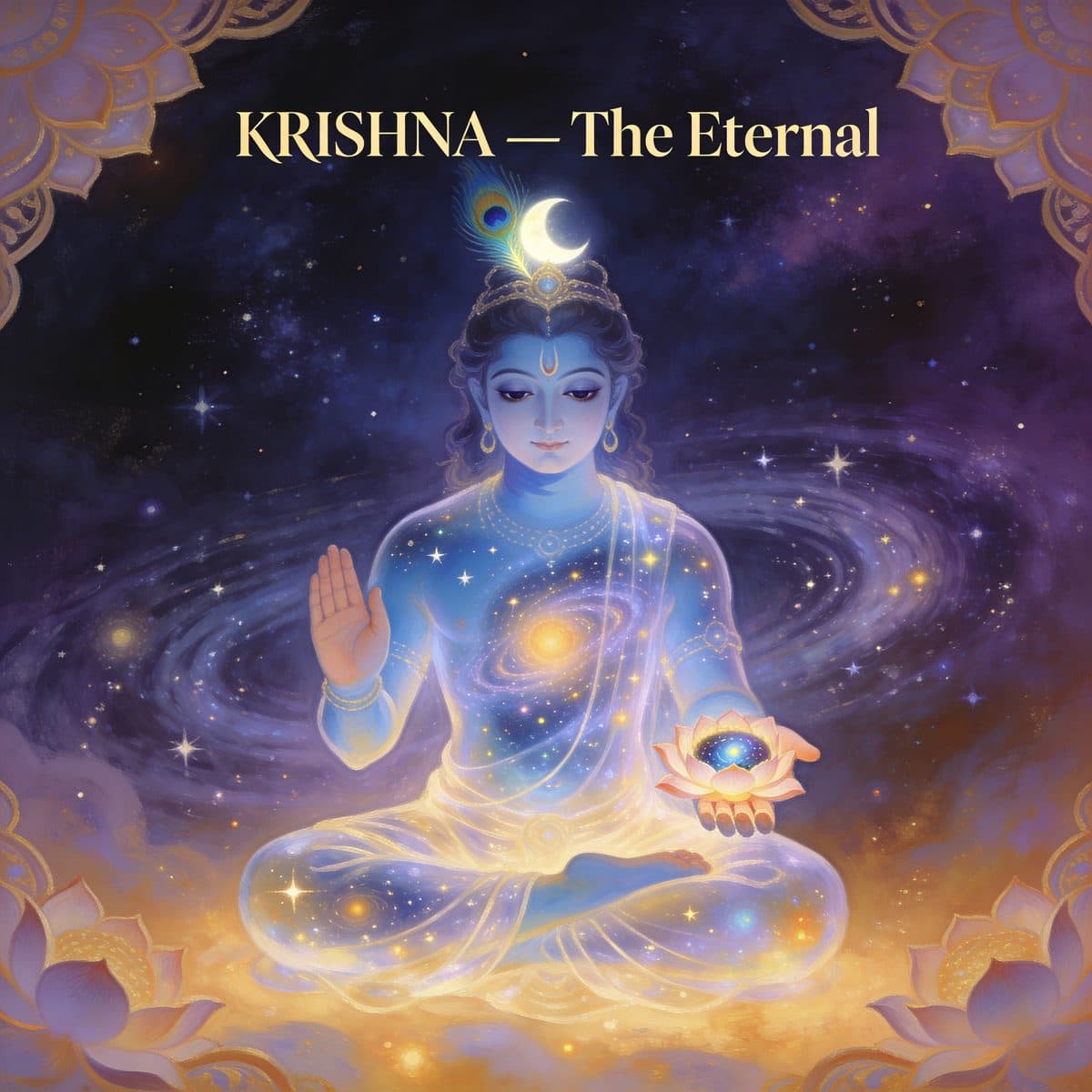
Lord Krishna
Divine TeacherThe Supreme Lord, the charioteer and divine guide of Arjuna. Krishna delivers the eternal wisdom of the Gita, revealing the nature of the soul, duty, and the path to liberation.
Speaking: Chapter 18, Verse 40
Verse 40
The Yoga of Liberation through Renunciation
There is no being on earth or in the heavens among the gods who is free from these three Gunas born of material nature.
Context & Meaning
This is one of the most sweeping statements in the entire Gita: the three Gunas operate throughout the entire range of existence — from the densest material reality on earth to the most refined spiritual realms of the gods. No being — human, animal, divine — exists outside the field of sattva, rajas, and tamas. This universality serves two purposes: it prevents spiritual pride (even the most refined spiritual practitioner operates within the Gunas) and it points toward what must lie beyond them — the witness-consciousness that is not itself a Guna-state but the aware space in which all Guna-states arise and pass. Liberation is not the attainment of pure sattva; it is the recognition of what one has always been beyond all three.
Scholar Commentaries
1 commentary · Public domainAdi Shankaracharya
AdvaitaNa tadasti pṛthivyāṃ vā divi deveṣu — not on earth or among the gods. The Advaita teaching finds in this verse its most important practical implication: since all Guna-bound existence falls short of liberation, liberation cannot be the achievement of any state within Prakriti — not even the highest sattvic state. It must be the recognition of that which is never within Prakriti at all: the pure witnessing Self, Ātman-Brahman. This means that liberation is not a future achievement but a present recognition — the recognition of what one already is beneath all the Guna-play. The Gunas apply to everything one appears to be; liberation is the recognition of what one actually is.