
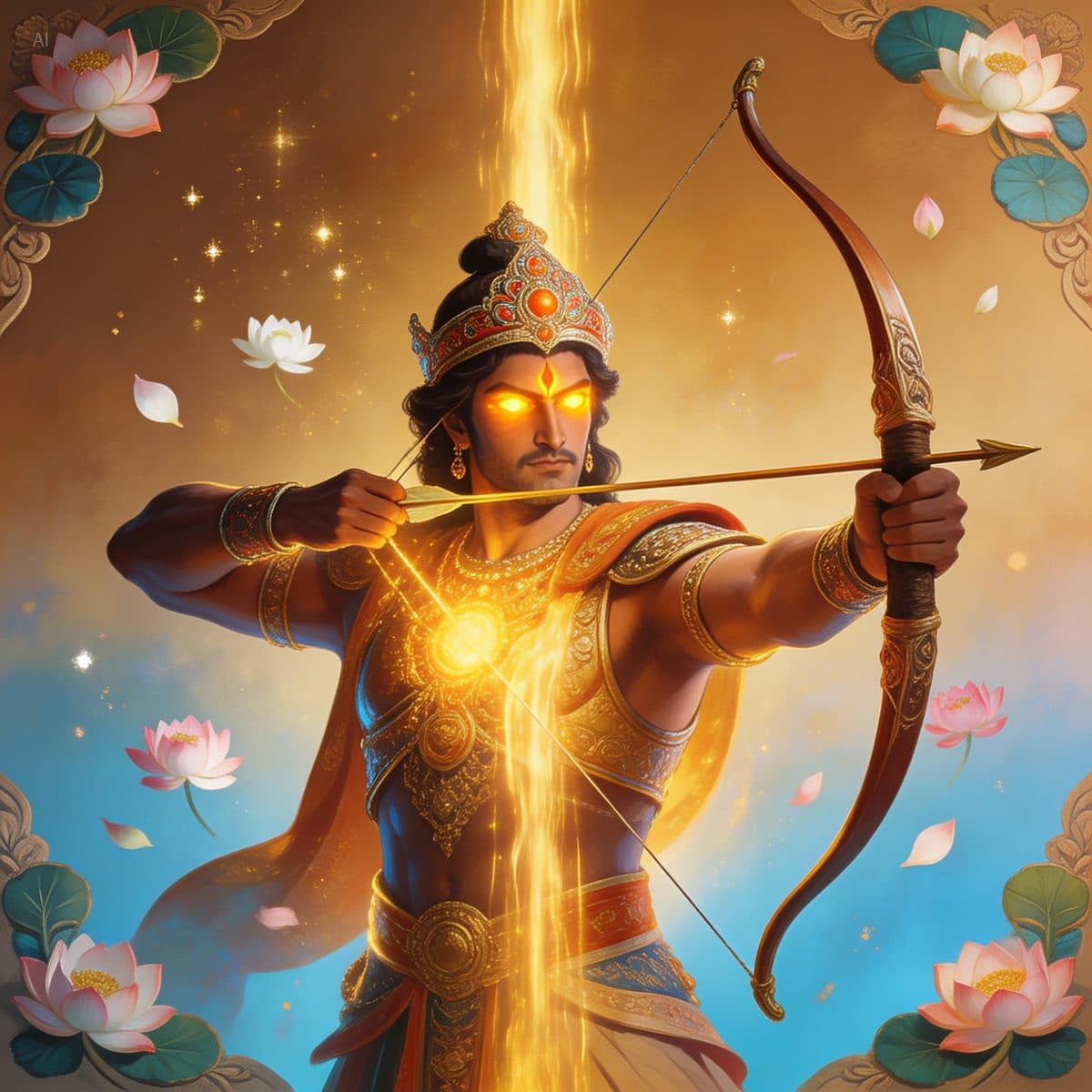
Arjuna
Devotee & WarriorThe great Pandava warrior and skilled archer. Overwhelmed by moral dilemma on the battlefield, he seeks guidance from Krishna, becoming the ideal disciple.
Speaking: Chapter 18, Verse 73
Verse 73
The Yoga of Liberation through Renunciation
Arjuna said: My delusion is destroyed, and my memory is restored — by Your grace, O Achyuta, O infallible one. I stand firm, free from all doubt. I will act according to Your word.
Context & Meaning
These are among the most important words in the Gita — Arjuna's answer. Not a promise of philosophical agreement but a declaration of transformation: naṣṭo mohaḥ — the delusion is gone. Smṛtir labdhā — memory is regained. Not new knowledge acquired but original clarity recovered. Arjuna does not say "I now understand" — he says "I remember." The teaching did not add something external; it removed the covering over what was always already known. Tvatprasādāt — by your grace — places the source correctly: it was not Arjuna's effort or intelligence that cleared the clouds. It was the Lord's gift. And the result: sthito'smi gata-sandehaḥ kariṣye vacanaṃ tava — I stand firm, free from doubt, I will act on your word. The Gita ends not with renunciation but with decisive, joyful readiness to engage.
Scholar Commentaries
2 commentaries · Public domainRamanujacharya
VishishtadvaitaTvatprasādān mayācyuta — by Your grace, O infallible one. The name Achyuta — the one who never falls, the infallible — is chosen with precision at this moment of Arjuna's restoration. The Vishishtadvaita tradition reads this as the paradigm of all spiritual transformation: it is not achieved by the jiva alone but received through the Lord's grace, given freely to the surrendered heart. Arjuna did not argue his way out of delusion; he was graced out of it by the Lord who loves him. This is prapatti — surrender — bearing its fruit in real time.
Adi Shankaracharya
AdvaitaNaṣṭo mohaḥ smṛtir labdhā — the delusion is gone, memory is regained. The Advaita tradition celebrates this verse as the clearest description of Self-realisation available in the scripture. The moha that drove Arjuna to collapse was the forgetting of his true nature — the identification of the deathless Self with the mortal body and its relationships. What is regained is smṛti — not new memory but the fundamental remembering of what one always was. In this remembering, there is nothing more to fear, nothing more to grieve, and no question of what to do: the one who knows the Self acts from the Self, and that action is always right.