
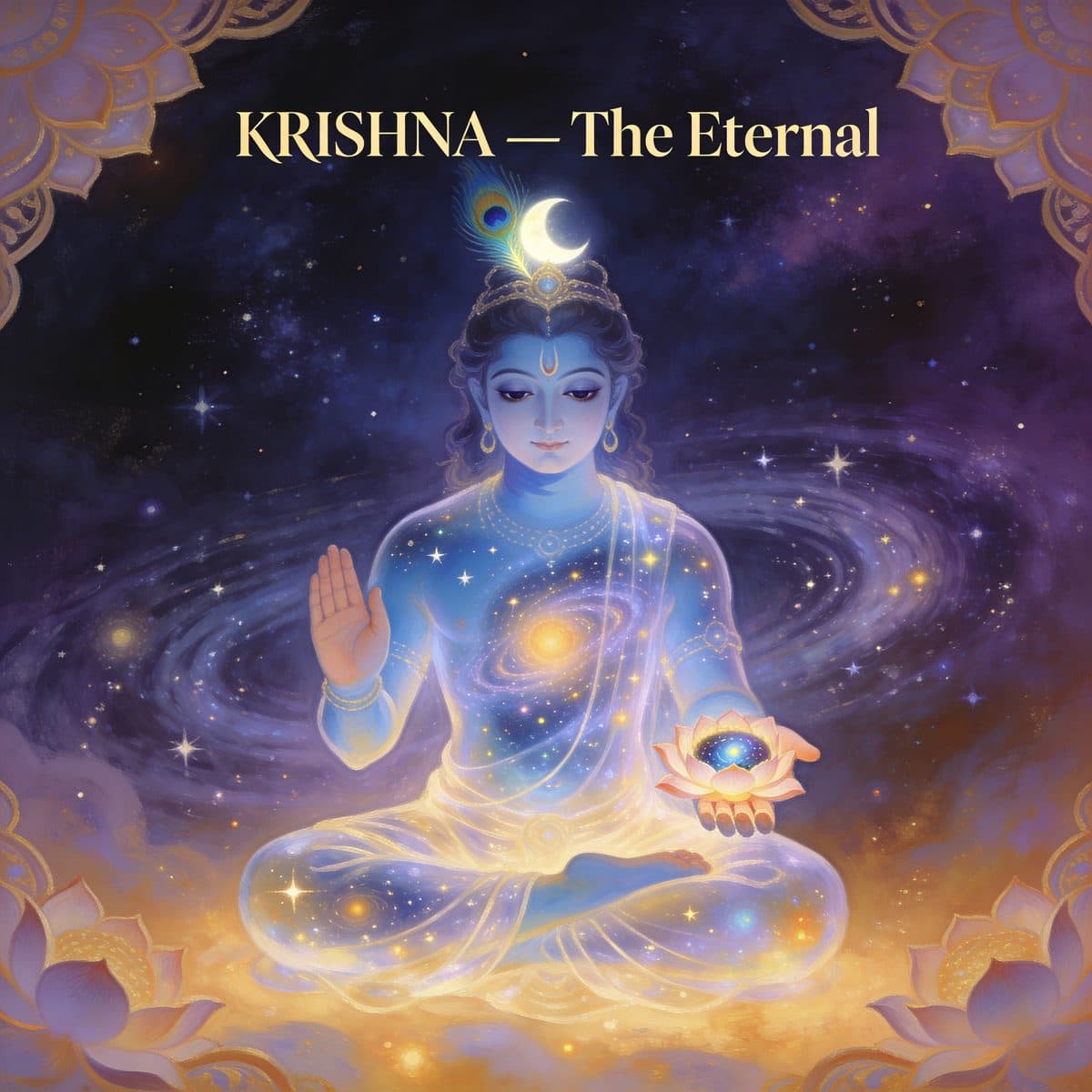
Lord Krishna
Divine TeacherThe Supreme Lord, the charioteer and divine guide of Arjuna. Krishna delivers the eternal wisdom of the Gita, revealing the nature of the soul, duty, and the path to liberation.
Speaking: Chapter 18, Verse 15
Verse 15
The Yoga of Liberation through Renunciation
Whatever action a person performs with body, speech, or mind — whether right or wrong — these five are its causes.
Context & Meaning
The scope of this teaching is total: every action — whether righteous or unrighteous, beneficial or harmful — whether performed through body, speech, or mind — has these five causes. This is a philosophically liberating statement because it means that no single action can be fully attributed to the ego alone. This does not eliminate moral responsibility — the ego is one of the five causes — but it relativises the ego's claim to be the sole author of what happens. The great value of this understanding is not as an excuse but as a corrective to the inflation of ego-identity: the one who says "I did this great thing" and the one who says "I did this terrible thing" are both making the same fundamental error of identification.
Scholar Commentaries
1 commentary · Public domainMadhvacharya
DvaitaNyāyyaṃ vā viparītaṃ vā — whether right or wrong. The Dvaita tradition emphasises that this teaching does not abolish the distinction between right and wrong action — Arjuna must still fight his righteous battle, and the question of dharma remains fully alive. What the teaching abolishes is the inflation of personal agency: the one who performs right action should not be puffed up with self-congratulation, nor should the one who falls into wrong action be crushed with self-condemnation. Both are responding to a convergence of forces, of which the ego is only one. Understanding this, one can act rightly with greater steadiness and recover from error with greater equanimity.