
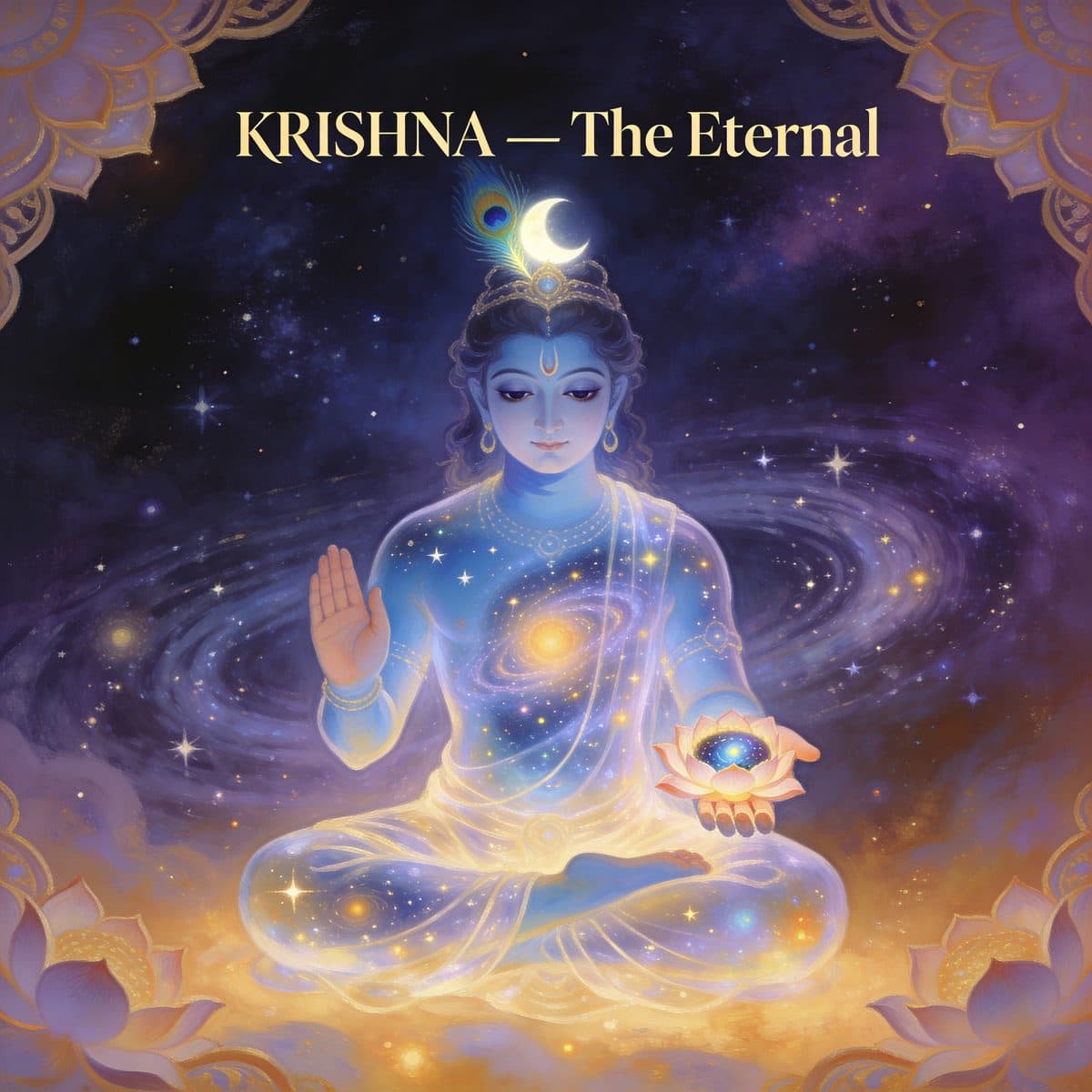
Lord Krishna
Divine TeacherThe Supreme Lord, the charioteer and divine guide of Arjuna. Krishna delivers the eternal wisdom of the Gita, revealing the nature of the soul, duty, and the path to liberation.
Speaking: Chapter 18, Verse 51
Verse 51
The Yoga of Liberation through Renunciation
Endowed with a purified intellect, restraining oneself with fortitude, abandoning sound and other sense-objects, casting away attraction and aversion —
Context & Meaning
This verse begins a sequence (continuing through verse 53) describing the prerequisites for the attainment of Brahman. The first cluster of conditions: viśuddhā buddhi (purified intellect — refined by knowledge, practice, and sattva cultivation), dhṛti (fortitude — the inner stability that holds through difficulty), the abandonment of sense-objects beginning with sound, and the casting away of rāga (attraction) and dveṣa (aversion). These are the conditions of the purified seeker — not someone who has achieved Brahman but someone whose inner instrument is prepared to receive it. The inner work must precede the realisation.
Scholar Commentaries
1 commentary · Public domainMadhvacharya
DvaitaViśuddhayā buddhyā — with a purified intellect. The Dvaita tradition holds that the purification of the intellect is above all a purification from the distortion of the ego's self-interest: the intellect that serves the ego sees the world through the lens of "what is useful for me." The intellect purified through devotion sees the world through the lens of "what is Vishnu's truth here?" This is not merely a moral shift but a perceptual one: the purified intellect literally sees differently, because it is no longer filtered through the coloured glass of personal desire.