
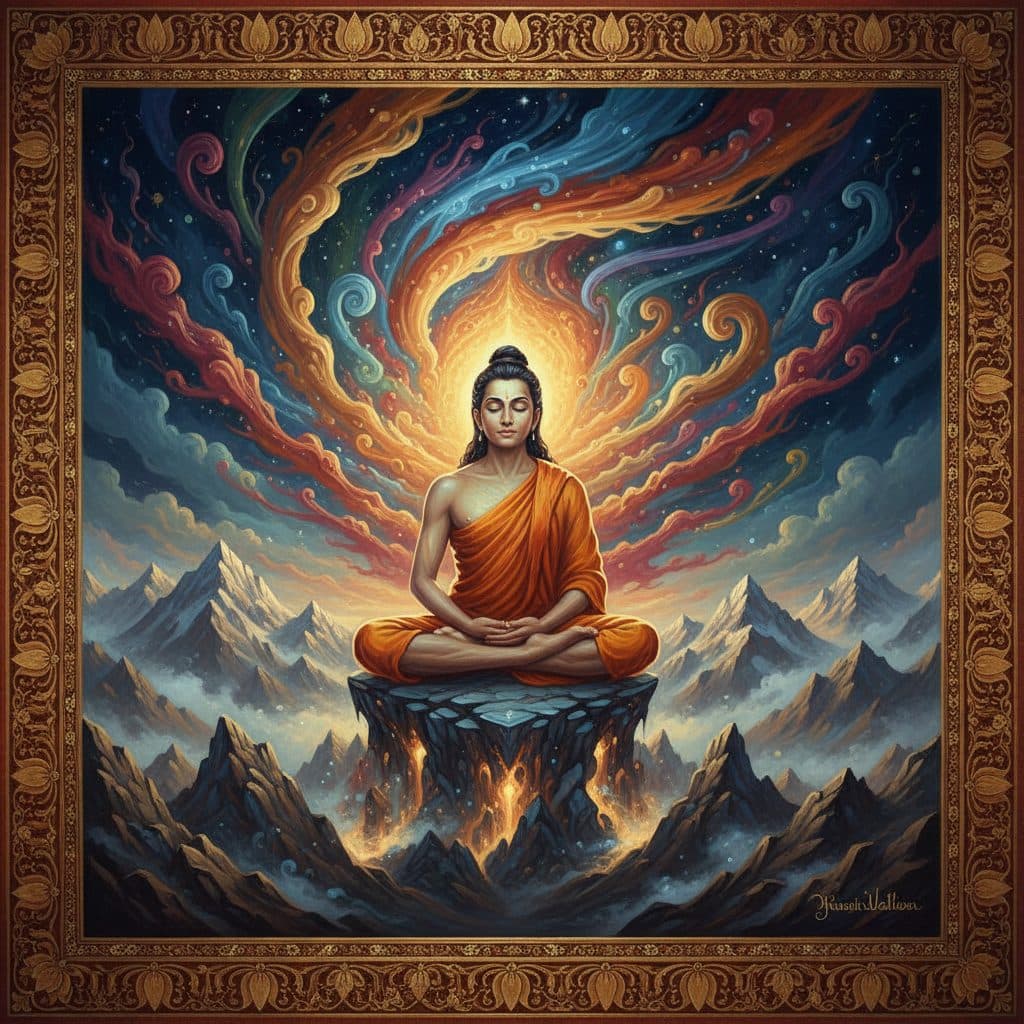
ध्यान योग
The Yoga of Meditation
47 VersesDescription
Krishna explains the practice of Dhyana Yoga (meditation) and the lifestyle of a yogi. He describes how to meditate, the importance of moderation, and the characteristics of a self-controlled person who has attained union with the Divine. He also addresses the fate of those who stray from the path of yoga.
Location
Kurukshetra Battlefield
Characters


Watch Chapter Discourse
Video coming soon
Add a YouTube URL to the videoUrl field in chapters.ts
Chapter 6 — The Yoga of Meditation
Read Verses
47 of 47 availableThe Supreme Lord said: One who is unattached to the fruits of his work and who works as he is obligated is in the renounced order of life, and he is the true mystic, not he who lights no fire and performs no duty.
A true sannyasi and a true yogi is not one who has simply abandoned outward rituals or stopped working — it is one who acts dutifully without clinging to the fruits. Inner renunciation, not outer show, defines the yogi.
What is called renunciation you should know to be the same as yoga, or linking oneself with the Supreme, O son of Pandu, for one can never become a yogi unless he renounces the desire for sense gratification.
Renunciation and yoga are the same thing seen from two angles. No one becomes a true yogi without first renouncing the resolve born of selfish desire. The inner giving-up of craving is what yoga fundamentally is.
For one who is a neophyte in the eightfold yoga system, work is said to be the means; and for one who is already elevated in yoga, cessation of all material activities is said to be the means.
The path has two stages: for the beginner, selfless action (karma) is the ladder upward; for one who has ascended, inner stillness (shama) sustains the height. The medicine changes as the patient progresses.
A person is said to be elevated in yoga when, having renounced all material desires, he neither acts for sense gratification nor engages in fruitive activities.
The mark of one who has truly ascended in yoga: no longer pulled toward sense-objects, no longer clinging to the fruits of action, having renounced all personal agendas. This is not suppression — it is natural freedom.
One must deliver himself with the help of his mind, and not degrade himself. The mind is the friend of the conditioned soul, and his enemy as well.
You must rescue yourself — no one else can do it for you. The mind is both your closest ally and your most dangerous enemy. Whether it liberates or enslaves you depends entirely on how you relate to it.
For him who has conquered the mind, the mind is the best of friends; but for one who has failed to do so, his very mind will be the greatest enemy.
For the person who has mastered their mind it becomes their truest friend — a steady, reliable instrument. For one who has not, the same mind becomes their worst enemy — pulling them toward ruin against their own wishes.
For one who has conquered the mind, the Supersoul is already reached, for he has attained tranquility. To such a man happiness and distress, heat and cold, honor and dishonor are all the same.
The person who has mastered the mind rests in the Supreme Self — undisturbed by heat or cold, pleasure or pain, honor or insult. These pairs of opposites lose their tyranny over one who has found the still center within.
A person is said to be established in self-realization and is called a yogi [or mystic] when he is fully satisfied by virtue of acquired knowledge and realization. Such a person is situated in transcendence and is self-controlled. He sees everything—whether it be pebbles, stones or gold—as the same.
The yogi who is satisfied by knowledge and its realization, who is steady as a mountain peak, who has mastered the senses, and who sees equal value in a clod of earth, a stone, and gold — such a person is called truly "in yoga."
A person is considered still further advanced when he regards honest well-wishers, affectionate benefactors, the neutral, mediators, the envious, friends and enemies, the pious and the sinners all with an equal mind.
Across the full spectrum of human relations — well-wishers, friends, enemies, neutrals, the virtuous, the sinful — the yogi who maintains equal vision toward all is considered the most advanced of all.
A transcendentalist should always engage his body, mind and self in relationship with the Supreme; he should live alone in a secluded place and should always carefully control his mind. He should be free from desires and feelings of possessiveness.
The yogi should practice constantly, alone in a solitary place, with controlled mind and self, free from desire and possessiveness. This verse begins the Gita's direct instruction on how to meditate — the "how" after the "why."
To practice yoga, one should go to a secluded place and should lay kusha grass on the ground and then cover it with a deerskin and a soft cloth. The seat should be neither too high nor too low and should be situated in a sacred place.
The first practical instruction: prepare a firm, stable seat (asana) in a clean and quiet place — neither too high nor too low. Even the physical setup of meditation matters; a stable seat supports a stable mind.
Having established his seat there, the yogi should practice yoga to purify the heart by controlling his mind, senses and activities and fixing the mind on one point.
Seated, the yogi should one-pointedly direct the mind inward — controlling the activities of both mind and senses — and practice yoga for the purification of the self. The goal is not mere concentration but inner cleansing.
One should hold one's body, neck and head erect in a straight line and stare steadily at the tip of the nose. Thus, with an unagitated, subdued mind, devoid of fear, completely free from sex life, one should meditate upon Me within the heart and make Me the ultimate goal of life.
The correct posture: body, neck and head aligned in a straight line; gaze softly directed at the nose-tip; neither looking around nor restless. This physical alignment supports the alignment of attention that meditation requires.
Thus, with an unagitated, subdued mind, devoid of fear, completely free from sex life, one should meditate upon Me within the heart and make Me the ultimate goal of life.
The inner qualities that complete the outer posture: a tranquil self, no fear, established in brahmacharya (continence), mind controlled, heart fixed on the Supreme. Inner and outer alignment together constitute genuine meditation.
Thus practicing control of the body, mind and activities, the mystic transcendentalist, having regulated his mind, attains to the kingdom of God [or the abode of Krishna] by cessation of material existence.
The yogi who practices thus — consistently, with a disciplined mind — attains the supreme peace of nirvana, the peace that rests in the Supreme. This is the fruit promised for the practice described in verses 10–14.
There is no possibility of one's becoming a yogi, O Arjuna, if one eats too much or eats too little, sleeps too much or does not sleep enough.
Yoga is not compatible with extremes. Eating too much or too little, sleeping too much or too little — all these imbalances obstruct the steady, regulated inner life that meditation requires.
He who is regulated in his habits of eating, sleeping, recreation and work can mitigate all material pains by practicing the yoga system.
For the yogi who regulates eating, recreation, effort in work, and the balance of sleep and wakefulness — yoga becomes the destroyer of all sorrow. The middle path of moderation is the only viable foundation for sustained practice.
When the yogi, by practice of yoga, disciplines his mental activities and becomes situated in transcendence—devoid of all material desires—he is said to be well established in yoga.
The sign that yoga has truly taken hold: the mind, fully trained, rests in the Self alone, free from all craving. This self-settled stillness — not imposed from outside but arising from within — is the definition of being "in yoga."
As a lamp in a windless place does not waver, so the transcendentalist, whose mind is controlled, remains always steady in his meditation on the transcendent self.
A lamp in a sheltered, windless place burns perfectly still — its flame neither flickers nor bends. This is the classic image of the meditator's mind: unwavering, consistent, undisturbed by the gusts of thought and sensation.
In the stage of perfection called trance, or samadhi, one's mind is completely restrained from material mental activities by practice of yoga. This perfection is characterized by one's ability to see the self by the pure mind and to relish and rejoice in the self.
In samadhi — the culmination of practice — the mind ceases its ordinary movements, restrained by yoga. In that stillness, the Self sees itself by itself and is satisfied in itself alone. This self-illuminating, self-sufficient joy is the mark of genuine samadhi.
In that joyous state of yoga, called trance, one is situated in boundless transcendental happiness, realized through transcendental senses. Established thus, one never departs from the truth, and upon gaining this he thinks there is no greater gain.
The happiness of samadhi is absolute and transcends the senses — it is grasped only by the purified intellect. Whoever has established themselves in this state does not waver from the truth and considers nothing else worth gaining.
Upon gaining this, one thinks that there is no greater gain. Being situated in such a position, one is never shaken, even in the midst of the greatest difficulty.
Whoever has attained this state considers nothing else a gain — no wealth, power, or pleasure compares. And from this ground, even the heaviest suffering cannot dislodge them. True unshakeability is the fruit of samadhi.
That state of severance from union with suffering is called yoga. This yoga should be practiced with determination and without despair.
Yoga is defined here from its final side: the complete disconnection from suffering. This is not suppression of suffering but its total severance at the root. Such yoga must be pursued with unwavering resolve and a mind that never despairs.
One should engage oneself in the practice of yoga with determination and faith and not be deviated from the path. One should abandon, without exception, all material desires born of mental speculation and thus control all the senses on all sides by the mind.
The practitioner must completely abandon all desires born of mental willing, and use the mind itself to rein in the senses from all directions. The mind is both the source of bondage (through desire) and the instrument of liberation (through discipline).
Gradually, step by step, one should become situated in trance by means of intelligence sustained by full conviction, and thus the mind should be fixed on the Self alone and should think of nothing else.
The instruction is patient: gradually, step by step, with a resolute and convinced intellect, bring the mind to rest in the Self and think of nothing else. There is no urgency or violence in this process — steadiness and gradualness are themselves the method.
From whatever and wherever the mind wanders due to its flickering and unsteady nature, one must certainly withdraw it and bring it back under the control of the Self.
Wherever the restless, wandering mind strays — again and again, without frustration — the meditator must gently bring it back to the Self. This repeated returning is not failure; it is the very practice of meditation.
The yogi whose mind is fixed on Me verily attains the highest perfection of transcendental happiness. He is beyond the mode of passion, he realizes the quantitative and qualitative infinity of the Supreme, and thus he joys in the Supreme.
The supreme happiness comes to the yogi whose mind is perfectly tranquil, whose passions have quieted, who is free from impurity and has become Brahman. This happiness does not require a cause — it is the natural state of the purified Self.
Thus the self-controlled yogi, constantly engaged in yoga practice, becomes free from all material contamination and achieves the highest stage of perfect happiness in transcendental loving service to the Lord.
The yogi who practices continuously and is purified of all impurities easily attains the touch of Brahman — the limitless happiness of direct contact with the Supreme. Brahma-sparsha (the touch of Brahman) is the supreme reward of sustained practice.
A true yogi observes Me in all beings and also sees every being in Me. Indeed, the self-realized person sees Me, the same Supreme Lord, everywhere.
The realized yogi sees with the eye of yoga: the Self in all beings, and all beings in the Self. This double vision — inward and outward simultaneously — is the perfect equal-sightedness of the liberated person.
For one who sees Me everywhere and sees everything in Me, I am never lost, nor is he ever lost to Me.
For the person who sees Krishna everywhere and all things in Krishna — there is no separation, ever. This mutual non-loss is the Gita's most intimate statement of union: the seeker and the sought are never hidden from each other once this vision is attained.
Such a yogi, who engages in the worshipful service of the Supersoul knowing that I and the Supersoul are one, remains always in Me in all circumstances.
The yogi who worships the Supreme as dwelling in all beings, established in this oneness — whatever their circumstances, whatever they do — always abides in Krishna. The vision of unity transforms every moment into yoga.
He is a perfect yogi who, by comparison to his own self, sees the true equality of all beings, in both their happiness and their distress, O Arjuna.
The highest yogi measures others by the same standard as themselves: knowing how much pleasure means to them and how much pain hurts, they feel this equally for all beings. Empathy based on self-knowledge is the practical form of universal vision.
Arjuna said: O Madhusudana, the system of yoga which You have summarized appears impractical and unendurable to me, for the mind is restless and unsteady.
Arjuna honestly admits what every practitioner feels: this yoga of equanimity sounds ideal but seems impossible. The mind is inherently restless — he cannot see how to hold it steady. This is not weakness; it is honest self-observation.
For the mind is restless, turbulent, obstinate and very strong, O Krishna, and to subdue it, I think, is more difficult than controlling the wind.
One of the most human moments in the entire Gita: Arjuna says what every meditator has felt. The mind is restless, stormy, powerful, and stubborn — taming it seems as impossible as catching the wind. Krishna's response to this honest admission is the heart of Chapter 6.
Lord Sri Krishna said: O mighty-armed son of Kunti, it is undoubtedly very difficult to curb the restless mind, but it is possible by suitable practice and by detachment.
Krishna does not contradict Arjuna — yes, the mind is genuinely difficult to control. But it is possible. The two instruments are abhyasa (consistent, repeated practice) and vairagya (dispassion toward sense-objects). These two together can tame what seems untameable.
For one whose mind is unbridled, self-realization is difficult work. But he whose mind is controlled and who strives by appropriate means is assured of success. That is My opinion.
For the undisciplined mind, yoga is hard to attain — Krishna agrees with Arjuna's difficulty. But for one who strives with a controlled mind and uses the right means (abhyasa and vairagya), success is assured. The path is hard but certain.
Arjuna said: O Krishna, what is the destination of the unsuccessful transcendentalist who in the beginning takes to the process of self-realization with faith but who later desists due to worldly-mindedness and thus does not attain perfection in mysticism?
Arjuna asks a deeply practical question: what happens to someone who starts on the yoga path with genuine faith but falls away before completing it? This is the question of spiritual failure, and it deserves a serious answer.
O mighty-armed Krishna, does not such a man, who is bewildered from the path of transcendence, fall away from both spiritual and material success and perish like a riven cloud, with no position in any sphere?
Arjuna fears the worst: such a person has abandoned worldly life but failed to complete the spiritual path — like a cloud torn apart, with no ground anywhere. Could they really be lost to both worlds?
This is my doubt, O Krishna, and I ask You to dispel it completely. But for You, no one is to be found who can destroy this doubt.
Arjuna places his doubt before Krishna with trust: only Krishna can fully answer this. The acknowledgment that some questions require a teacher — not just personal reasoning — is itself a mark of spiritual maturity.
The Supreme Personality of Godhead said: Son, a transcendentalist engaged in auspicious activities does not meet with destruction either in this world or in the spiritual world; one who does good, My friend, is never overcome by evil.
Krishna's reassurance is categorical: no sincere spiritual effort is ever lost. One who does good — who genuinely strives toward the Supreme, even without completing the path — does not perish. No effort on the spiritual path goes to waste.
The unsuccessful yogi, after many, many years of enjoyment on the planets of the pious living entities, is born into a family of righteous people, or into a family of rich aristocracy.
The yogi who fell short of the goal goes first to the higher realms to enjoy the fruits of their past merit, then returns to Earth born into a noble, virtuous, or prosperous family — favorable conditions to resume the practice.
Or [if unsuccessful after long practice of yoga], he takes his birth in a family of transcendentalists who are surely great in wisdom. Certainly, such a birth is rare in this world.
Better still, the fallen yogi may be reborn directly into a family of wise yogis — the rarest and most auspicious birth of all, for they will be surrounded by spiritual wisdom from childhood and will naturally resume the path.
On taking such a birth, he revives the divine consciousness of his previous life, and he again tries to make further progress in order to achieve complete success, O son of Kuru.
In that auspicious rebirth, the spiritual intelligence accumulated in previous lives naturally revives. The fallen yogi picks up exactly where they left off — the progress is never erased, only carried forward. Each life builds on the last.
By virtue of the divine consciousness of his previous life, he automatically becomes attracted to the yogic principles—even without seeking them. Such an inquisitive transcendentalist stands always above the ritualistic principles of the scriptures.
The previous life's practice pulls the reborn yogi naturally toward spiritual inquiry — even involuntarily. Such a sincere seeker, driven by genuine curiosity for yoga, transcends the merely external observance of religious rituals.
And when the yogi engages himself with sincere endeavor in making further progress, being washed of all contaminations, he ultimately achieves the supreme goal after many, many births of practice.
Striving earnestly — purified across many lifetimes of accumulated practice — the yogi finally attains the supreme destination. The arc of the spiritual journey is long, but its direction is certain: every genuine effort bends toward the goal.
A yogi is greater than the ascetic, greater than the empiricist, and greater than the fruitive worker. Therefore, O Arjuna, in all circumstances, be a yogi.
Krishna's declaration: the yogi surpasses the ascetic (tapasvi), the scholar-philosopher (jnani), and the ritualist (karmi). Be a yogi above all else, Arjuna. This is the chapter's summary command.
And of all yogis, the one with great faith who always abides in Me, thinks of Me within himself, and renders transcendental loving service to Me—he is the most intimately united with Me in yoga and is the highest of all. That is My opinion.
The closing verse of Chapter 6 and the crown of the yoga hierarchy: of all yogis, the greatest is the one who worships Krishna with faith, with their inner self absorbed in Krishna. Bhakti — devotional love — is declared the highest form of yoga. This prepares the ground for the Bhakti Yoga teachings that dominate the second half of the Gita.
Key Teachings
- •The mind can be controlled through practice and detachment
- •A yogi sees all beings in the Self
- •No effort on the spiritual path is wasted