
श्रद्धात्रय विभाग योग
The Yoga of the Three Types of Faith
28 VersesDescription
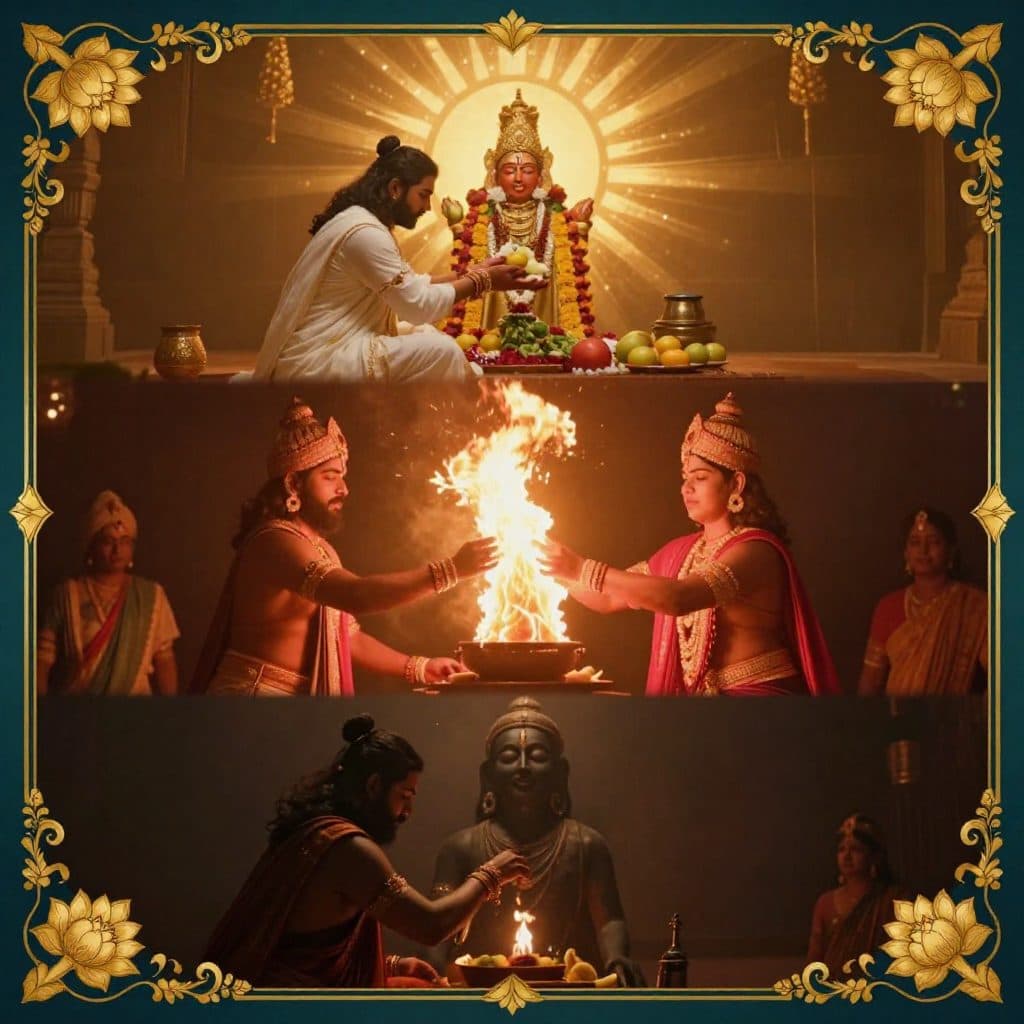
Arjuna asks about those who have faith but do not follow scriptural injunctions. Krishna explains that faith varies according to one's nature—sattvic people worship gods, rajasic people worship spirits, and tamasic people worship ghosts. He also describes three types of food, sacrifice, austerity, and charity based on the three Gunas.
Location
Kurukshetra Battlefield
Characters


Watch Chapter Discourse
Video coming soon
Add a YouTube URL to the videoUrl field in chapters.ts
Chapter 17 — The Yoga of the Three Types of Faith
Read Verses
28 of 28 availableArjuna said: Those who, setting aside the injunctions of scripture, worship with faith — what is their standing, O Krishna? Is it sattva, rajas, or tamas?
Arjuna's question is precise and practically important: what about people who are genuinely devout, who worship with real faith and sincerity, but who do not follow scriptural prescriptions — perhaps because they don't know them, or belong to traditions outside the Vedic mainstream? The previous chapter ended with scripture as the supreme authority. Arjuna now presses: does sincere faith without scriptural grounding count for anything? This question is not hypothetical — it touches the real lives of millions of seekers across every tradition, in every age, who approach the Divine with full hearts but without formal religious education. Krishna's answer in this chapter will show that faith itself is a force shaped by one's inner nature — and that the quality of faith determines the quality of everything that flows from it.
The Supreme Lord said: The faith of embodied beings is of three kinds, born of their own nature — sattvic, rajasic, and tamasic. Hear about this.
Krishna's opening answer is elegant in its economy: faith is threefold, and it is svabhāva-jā — born from one's own nature, one's accumulated inner character. This means faith is not simply a choice made in the moment but the expression of who one has become through the accumulated choices of one's life. The sattvic person naturally has sattvic faith — faith oriented toward truth, clarity, and the highest good. The rajasic person has rajasic faith — intense, passionate, ambitious. The tamasic person has tamasic faith — dull, misdirected, attached to inertia. The invitation to "hear about this" (tāṃ śṛṇu) signals that what follows is not merely classification but diagnosis — a mirror in which the serious student can recognise their own inner state.
The faith of each person accords with their inner nature, O Bharata. A person is made of faith — whatever one's faith is, that is what one is.
This verse contains one of the Gita's most penetrating psychological insights: yo yac-chraddhaḥ sa eva saḥ — whatever one's faith is, that is what one is. A person is not defined by their professed beliefs, their formal religious affiliation, or even their conscious intentions — they are defined by what they actually trust, what they orient themselves toward with their deepest energy. Faith here means not intellectual assent but the fundamental bet of one's life — the thing one actually lives for. The person who claims to believe in the supremacy of truth but actually lives for social status has sattvic words and rajasic faith. The equation is ruthless: you are what you truly trust, not what you say you trust.
The sattvic worship the gods; the rajasic worship yakshas and rakshasas; others — the tamasic — worship spirits and ghosts.
Faith expresses itself through what one chooses to worship — and the object of worship reveals the quality of one's faith. The sattvic, with their orientation toward light, truth, and harmony, worship the devas — the cosmic principles of order, intelligence, and grace. The rajasic, driven by ambition and desire for power, worship yakshas and rakshasas — the more volatile, power-conferring supernatural forces that can grant wealth, dominance, and worldly success. The tamasic, caught in the lowest orientation, worship pretas (spirits of the dead) and bhūta-gaṇas (elemental forces associated with darkness and inertia). The objects of worship are not arbitrary — they are chosen because they resonate with the worshipper's inner state and are believed to grant what the worshipper actually wants.
Those who practise terrible austerities not enjoined by scripture, impelled by hypocrisy and ego, driven by the force of desire and passion —
Krishna now addresses a particular spiritual pathology: extreme, self-punishing austerities performed outside scriptural guidance, driven not by genuine spiritual aspiration but by hypocrisy (dambha) and ego (ahaṃkāra), and fuelled by desire and passionate attachment. This describes a familiar type: the person who inflicts suffering on their body not to purify the spirit but to demonstrate their extraordinary commitment, to attract admiration, or to coerce the Divine into granting their wishes. The word ghora (terrible, dreadful) indicates these are not merely unconventional practices but genuinely harmful ones. Spiritual practice, when disconnected from wisdom and driven by ego, can become its own form of violence.
Torturing the elements of the body and Me who dwell within the body — know these unthinking ones to be of demonic resolve.
The conclusion of the thought begun in verse 5: those who torture their own bodies through extreme, ego-driven austerities are not only harming themselves but harming the Divine who dwells within them (ahaṃ antaḥ-śarīra-stham — I who dwell inside the body). This echoes the great teaching of Chapter 15, verse 7: every individual soul is a portion of the Divine. The body is the temple in which God resides; to torture it in the name of spirituality is to desecrate one's own shrine. Acetasaḥ — unthinking, unconscious — is the diagnosis: these practices arise from a fundamental failure of spiritual intelligence. They are called āsura-niścayāḥ — of demonic resolve — because the demonic nature always turns the instruments of life against themselves.
The food that is dear to each person is also of three kinds. Similarly, sacrifice, austerity, and charity are each of three kinds. Hear about their distinction.
Having established that faith is threefold and that external worship, food, and practices all take colour from the predominant guṇa, Krishna announces the systematic teaching that will occupy the rest of the chapter: the threefold classification of food, sacrifice, austerity, and charity. This is the Gita's great contribution to a practical ethics of daily life — not merely grand spiritual principles but a discrimination that can be applied at every meal, every act of worship, every effort at self-discipline, and every gift given. The invitation (śṛṇu — hear) signals that what follows requires careful attention: the distinctions are subtle but their consequences are significant.
Foods that promote longevity, vitality, strength, health, happiness, and delight — foods that are juicy, smooth, substantial, and pleasing to the heart — are dear to the sattvic.
The sattvic diet is described with remarkable precision. Six qualities it promotes: āyus (longevity), sattva (vitality of mind and spirit), bala (physical strength), ārogya (health, freedom from disease), sukha (happiness), and prīti (joy, loving delight). And four sensory qualities: rasya (full of flavour, nourishing the senses wholesomely), snigdha (smooth, unctuous, satisfying), sthira (substantial, sustaining), and hṛdya (pleasing to the heart, genuinely enjoyable). This is not an ascetic diet of tasteless austerity — it is food that genuinely nourishes the whole person. The sattvic relationship with food is one of intelligent gratitude, not joyless deprivation.
Foods that are bitter, sour, salty, very hot, pungent, dry, and burning — these are dear to the rajasic and produce pain, grief, and disease.
The rajasic diet is characterised by extremes of sensation: bitter, sour, salty, very hot, pungent, dry, burning. These are foods that stimulate intensely, that demand the attention of the senses, that create a sharp, vivid experience — and then leave one depleted, agitated, or unwell. The consequences stated are direct: duḥkha (pain), śoka (grief), and āmaya (disease). This is not moralistic condemnation of spicy food but an observation about what extreme sensory stimulation does to the inner state over time: it habituates the system to high stimulation, making subtlety invisible and contentment impossible. The rajasic eater cannot find satisfaction because they have trained their system to require ever-greater stimulation.
Food that is stale, tasteless, putrid, decomposed, left over, and impure — such food is dear to the tamasic.
The tamasic diet is defined by decay and impurity: yāta-yāma (cooked too long ago, stale), gata-rasa (with the life-force gone from it), pūti (putrid, malodorous), paryuṣita (decomposed, left overnight), ucchiṣṭa (leftovers, what others have abandoned), and amedhya (ritually or physically impure). This diet describes not just specific foods but an orientation toward nourishment: the tamasic person is not invested in the quality, freshness, or purity of what they consume. They eat whatever is available with minimal discrimination. The connection to tamas — inertia, dullness, heaviness — is direct: food stripped of vitality produces a being stripped of vitality.
That sacrifice which is performed according to scriptural prescription by those who desire no fruit, with the mind fixed on the thought "this is to be done" — that is sattvic.
The sattvic sacrifice is characterised by three qualities: it follows scriptural prescription (vidhi-dṛṣṭa — seen in the scripture, conducted according to the revealed method); it is performed without desire for results (aphala-ākaṅkṣibhiḥ — by those who seek no fruit); and it is done with the mind settled in the conviction that "this is simply to be done" (yaṣṭavyam eva iti). This last quality is perhaps the subtlest: the sattvic sacrificer does not need the act to produce a particular outcome to justify performing it. The act is its own justification — it is right, it is dharmic, it is the appropriate offering at this moment in this life. This is the purest form of yajña: action as cosmic participation, not transaction.
Know that sacrifice to be rajasic, O best of the Bharatas, which is performed with expectation of fruit, or for show.
The rajasic sacrifice is exposed by its motivation: abhisandhāya phalam — with the expectation of specific results. The sacrifice is performed as a transaction: I give this, I expect that. This includes not only the desire for material reward but also dambhārtham — for the sake of show, to display one's piety, to accumulate social respect and spiritual reputation. Both motivations — craving results and craving admiration — corrupt the sacrifice at its core, because both make the act fundamentally about the self. The outer form may be impeccable while the inner act is entirely self-serving. This is perhaps the most common distortion of religious practice: the ritual is correct, the execution is correct, the audience is correct — only the heart is absent.
Sacrifice performed without scriptural prescription, without food distribution, without sacred chanting, without gifts to priests, and without faith — that is declared to be tamasic.
The tamasic sacrifice is defined by what is absent rather than what is present: vidhi-hīna (without scriptural method — conducted randomly, carelessly), asṛṣṭa-anna (without the distribution of food — the sharing that is essential to yajña's communal dimension), mantra-hīna (without sacred chanting — the vibrational dimension that consecrates the act), adakṣiṇa (without the appropriate offerings to officiants — the acknowledgment of those who transmit sacred knowledge), and śraddhā-virahita (without faith — the essential inner quality that makes any outer act spiritually alive). This is ritual as hollow performance — or, more accurately, ritual as the absence of ritual. The form is maintained without any of its animating content.
Worship of the gods, the twice-born, teachers, and the wise; purity, uprightness, celibacy, and non-violence — this is called the austerity of the body.
Krishna now turns to the threefold classification of tapas (austerity, discipline) — first describing what constitutes austerity of the body. It is not primarily physical punishment but the disciplined, respectful orientation of the body's actions: the worship of those worthy of worship (gods, the learned, teachers, the wise), the maintenance of outer and inner purity (śauca), the practice of uprightness (ārjava — transparency in word and deed), brahmacharya (disciplined use of vital energy, traditionally translated as celibacy but more broadly meaning the direction of life-energy toward the highest), and ahiṃsā (non-violence). These are the austerities of the body — not what is done TO the body, but what the body is trained to DO.
Speech that is non-agitating, truthful, pleasant, and beneficial, together with regular study of scripture — this is called the austerity of speech.
The austerity of speech (vāṅmaya tapas) is defined by four qualities that every word should carry: anudvega-kara (non-agitating — words that do not create unnecessary distress or turmoil in the listener), satya (truthful — aligned with what is actually the case), priya (pleasant — delivered with care for the relationship), and hita (beneficial — actually useful to the one who hears them). These four are not easily reconciled — truth can be harsh, pleasantness can be dishonest, benefit can require agitation. The austerity of speech is precisely the discipline of holding all four simultaneously: saying what is true, in a way that is genuinely kind, that genuinely serves the other person, without creating unnecessary disturbance. This is the most demanding and most important discipline of daily life.
Serenity of mind, gentleness, silence, self-control, and purity of being — this is called the austerity of the mind.
The deepest of the three austerities: tapas of the mind (mānasa tapas). Five qualities characterise it: manaḥ-prasāda (serenity of mind — the settled, clear, undisturbed quality of a mind that is not at the mercy of every passing event), saumyatva (gentleness — the quality of equanimity that responds to difficulty without hardness), mauna (silence — not merely the absence of speech but the inner stillness from which wise speech can arise), ātma-vinigraha (self-control — the mastery of the inner movements of thought and desire), and bhāva-saṃśuddhi (purity of being — the complete integrity of inner motive, free from hidden agendas and self-deception). These are the qualities of a mind that has been genuinely trained, over years of practice, to rest in its own nature.
This threefold austerity — practised with supreme faith by persons of discipline, who desire no fruit — is said to be sattvic.
The key to sattvic austerity across all three dimensions (body, speech, and mind) is twofold: it is practised with śraddhayā parayā (supreme faith — deep, whole-hearted conviction that the practice is meaningful and leads toward the Real) and by those who are yukta (spiritually disciplined, integrated) and aphala-ākaṅkṣi (desiring no fruit from the austerity). The fruitlessness of expectation is what distinguishes genuine discipline from spiritual commerce. The sattvic person practises because practice itself is an alignment with truth, not because they expect payment. Their austerity is a gift, not an investment.
Austerity practised for the sake of honour, respect, and reverence — and with hypocrisy — is said to be rajasic, unstable and impermanent.
The rajasic austerity is motivated by social goods: satkāra (honour), māna (respect), and pūjā (reverence from others). The practitioner performs their austerity to be seen, admired, and held in high regard. This is not a small category — much of what passes for spiritual discipline in any culture is performed with a significant component of this motivation. The additional mark is dambha (hypocrisy) — the performance of the outer austerity while the inner life is not correspondingly purified. And the consequences: cala (unstable) and adhruva (impermanent). Austerity built on social motivation collapses when the social reward disappears. Without the inner fire of genuine aspiration, there is nothing to sustain the practice through difficulty.
Austerity practised with deluded obstinacy, with self-torture, or to destroy or harm another — that is declared to be tamasic.
The tamasic austerity is defined by two forms: mūḍha-grāheṇa ātmanaḥ pīḍayā (practised with deluded stubbornness, involving self-torture — the blind, compulsive harming of oneself) and parasyotsādanārtham (for the purpose of destroying or harming another person — austerity used as a weapon, as in the ancient concept of tapas performed to curse an enemy). Both are rooted in deep delusion: the first mistakes violence against oneself for purification; the second uses spiritual discipline as a tool of aggression. Both corrupt the very purpose of tapas, which is the refinement of the self toward the highest good.
That gift which is given with the thought "this is to be given," to one who cannot return the favour, at the right place, right time, and to a worthy recipient — that gift is remembered as sattvic.
The sattvic gift is characterised by three qualities of circumstance and one of motivation. The circumstance: the right place (deśa — an appropriate context for giving), the right time (kāla — when giving is genuinely helpful), and the right recipient (pātra — literally a worthy vessel, one who can genuinely receive and use the gift). The motivation: dātavyam iti — "this is simply to be given," without any expectation of return (anupakāriṇe — to one who cannot repay). This last quality is the heart of sattvic giving: the gift is not an investment, not a social obligation, not a transaction — it is a pure expression of generosity, modelled on the sun's giving of light, which asks for nothing in return.
But that gift which is given expecting something in return, or with a view to its fruits, or given grudgingly — that gift is remembered as rajasic.
The rajasic gift is exposed by three motivations: pratyupakāra-artham (expecting something in return — social credit, future favours, reciprocal obligation), phalam uddiśya (aiming at a specific fruit — perhaps a religious result, perhaps a business advantage), and parikliṣṭa (given grudgingly, with inner reluctance — the gift that is given because social pressure makes refusal awkward but the heart is not in it). All three describe a gift that is fundamentally a self-serving transaction: the form of generosity is maintained while the substance — genuine care for the other — is absent. The rajasic giver calculates, even if subconsciously, the return on every offering.
The gift that is given at the wrong place, the wrong time, to unworthy recipients, without respect and with contempt — that is declared to be tamasic.
The tamasic gift is the inversion of the sattvic: wrong place (adeśa), wrong time (akāla), wrong recipient (apātra — literally an unworthy vessel, one who cannot receive the gift beneficially). And two qualities of manner: asatkṛta (given without proper respect, carelessly) and avajñāta (with contempt — the gift that humiliates the recipient rather than honouring them). Giving with contempt — the charitable donation designed to remind the recipient of their inferiority — is a form of violence disguised as generosity. The tamasic gift does not serve the other; it serves the giver's sense of superiority or relieves an unwanted possession without genuine care for where it lands.
"Om, Tat, Sat" — this has been declared the threefold designation of Brahman. By this were ordained of old the Brahmanas, the Vedas, and the sacrifices.
The chapter turns to its closing teaching with the introduction of the most sacred of all formulas: Om Tat Sat — the threefold designation (nirdeśa) of Brahman, the Absolute Reality. OM is the primordial sound that underlies all manifest existence, the vibrational basis of creation. TAT means "That" — the pointer toward the Absolute that cannot be directly named, gesturing beyond all concepts toward the reality that transcends description. SAT means "Being, Truth, Goodness" — the ultimate affirmation that what is real is also what is true and what is good. By this triple formula were ordained, from the beginning of creation, the Vedas (the scripture of knowledge), the Brāhmaṇas (the keepers of the sacred tradition), and the sacrifices (the rituals that reconnect creation to its source).
Therefore, uttering "Om," the acts of sacrifice, charity, and austerity, as prescribed in the scriptures, always begin for those who follow Brahman.
The practical application of Om Tat Sat: every sacred act — sacrifice, charity, austerity — begins with the invocation of Om by those who walk the path of Brahman (brahma-vādins — followers of the Vedic path of liberation). Om is not merely a preliminary sound but a declaration of intention: this act is being dedicated to the Absolute, not to personal gain. The consecration of an act with Om transforms its nature — not magically, but through the reorientation of the actor's consciousness toward the highest. Every act of sacrifice, giving, or self-discipline that begins with genuine invocation of the Absolute is, from that beginning, a sattvic act.
"Tat" — without aiming at the fruit, various acts of sacrifice, austerity, and charity are performed by those who seek liberation.
TAT — "That," the unnameable Absolute — is the invocation of those who seek liberation (mokṣa-kāṅkṣibhiḥ). The specific quality associated with TAT is anabhisandhāya phalam — without aiming at any fruit. When an act is dedicated to "That" — to the transcendent reality beyond all personal interest — the attachment to results naturally falls away. There is nothing to claim the fruit for, because the actor has, in that invocation, stepped back from personal ownership of the act. The act is TAT's, the fruit is TAT's, the actor is merely the instrument. This is the deepest form of karma yoga: action performed in the name of the Unnameable.
"Sat" is used in the sense of reality and goodness; and likewise, O Partha, the word "Sat" is applied to auspicious action.
SAT is explained in its range of application: sat-bhāve (in the sense of existence, reality — that which truly is) and sādhu-bhāve (in the sense of goodness, virtue — the quality of being genuinely beneficial). And more broadly: the word sat is applied to praśasta-karma — auspicious, laudable action, action that is aligned with truth and goodness. SAT therefore names the fundamental identity of being, goodness, and right action: what is truly real is also what is truly good, and what is truly good expresses itself in action that is aligned with the Real. This triple identity — being, goodness, and right action — is the philosophical heart of the Vedic vision.
Steadfastness in sacrifice, austerity, and charity is also called "Sat." And action performed for the sake of That is also designated as "Sat."
The application of SAT is extended: sthiti (steadfastness, the unwavering commitment to see through one's practice) in sacrifice, austerity, and charity is itself called sat — it partakes of the quality of genuine being. And any action performed tad-arthīya — for the sake of That, as an offering to the Absolute — is likewise called sat. The chapter thus completes the threefold formula: Om inaugurates, Tat detaches from fruits, and Sat consecrates the action as aligned with ultimate reality. Together, Om Tat Sat is both the philosophical formula of the highest truth and the practical formula for transforming any act into a sacred offering.
Whatever is sacrificed, given, or performed, whatever austerity is practised without faith — it is called "Asat," O Partha. It is of no benefit, neither in this life nor after death.
The chapter closes with its definitive opposite: aśraddhayā (without faith) — the single quality whose absence makes all else meaningless. Whatever is sacrificed, whatever is given, whatever austerity is practised — if it is done without genuine faith, it is asat (non-being, unreality, falsehood). It produces no benefit: na pretya (not after death) and na iha (not even in this life). The closure is perfect: the chapter began by asking about the fate of those who worship with faith but without scriptural guidance. The final answer is that faith is the non-negotiable element. Forms can vary, methods can differ — but without faith, the animating principle is absent, and all the outer activity produces asat — unreality, non-being, spiritual void.
Key Teachings
- •Faith reflects one's inner nature
- •Food affects the mind and body
- •Sacrifice and charity should be performed selflessly