
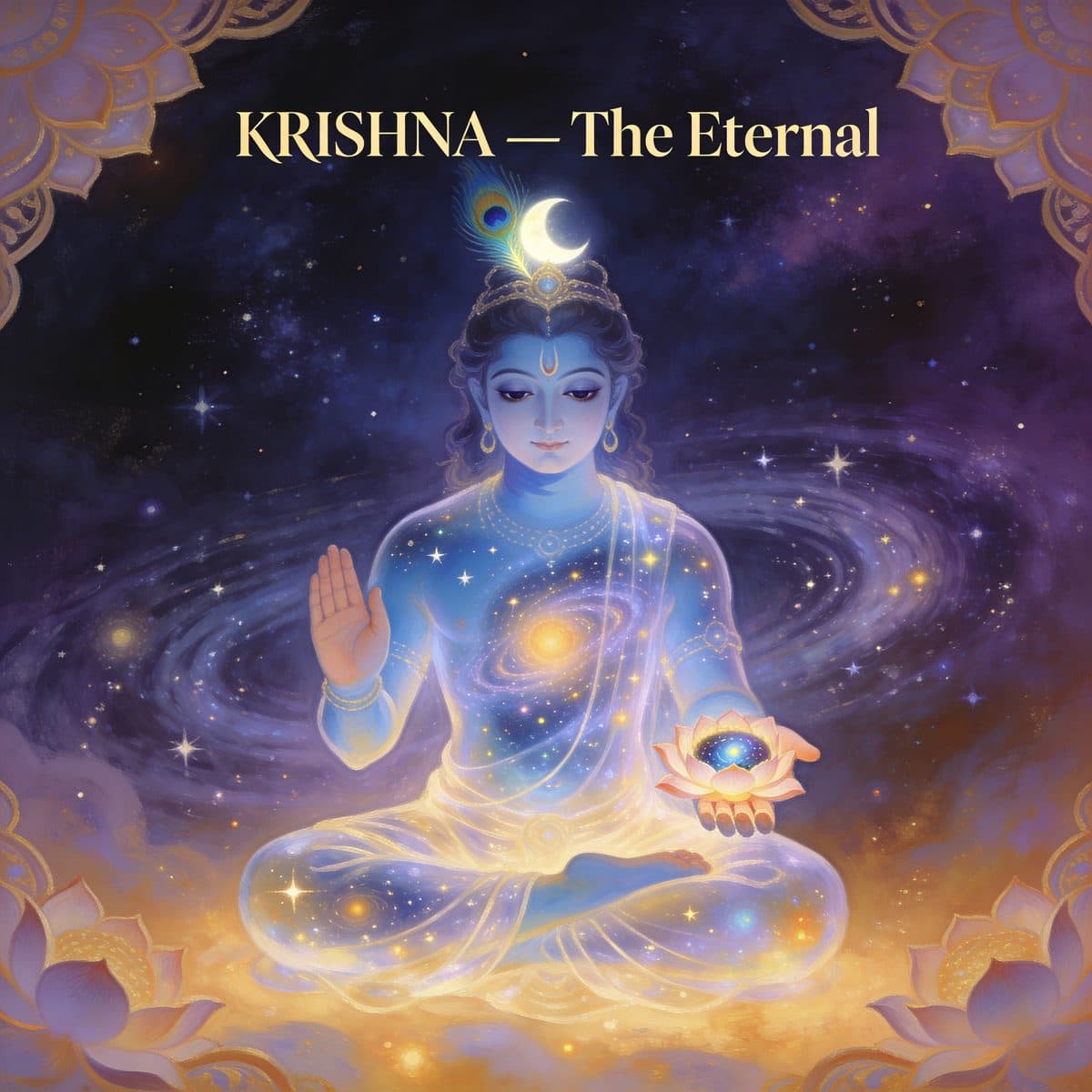
Lord Krishna
Divine TeacherThe Supreme Lord, the charioteer and divine guide of Arjuna. Krishna delivers the eternal wisdom of the Gita, revealing the nature of the soul, duty, and the path to liberation.
Speaking: Chapter 18, Verse 50
Verse 50
The Yoga of Liberation through Renunciation
Learn from me briefly, O son of Kunti, how one who has attained perfection also attains Brahman — the supreme culmination of knowledge.
Context & Meaning
Having described the attainment of naiṣkarmya-siddhi (transcendence from action), Krishna now describes the further journey: from siddhi (perfection) to Brahman (the absolute reality). This progression is important: perfection in the practice of yoga is not the final end — it is the doorway to Brahman. Krishna promises a concise teaching (samāsena — in brief) of the supreme culmination of knowledge (jñānasya yā parā niṣṭhā). The transition from practice to realisation, from the attainment of inner freedom to the recognition of absolute reality — this is what the next several verses will sketch.
Scholar Commentaries
1 commentary · Public domainRamanujacharya
VishishtadvaitaJñānasya yā parā niṣṭhā — the supreme culmination of knowledge. In the Vishishtadvaita reading, this culmination is not an impersonal absorption into featureless Brahman but the soul's arrival at its eternal relationship with Bhagavān — a relationship of love, devotion, and transparency. The knowledge that reaches its culmination is the knowledge of who God is, who the soul is, and the eternal, inseparable relationship between them. This knowledge, when fully realised, is not merely intellectual but experiential — a direct knowing that is simultaneously an eternal loving.