
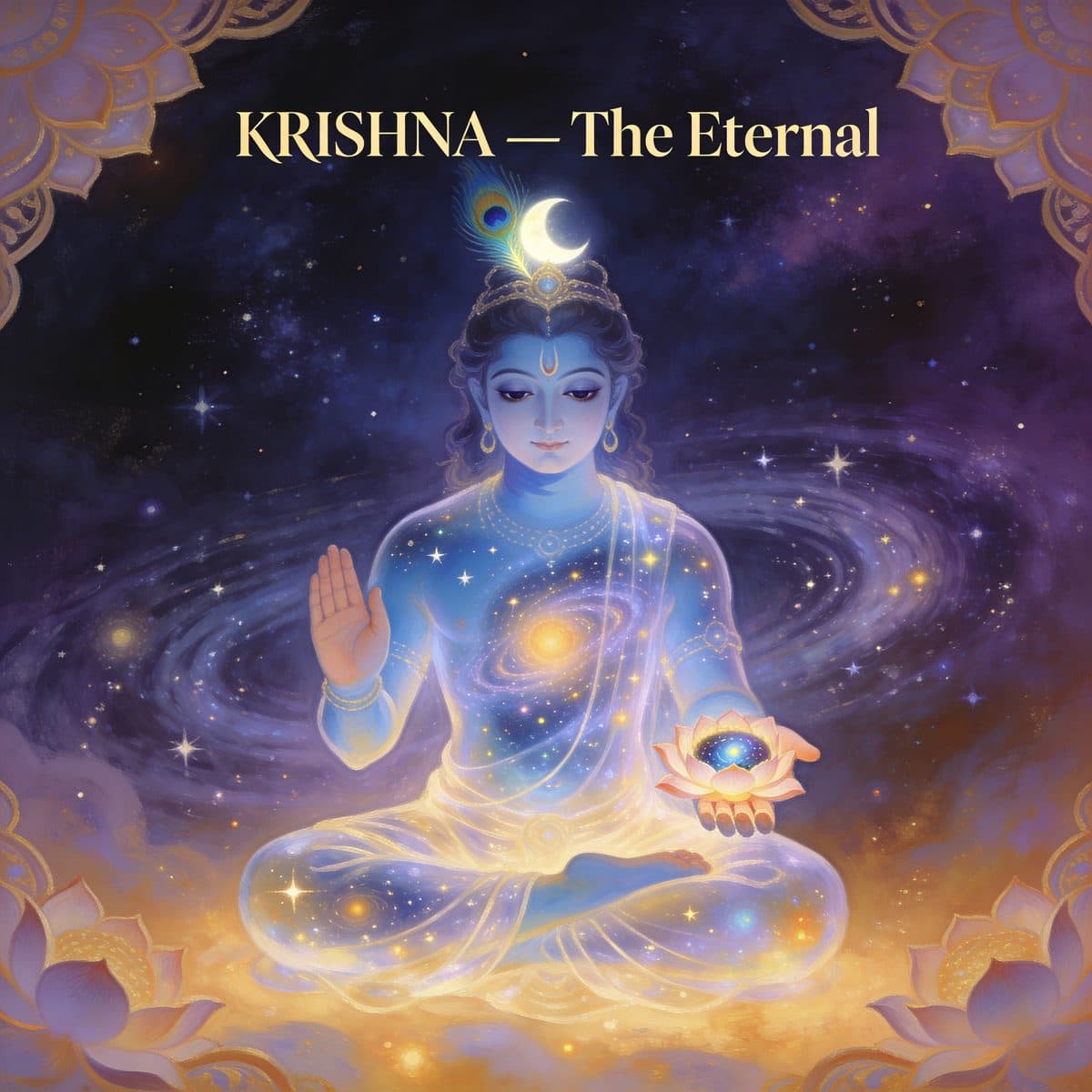
Lord Krishna
Divine TeacherThe Supreme Lord, the charioteer and divine guide of Arjuna. Krishna delivers the eternal wisdom of the Gita, revealing the nature of the soul, duty, and the path to liberation.
Speaking: Chapter 18, Verse 55
Verse 55
The Yoga of Liberation through Renunciation
Through devotion one comes to know me in truth — who and how great I am. Then, knowing me in truth, one enters into me immediately.
Context & Meaning
The final movement: it is through bhakti — devotion — that the ultimate truth of the divine is known. Not through logic alone, not through scriptural study alone, not through meditation technique alone — but through bhakti. This is the Gita's most definitive claim about the epistemology of divine knowledge: God is known through love. The knowledge here is tattvatah — in truth, in reality — not a conceptual approximation but direct knowing. And having known thus, one enters (viśate) immediately: the knowledge and the entry are not separated by any further process. This is the promise of the entire Gita expressed in two lines: know through devotion; enter through knowing.
Scholar Commentaries
1 commentary · Public domainAdi Shankaracharya
AdvaitaBhaktyā māmabhijānāti — through devotion one comes to know me. The Advaita reading accepts the primacy of bhakti at this level not as a contradiction of jñāna but as its highest expression: the knowledge that arises in the state of pure devotion is not conceptual but participatory — it is the knowing of union, of non-separation. The Self knowing the Self, the wave knowing the ocean. Viśate — enters: the entry is not a physical movement but the dissolution of the last veil of separation, the recognition that the devotee and the Beloved have never in reality been apart.