
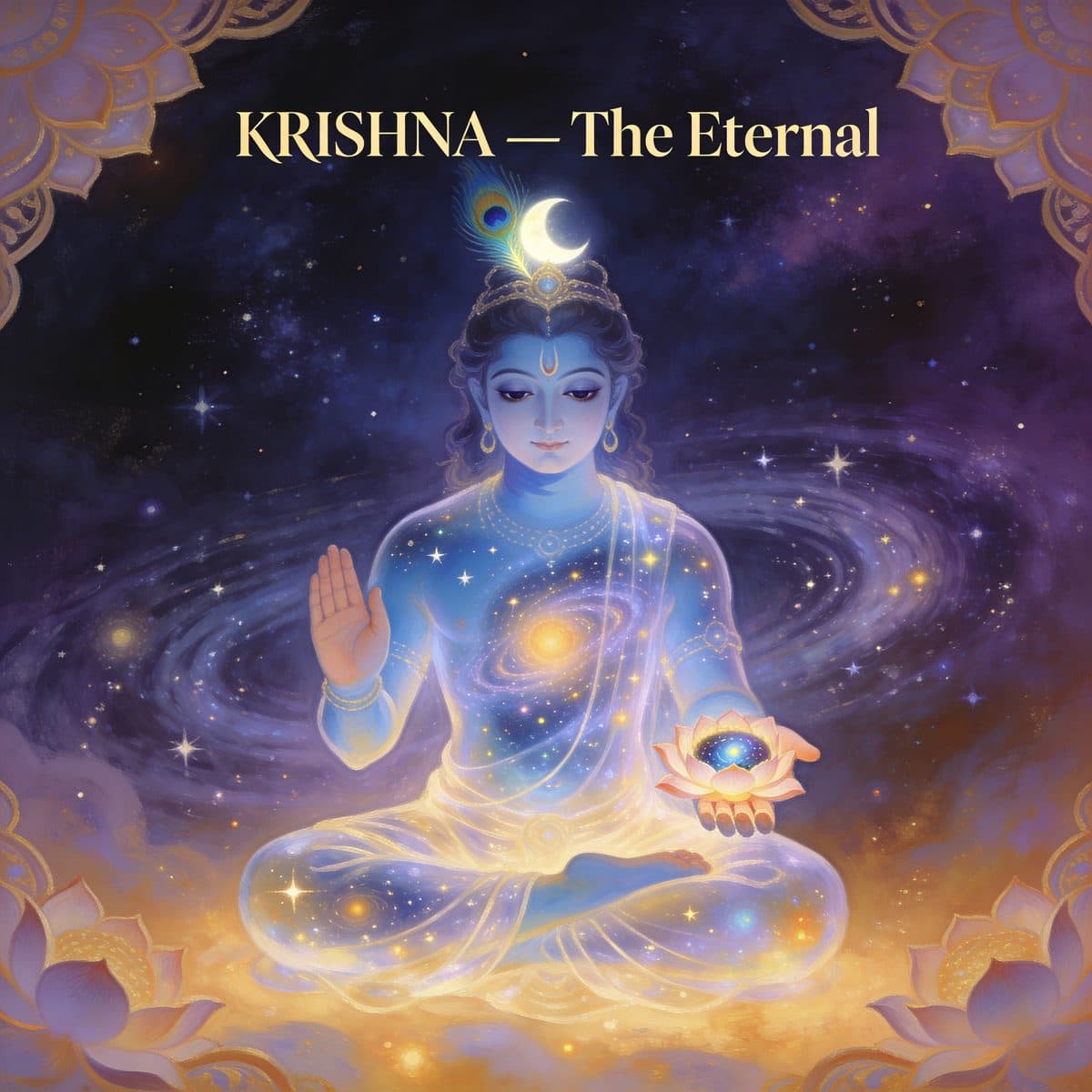
Lord Krishna
Divine TeacherThe Supreme Lord, the charioteer and divine guide of Arjuna. Krishna delivers the eternal wisdom of the Gita, revealing the nature of the soul, duty, and the path to liberation.
Speaking: Chapter 18, Verse 66
Verse 66
Hard VerseThe Yoga of Liberation through Renunciation
Abandon all varieties of dharma and surrender unto Me alone. I shall liberate you from all sinful reactions — do not fear.
Context & Meaning
This is the charama-shloka — the ultimate verse, the verse to which all 700 verses of the Gita have been leading. Three movements: the complete letting go (sarva-dharmān parityajya — abandon all), the complete turning toward (mām ekaṃ śaraṇaṃ vraja — come to Me alone), and the complete assurance (ahaṃ tvāṃ sarva-pāpebhyo mokṣayiṣyāmi mā śucaḥ — I will free you from all sins; do not be afraid). The path is total surrender — not the abandonment of righteous living but the abandonment of self-reliance as the foundation. Every other support is released so that the Lord alone is the ground. And from that ground, the Lord himself acts: I will free you. Not you will free yourself; not effort will free you. I will. The closing words — mā śucaḥ, do not fear — are among the most tender in all of scripture. After the enormity of the instruction, the Lord adds: do not be afraid.
Scholar Commentaries
3 commentaries · Public domainRamanujacharya
VishishtadvaitaSarva-dharmān parityajya — abandoning all dharmas. The Vishishtadvaita tradition holds this verse as the apex of the entire Gita and the supreme statement of prapatti — complete self-surrender to the Lord. Ramanujacharya understood parityajya not as abandoning ethical life but as releasing the sense that one's own effort, merit, or dharma can be the cause of liberation. All paths, all practices, all virtues are surrendered as means and the Lord himself is accepted as both means and end. This is not laziness but the highest activity: the total, deliberate, loving release of the self into divine care. Ahaṃ tvāṃ... mokṣayiṣyāmi — I shall liberate you — is the Lord's unconditional guarantee to the one who surrenders thus. Grace does not merely assist; it accomplishes everything.
Adi Shankaracharya
AdvaitaMām ekaṃ śaraṇaṃ vraja — take refuge in Me alone. The Advaita reading sees this as the final dissolution of the illusion of a separate self that requires separate effort to attain a separate liberation. When the apparent multiplicity of dharmas is released and the one ground is recognised, what remains is already free. The liberation promised is not a future event but the recognition of what is always already the case: the Self is the Lord, the Lord is the Self, and the fear that gave rise to the search was itself the only bondage. Mā śucaḥ — do not grieve — is addressed to the one who feared there was something to lose. There was never anything to lose.
Madhvacharya
DvaitaAhaṃ tvāṃ sarva-pāpebhyo mokṣayiṣyāmi — I shall liberate you from all sins. In the Dvaita tradition, this promise is the bedrock of devotional confidence. It is not that the devotee becomes sinless through their own purification — it is that Vishnu himself removes every obstacle between the surrendered soul and liberation. The word sarva — all — is absolute: no residue of karma, no weight of past, no entanglement of the present survives the Lord's grace when surrender is complete. Mā śucaḥ is therefore not a reassurance but a statement of fact: when one has surrendered to Vishnu, there is nothing left to fear, because the Lord of all is personally attending to the devotee's liberation.