
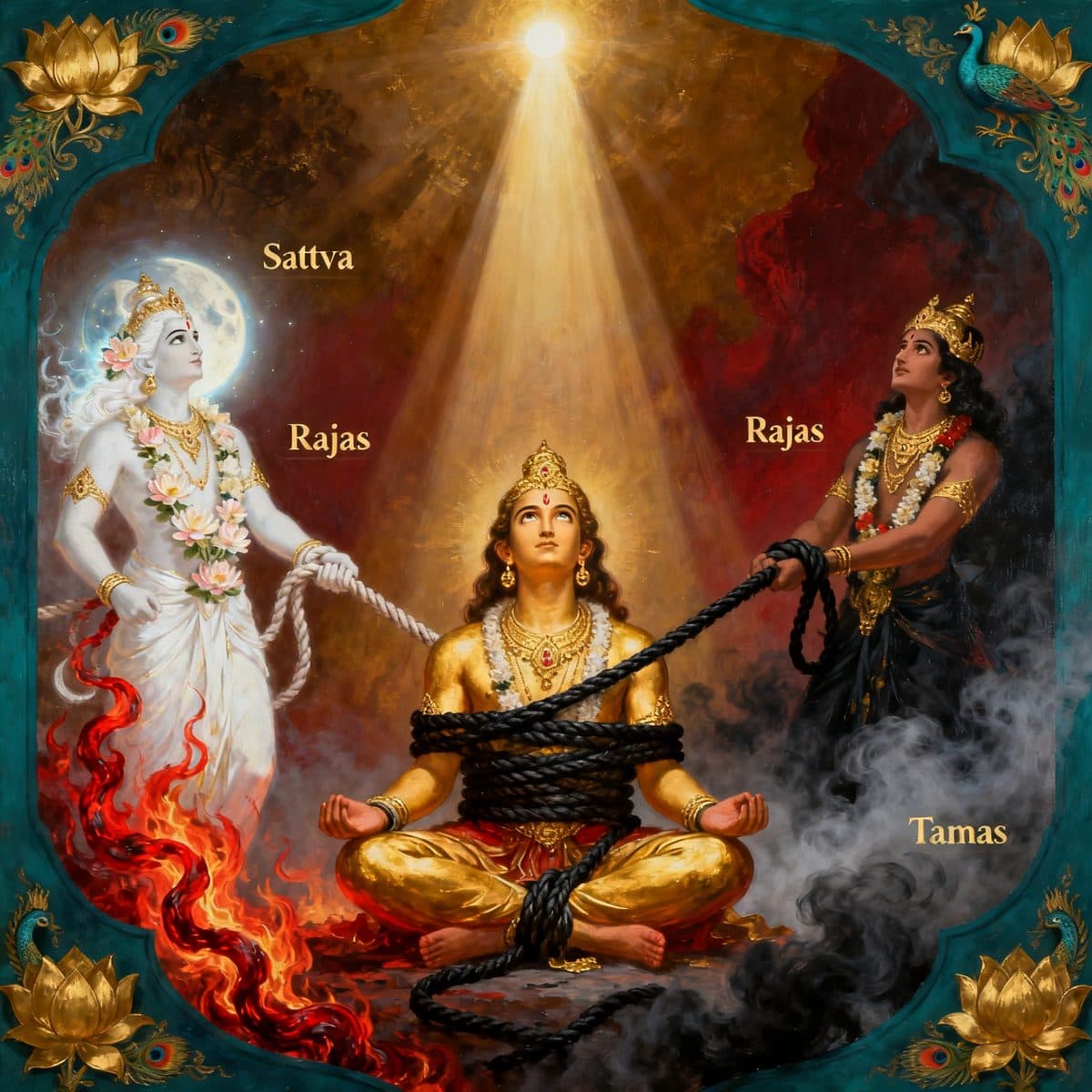
गुणत्रय विभाग योग
The Yoga of the Three Gunas
27 VersesDescription
Krishna explains the three Gunas (modes of material nature)—Sattva (purity), Rajas (passion), and Tamas (ignorance). He describes how these Gunas bind the soul to the body and determine one's nature and actions. He explains the characteristics of each Guna and how one can transcend them to attain the supreme goal.
Location
Kurukshetra Battlefield
Characters
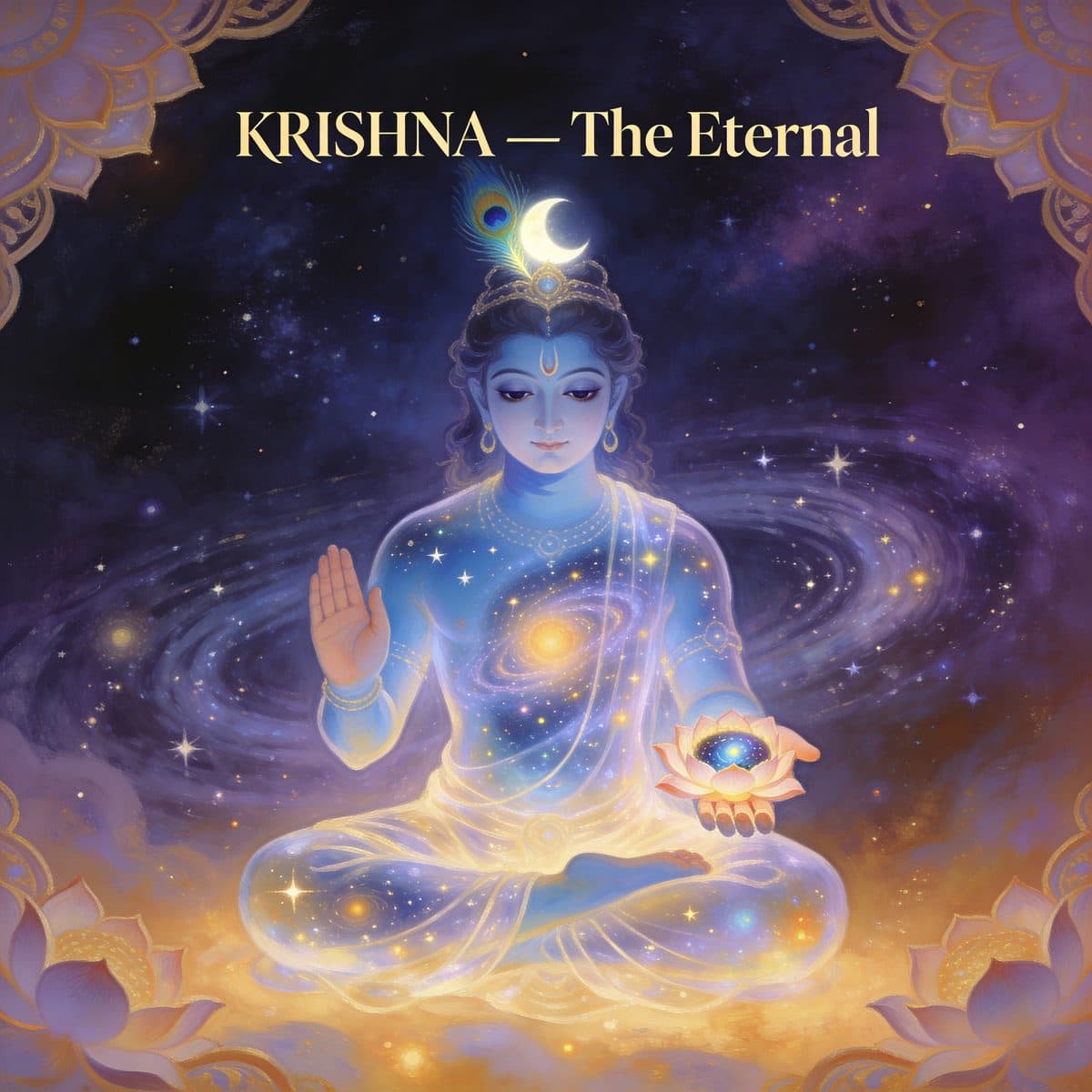
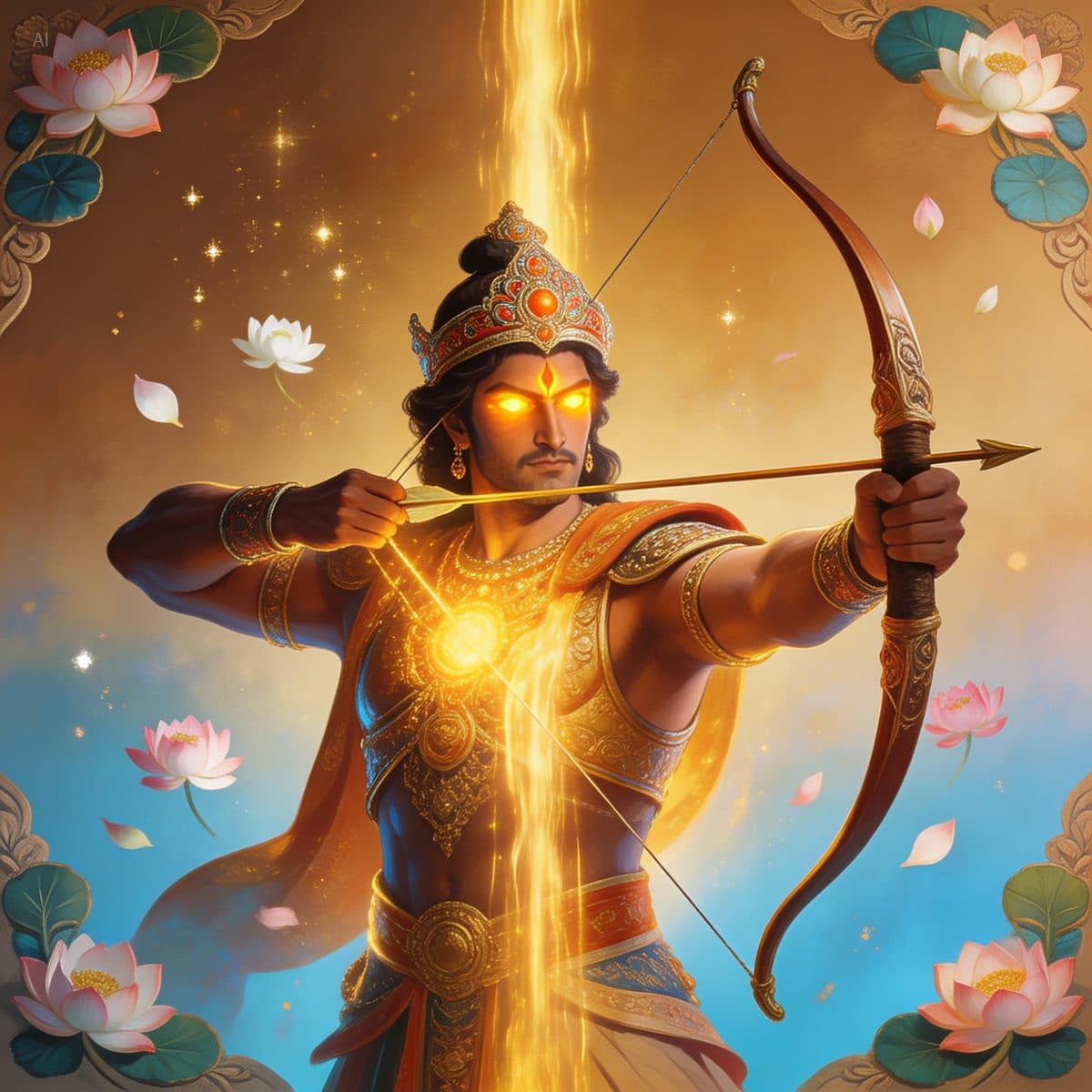
Watch Chapter Discourse
Video coming soon
Add a YouTube URL to the videoUrl field in chapters.ts
Chapter 14 — The Yoga of the Three Gunas
Read Verses
27 of 27 availableThe Supreme Personality of Godhead said: I shall again declare the supreme knowledge, the best of all knowledge, by knowing which all the sages have gone from this world to the highest perfection.
Krishna opens Chapter 14 with a bold declaration: he is about to share the highest of all knowledge — that which, when truly understood, has carried every sage who has ever lived to supreme perfection. The word bhūyaḥ means "again" — this is not an entirely new teaching but a deepening of what has already been shared. Chapter 13 described the field and its knower; Chapter 14 will now explain the mechanism by which the field operates on the knower — the three qualities of nature (guṇas) — and how the knower can rise above them.
By taking refuge in this knowledge and attaining My nature, they are not born again at the time of creation, nor are they disturbed at the time of dissolution.
The fruit of this knowledge is stated immediately: those who truly absorb it attain the nature of God (mama sādharmyam) — and from that elevation, they are untouched by the cosmic cycles of creation and dissolution. They are not re-born at the start of a new universe, nor do they suffer at its end. They have stepped outside the river of time entirely. This is moksha described in its most cosmic dimension: freedom not just from personal suffering but from the entire machinery of manifestation.
My womb is the great Brahman — the total material substance. In that I place the seed of life; from this, O Bharata, the birth of all beings comes about.
Krishna describes the cosmic genesis with an intimate metaphor: the great Brahman — the totality of Prakriti — is the womb, and He places within it the seed of all life. All beings arise from this primordial union. This is not merely cosmology but theology: creation is not a mechanical accident but an act of the Divine placing itself into matter, animating it, making it alive with consciousness. The entire universe is the offspring of this sacred encounter between consciousness and matter.
O son of Kunti, whatever forms are born in all the wombs, the great Brahman is their womb and I am the seed-giving father.
The cosmic principle of the previous verse is here made universal: every living form, in every species, in every womb throughout the universe, is born of this same primordial union. Prakriti is the universal mother; the Divine is the universal father who places the seed of consciousness into her. This is a vision of radical kinship — all beings, however different in form, share the same cosmic parentage. The recognition of this kinship is itself a form of liberation from the illusion of separation.
Sattva, rajas, and tamas — these qualities, born of Prakriti, bind the imperishable soul to the body, O mighty-armed.
The central problem of the chapter is stated: the three guṇas (qualities of nature) — sattva (purity, clarity, light), rajas (passion, activity, agitation), and tamas (inertia, darkness, delusion) — bind the immortal, imperishable soul to the body. The soul itself is avyaya — unchangeable, inexhaustible — yet it becomes bound through these three modes of Prakriti. This is the mystery of bondage: the infinite is bound not by chains but by qualities. Understanding these qualities, their operation, and how to transcend them is the central teaching of this chapter.
Among these, sattva — being pure — is illuminating and free from disease. It binds through attachment to happiness and attachment to knowledge, O sinless one.
The description of sattva: it is the most refined of the three guṇas — pure (nirmala), illuminating (prakāśaka), free from the corruption of disease (anāmaya). Sattva produces clarity of mind, joy, and the love of knowledge. Yet — and this is the crucial paradox — even sattva binds. It binds through attachment to the very happiness and knowledge it produces. The sāttvic person becomes attached to their clarity, their joy, their spiritual insight — and this very attachment keeps them tethered to the cycle of birth and death. Even virtue, when clung to as identity, is a subtle form of bondage.
Know that rajas is of the nature of passion, arising from craving and attachment. O son of Kunti, it binds the embodied being through attachment to action.
Rajas is defined by its essence: rāgātmakam — its very nature is passion, desire, the push toward objects. It arises from tṛṣṇā (thirst, craving) and saṅga (attachment). Where sattva binds through the joy of knowing, rajas binds through the compulsion to do — karma-saṅga, attachment to action and its fruits. The rājasic person cannot rest; they are driven from project to project, desire to desire, achievement to achievement. Even their apparent energy is actually a form of restlessness — the soul mistaking the agitation of Prakriti for aliveness.
Know that tamas, born of ignorance, deludes all embodied beings. It binds through negligence, laziness, and sleep, O Bharata.
Tamas is the densest of the three guṇas: born of ignorance (ajñāna-jam), it produces delusion (mohanam) in all who are subject to it. Where sattva illuminates and rajas agitates, tamas obscures and stupefies. It binds through pramāda (negligence, heedlessness), ālasya (laziness, inertia), and nidrā (excessive sleep or unconsciousness). The tāmasic state is one of forgetting — forgetting one's duties, forgetting one's higher nature, forgetting the very existence of a spiritual dimension to life. It is not rest but oblivion.
Sattva attaches one to happiness, rajas to action, O Bharata. But tamas, covering over knowledge, attaches one to negligence.
A concise summary of the three modes of bondage: sattva draws the soul toward sukha (happiness and wellbeing); rajas draws it toward karma (incessant activity); tamas covers over jñāna (knowledge itself) and draws the soul toward pramāda (heedlessness, negligence, oblivion). The most dangerous of the three is tamas, precisely because it obscures the very capacity for discrimination that would allow the soul to recognise its situation. One cannot easily escape a trap one cannot see.
Sometimes sattva prevails, having overcome rajas and tamas, O Bharata; sometimes rajas prevails over sattva and tamas; and sometimes tamas prevails over sattva and rajas.
The guṇas are not fixed in their relative proportions — they are in constant flux and competition. At any given time, one predominates over the other two. Sattva rises when it overcomes rajas and tamas; rajas prevails when it subdues sattva and tamas; tamas darkens when it overwhelms the other two. This is the dynamic landscape of human consciousness: the inner life as a shifting field where three great forces contend for dominance. Understanding this explains the variability of human mood, motivation, and capacity — and points to the possibility of deliberately cultivating sattva.
When the light of knowledge shines through all the gates of the body, then one should know that sattva has increased.
The first of three diagnostic signs by which one can recognise the prevailing guṇa. When sattva is dominant, a light of knowledge (prakāśa — illumination, clarity) shines through all the gates of the body — the senses, the mind, the intellect. Everything becomes clearer: perception is sharper, understanding deeper, emotions more settled. The sāttvic state is recognisable by this quality of inner luminosity — the sense that one can see things as they are, without the distortion of desire or the fog of confusion.
When rajas increases, O best of the Bharatas, greed, outward activity, undertaking of actions, restlessness, and longing arise.
The signs of prevailing rajas: lobha (greed, the hunger for more), pravṛtti (outward orientation, engagement with the world), ārambha (the constant initiating of new projects), aśama (restlessness, inability to be still), and spṛhā (longing, the perpetual reaching toward what is not yet possessed). The rājasic state is recognisable by its feverish quality — a compulsion to act, acquire, achieve, and accumulate that cannot find rest even in attainment. The moment one desire is satisfied, another rises to take its place.
When tamas increases, O son of the Kurus, darkness, inactivity, negligence, and delusion arise.
The signs of prevailing tamas: aprakāśa (darkness, the absence of inner light), apravṛtti (inactivity, withdrawal from appropriate engagement), pramāda (negligence, heedlessness toward one's duties and opportunities), and moha (delusion, confusion about what is real and what matters). The tāmasic state is the opposite of both the illuminated sāttvic state and the energised rājasic state — it is characterised by a heaviness, a fogginess, a kind of living unconsciousness. Things that matter do not register; effort feels impossible; the horizons of possibility contract.
If the embodied one meets death when sattva prevails, then one attains the pure realms of those who know the highest.
The guṇas determine not just the quality of life but the quality of death and rebirth. One who dies in a state of sattva — of inner clarity, purity, and luminosity — attains the luminous realms of the great knowers of truth. The state at the moment of death is not arbitrary; it is the culmination of a lifetime of cultivation. The sāttvic death is a natural fruit of a sāttvic life — a life oriented toward truth, clarity, and spiritual understanding gathers, at its close, the corresponding quality of experience and destination.
Dying in rajas, one is born among those attached to action; dying in tamas, one is born in the wombs of the deluded.
The parallel fates of rājasic and tāmasic deaths: one who dies in rajas — in a state of passion, desire, and agitation — is born into circumstances that perpetuate that orientation, among people similarly absorbed in action and its fruits. One who dies in tamas — in delusion, heaviness, and unconsciousness — is born into circumstances even further from clarity, into what the verse calls mūḍha-yoni, the wombs of the deluded. The continuity of karma is not punishment but logical consequence: the quality of consciousness at death determines the quality of the next life's starting conditions.
The fruit of good action is said to be pure and sāttvic; the fruit of rājasic action is suffering; and the fruit of tāmasic action is ignorance.
The three guṇas produce different fruits in their corresponding actions. Sāttvic action — done with clarity, without selfish desire, in alignment with dharma — yields pure fruit: clarity, peace, and progress toward liberation. Rājasic action — driven by desire and passion — yields duḥkha (suffering, frustration, the endless hunger of desire that is never finally satisfied). Tāmasic action — born of confusion and negligence — yields only deeper ajñāna (ignorance), a further thickening of the veil over consciousness.
From sattva, knowledge arises; from rajas, greed; from tamas come negligence and delusion, and ignorance as well.
The direct psychological offspring of each guṇa: sattva generates jñāna (knowledge, understanding, wisdom); rajas generates lobha (greed, the compulsive hunger for more); tamas generates pramāda (negligence), moha (delusion), and ajñāna (ignorance). This gives a diagnostic tool of great power: look at what is arising in the mind — clarity or craving or confusion — and you can identify which guṇa is currently dominant. And knowing which guṇa dominates, you know what to do: strengthen sattva, restrain rajas, dispel tamas.
Those established in sattva rise upward; those in rajas remain in the middle; those abiding in the lowest quality — tamas — go downward.
A vertical cosmology of the guṇas: sattva leads upward (toward higher states of being, toward liberation); rajas keeps one in the middle (in the ordinary human world of striving and partial satisfaction); tamas pulls downward (toward denser births, heavier states of consciousness). The direction of one's existence is set by the quality one predominantly inhabits. This is not fatalism — it is a map of the forces at work — and the entire teaching of the Gita is about how to orient one's movement upward, and ultimately beyond even the highest of the three.
When the seer perceives no doer other than the guṇas, and knows what is beyond the guṇas — that one attains My nature.
The liberating insight: when the witness (draṣṭā — the seer) clearly perceives that all action is performed by the guṇas alone — that there is no doer other than the three modes of Prakriti — and when they also know what is beyond the guṇas (the pure witnessing consciousness that is unaffected by them), then they attain the divine nature. The two parts of the insight are inseparable: one must see that the guṇas are the doers (dissolving ego-doership) AND that pure awareness transcends all three (revealing the true self as the witness).
Having transcended these three guṇas that are the source of the body, the embodied soul is freed from birth, death, old age, and suffering, and attains immortality.
The promise at the heart of the chapter: transcend the three guṇas — which are the very source and substance of embodied existence — and one is freed from the entire cycle of janma (birth), mṛtyu (death), jarā (old age), and duḥkha (suffering). Amṛtam aśnute — one tastes immortality. Not merely a better rebirth, not merely a more pleasant existence within the cycle, but the complete cessation of the cycle itself. This is the destination that the entire teaching of the guṇas points toward: not the improvement of life within the three modes, but the transcendence of the three modes altogether.
Arjuna said: O Lord, by what signs is one who has transcended these three guṇas known? What is their conduct? And how does one transcend these three guṇas?
Arjuna's question is threefold and entirely practical: How do we recognise a guṇātīta — one who has transcended the three guṇas? How do they behave in the world? And how does one actually achieve this transcendence? These are among the most important questions in the entire Gita, because they bring the abstract metaphysics of the guṇas into the domain of lived experience and practical path. The answer that follows (verses 22–26) is one of the most memorable portraits of the liberated person in world spiritual literature.
The Supreme Lord said: O Pandava, one who does not hate illumination, activity, or delusion when they arise, nor craves for them when they cease—
Krishna begins his description of the guṇātīta — the one who has transcended the guṇas — and it opens with a striking non-reaction: this person neither hates the guṇas when they arise (illumination of sattva, the activity of rajas, the confusion of tamas) nor craves them when they cease. The enlightened person is not someone who has permanently eliminated rajas and tamas from their experience — those forces still operate in Prakriti. What has changed is the relationship to them: no aversion when they come, no craving when they go. This non-reactive witness-stance is the signature of transcendence.
One who sits as if unconcerned, who is not disturbed by the guṇas, who remains steady knowing that the guṇas alone are acting — who does not waver—
The guṇātīta is described as udāsīnavad — sitting as if neutral, as if uninvested. Not actually indifferent to the world, but inhabiting a position of inner non-reactivity. They are not disturbed (na vicālyate) by the play of the guṇas, and they remain anchored in the knowledge: "the guṇas alone are acting" (guṇā vartante iti). This knowing — that it is Prakriti doing everything through the body-mind, while the true Self merely witnesses — is not a philosophical position they temporarily adopt. It is a constant, lived reality from which they do not waver (na iṅgate).
Equal in pleasure and pain, self-contained, seeing a clod, a stone, and gold as the same; equal toward the pleasant and unpleasant, steady, equal in blame and praise—
The portrait of the guṇātīta deepens with a series of equalities that span the entire range of human valuation. Equal in pleasure and pain (sama-duḥkha-sukha). Self-abiding, resting in the Self (svastha — literally, "situated in one's own nature"). Seeing a clod of earth, a stone, and gold as equally real — equally products of Prakriti, equally impermanent (sama-loṣṭāśma-kāñcana). Equal toward the pleasant and the unpleasant (tulya-priyāpriya). Steady, wise (dhīra). Equal in blame and praise (tulya-nindātmasaṃstuti). These are not cultivated attitudes — they are natural expressions of one who has found their identity beyond all of Prakriti's fluctuations.
Equal in honour and dishonour, equal toward friend and foe, having renounced all personal undertakings — that one is said to have transcended the guṇas.
The final attributes of the guṇātīta: equanimity in honour and dishonour (māna-apamāna) — the opinion of others neither inflates nor deflates; equanimity toward friend and enemy (mitra-ari-pakṣa) — the same warm awareness meets all without the partitioning of preference; and sarvārambha-parityāgī — the renunciation of all personal undertakings, meaning action without the ego's signature of ownership and agenda. This is the person. Sa guṇātītaḥ ucyate — this one is called the transcender of the guṇas. Not someone who has escaped the world, but someone who lives in the world with a freedom the world cannot disturb.
And one who serves Me with unwavering devotion, transcending all these guṇas, becomes worthy of attaining Brahman.
Having described who the guṇātīta is and what they look like, Krishna now reveals how one becomes one: avyabhicāreṇa bhakti-yogena — through unwavering, exclusive devotion. This is the means of transcendence Arjuna asked about in verse 21. The path through and beyond the guṇas is not a technique of willpower or philosophical discipline alone — it is the path of love. One who loves God without wavering, serving with steady devotion, transcends all three guṇas and becomes worthy of realising Brahman. Bhakti, here, is not the emotional expression of a lower stage — it is the supreme means to the highest goal.
For I am the foundation of Brahman — the immortal, the imperishable; of eternal dharma; and of absolute, unending bliss.
The chapter's final verse is one of the most majestic in the entire Gita — a declaration of the ultimate ground. Krishna declares Himself to be the very foundation (pratiṣṭhā) of Brahman — of what is immortal and imperishable (amṛtasya avyayasya), of eternal dharma (śāśvatya dharma), and of absolute bliss (sukhasya aikāntikasya — the unambiguous, undiluted happiness that is not mixed with suffering). Even Brahman — the supreme impersonal Absolute — rests on Krishna as its foundation. This is the Gita's deepest metaphysical claim: beyond the impersonal Absolute stands the personal Divine as its innermost ground and support.
Key Teachings
- •The three Gunas bind the soul to matter
- •Sattva leads to knowledge, Rajas to action, Tamas to delusion
- •Transcending the Gunas leads to liberation