
पुरुषोत्तम योग
The Yoga of the Supreme Person
20 VersesDescription
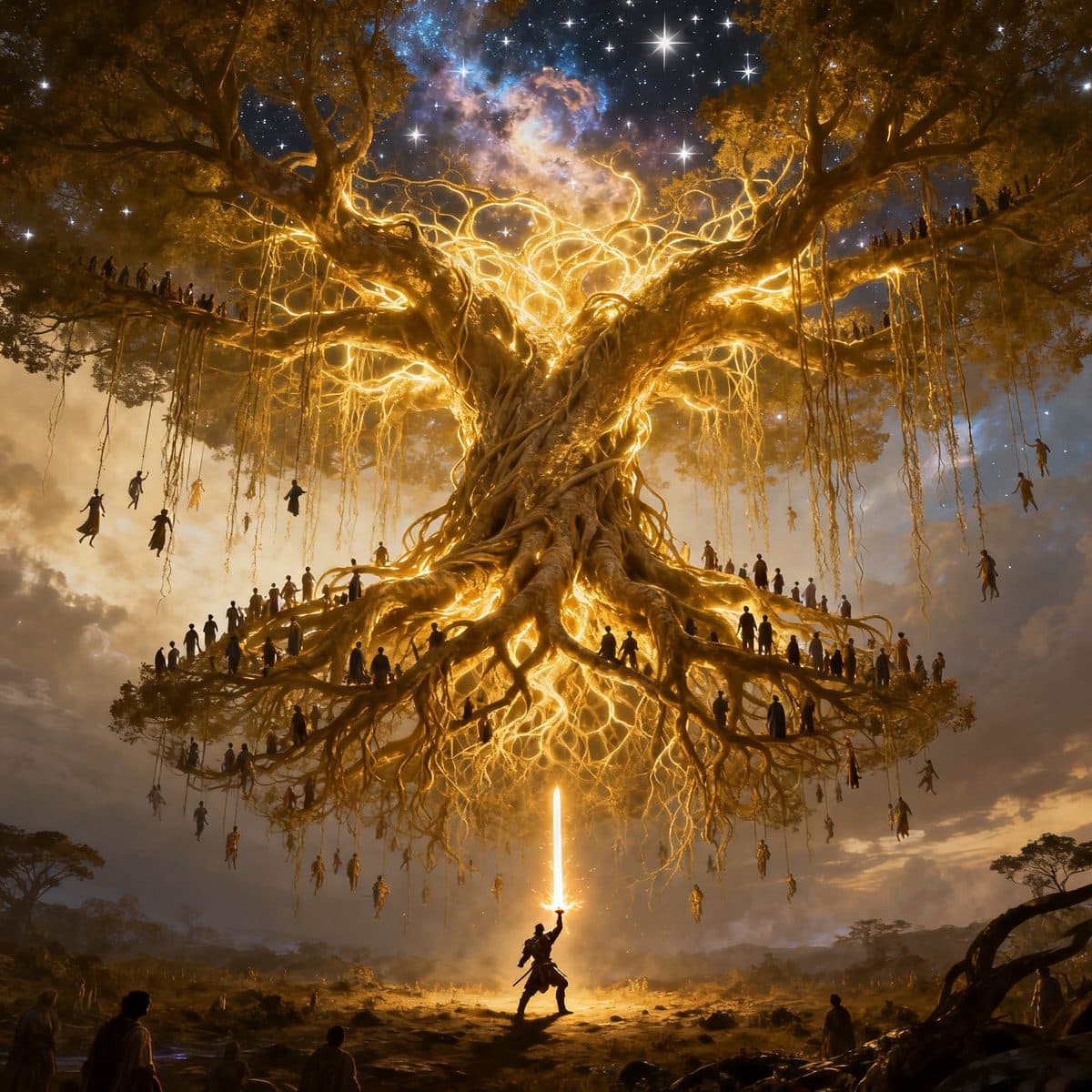
Krishna uses the metaphor of an upside-down banyan tree to describe the material world, with roots above (in the spiritual realm) and branches below (the material world). He explains that the axe of detachment must cut this tree to attain liberation. He reveals himself as the Purushottama (Supreme Person), beyond both the perishable and the imperishable.
Location
Kurukshetra Battlefield
Characters
Watch Chapter Discourse
Video coming soon
Add a YouTube URL to the videoUrl field in chapters.ts
Chapter 15 — The Yoga of the Supreme Person
Read Verses
20 of 20 availableThe Supreme Lord said: The wise speak of an imperishable Ashvattha tree with its roots above and branches below, whose leaves are the Vedic hymns. One who knows this tree is a knower of the Vedas.
Krishna opens Chapter 15 with one of the Gita's most arresting images: the cosmic Ashvattha tree — the sacred fig, symbol of eternal life — growing upside down. Its roots are above, in the Supreme; its branches spread downward into the manifested world. The Vedic hymns are its leaves — protective, nourishing, beautiful, but not the trunk or the root. To know this tree — to understand that the entire universe is an inverted reflection of a higher reality — is the beginning of true Vedic knowledge. This is not botanical metaphor alone; it is a map of consciousness. The nourishment flows downward from the Divine; the seeker must trace it upward to its source.
Its branches spread below and above, nourished by the three qualities of nature, with sense objects as its twigs. Below, in the world of humans, its roots extend downward, bound to action.
The cosmic tree's anatomy is detailed: branches both above and below, all nourished by the three gunas — sattva, rajas, and tamas. The twigs are the sense objects, those small attractive terminals that draw living beings outward and downward. And here is the critical insight: in the human world, there are secondary roots growing downward — the roots of karma, of action bound to desire. Every attachment we form, every action driven by craving, sends another root deeper into the material soil, binding us further. The tree is not evil; it is the structure of samsara itself — endlessly self-reinforcing unless the original root above is recognised and the secondary roots below are severed.
The real form of this tree is not perceived here, nor its end, nor its beginning, nor its foundation. Having cut down this deeply rooted Ashvattha tree with the strong sword of non-attachment —
This is the axe verse — a turning point. The tree of samsara cannot be seen clearly from within it. Standing among its branches, we cannot perceive its true form, its beginning, its end, or where it is truly rooted. The entire structure of the conditioned world is opaque to the conditioned mind. What then is the solution? Not analysis, not clever doctrine — but the sword of non-attachment (asanga). Asanga means non-clinging, non-adhesion — the inner freedom of one who engages fully with life without being captured by it. This sword must be dṛḍha — firm, unwavering. Half-hearted detachment merely prunes the tree; firm non-attachment severs it at the root.
Then that supreme abode must be sought from which, having gone, one does not return again. One should take refuge in that Primal Person from whom the ancient stream of creation has flowed.
Having cut the tree with non-attachment, what then? This verse gives the direction: seek the supreme abode — that state from which there is no return to samsara. But this is not a place to find with coordinates; it is the Primal Person (Ādi Puruṣa), the original source from which all of existence has flowed since before time. The path is prapadye — complete surrender, taking refuge. This is not a resignation but a homecoming: returning to the source from which the ancient stream of creation first arose. The seeker who has severed attachment finds, in that very freedom, the pull toward the origin — the Divine Person who was always the root of the tree.
Free from pride and delusion, having conquered the fault of attachment, ever dwelling in the Self, with desires fully withdrawn, liberated from the pairs of opposites such as pleasure and pain — the undeluded reach that imperishable abode.
Here Krishna paints the portrait of one who reaches the imperishable abode. Five qualities mark them: free from pride and delusion (the ego's twin illusions); having overcome the defect of attachment; continuously established in the Self (adhyātma-nitya — not occasional meditation but a steady orientation of consciousness); desires fully withdrawn from objects; and liberated from the pairs of opposites — pleasure and pain, heat and cold, honour and dishonour — those forces that pull the ordinary mind like tides. Such a person, described as amūḍha (undeluded, clear-sighted), moves naturally toward the imperishable. It is not effort that takes them there; it is the natural movement of a mind no longer dragged away from itself.
Neither the sun illuminates it, nor the moon, nor fire. That is My supreme abode, having reached which one does not return.
This is perhaps the most luminous verse of Chapter 15. The supreme abode of God requires no external light — not the sun, not the moon, not fire. Why? Because it is itself the source of all light. The sun shines by the light of Brahman; the moon reflects it; fire burns with it — but none of them can illuminate that from which all light ultimately derives. This paradox — that the brightest thing cannot be seen by any lamp — points to the nature of pure consciousness. It is self-luminous (svayaṃ-jyoti), known not by another light but by itself. And from that abode, once reached, there is no return: not because it is a place that traps, but because the seeker has finally arrived at what they always, at the deepest level, already were.
An eternal portion of Me alone becomes the individual soul in the world of the living. Drawing to itself the six senses including the mind, which abide in Prakriti.
This verse contains one of the Gita's most intimate revelations: the individual soul (jīva) is an eternal portion (sanātana aṃśa) of God Himself. Not a temporary emanation, not an illusion, not a mechanical product of matter — but an eternal fragment of the Divine. Yet in taking embodied form, this fragment draws to itself the six senses — the five senses plus the mind — which belong to Prakriti (nature). The result is the familiar human experience: a divine spark dressed in a natural instrument, pulled in multiple directions, often forgetting its own origin. This verse is a diagnosis of the human condition: divine in nature, but obscured by the machinery of sense and mind that the soul has, in some sense, chosen to operate.
When the Lord — the individual soul — takes on a body and when he departs from it, he takes these senses along with him, as the wind carries fragrances from their source.
Death and rebirth are here described with a simple, beautiful precision. When the individual soul (called īśvara here — the lord of the body, the inner governor) migrates from one body to another, it takes the senses with it — just as the wind, passing through a garden, carries the fragrance of flowers from one place to another. The wind itself has no fragrance; the flower has no mobility. But together they create the momentary presence of fragrance far from its source. So too, the soul itself is formless and free; the senses are rooted in matter. But in transit, the soul carries the subtle impressions of its senses into the next embodiment — which is why tendencies, memories, and character persist across lives.
Presiding over the ear, the eye, the sense of touch, the sense of taste, and the sense of smell, as well as the mind, this soul experiences the objects of the senses.
Krishna continues the account of embodied experience: the soul, seated as the inner witness, presides over the five senses and the mind, through which it experiences the world of objects. The word adhiṣṭhāya — "presiding over" — is important. The soul does not become the senses; it presides over them, as a king presides over his officers without being identical to any of them. Yet in ordinary experience, this distinction is forgotten — the presider becomes so absorbed in the reports of the senses that it takes itself to be the sensor. This forgetting is the root of bondage. Remembering the distinction — even briefly, even imperfectly — is the beginning of liberation.
The deluded do not perceive the soul as it departs, abides, or experiences, imbued with the qualities of nature. But those with the eye of knowledge see it.
Two kinds of eyes are described here — the ordinary eye of sense, which sees only the gross surface of things, and the eye of knowledge (jñāna-cakṣus), which perceives the deeper reality. The deluded (vimūḍha — those thoroughly lost in illusion) cannot see the soul as it departs the body at death, as it inhabits the body during life, or as it experiences the world filtered through the gunas. These events — the most significant events of existence — are entirely invisible to the sensory eye. But the one who has cultivated inner discernment, who has trained the inward gaze, perceives the soul operating beneath all of life's apparent surfaces. This is the purpose of spiritual practice: not to acquire new experiences, but to develop new sight.
The striving yogis perceive this soul seated within the Self. But those of impure heart, though striving, do not perceive it — the unintelligent.
Effort is not sufficient by itself — a remarkable and honest teaching. The striving yogis (yatanto yoginaḥ) do perceive the soul established within the Self. But others who also strive — called akṛtātmana (those of uncultivated or unpurified self) and acetasa (those without true inner intelligence) — do not perceive it, despite their efforts. The implication is sobering: it is possible to practice sincerely and still miss the target, because the obstacle is not lack of effort but impurity of heart (akṛta-ātmā). The cultivation of the self — through ethical living, surrender, devotion, and the washing away of self-deception — is what makes the soil fertile for perception. Effort without inner purification is like water poured on stone.
Know that the light in the sun that illuminates the entire world, the light in the moon, and the light in fire — that light is Mine.
After establishing the supreme abode as self-luminous (verse 6), Krishna now reveals himself as the source of all the light that does exist in the manifest world. The light of the sun that illuminates all creation, the soft light of the moon that governs tides and moods, the heat and light of fire that sustains life — all of it is the effulgence of the Divine flowing through these cosmic instruments. This is not pantheism — God is not the sun. Rather, the sun is a focused expression of God's light, as a lamp is an expression of electricity. To see the sun and be moved by its beauty is, for the person of wisdom, to see a ray of the Divine. The entire phenomenal world is a theophany — a showing-forth of God.
Entering the earth, I sustain all beings with My energy. Becoming the moon, the essence of sap, I nourish all plants.
The divine presence is not only cosmological but ecological. Krishna reveals himself as the sustaining force within the earth itself — the energetic substrate that holds the physical world together and upholds all beings upon it. And becoming the moon (soma), the principle of lunar moisture and vital sap (rasa), he nourishes every plant. Ancient Indian understanding saw the moon as the nourisher of vegetation through the vital fluid it infuses into plants — rasa, meaning sap, taste, essence, joy. God is not only the light above but the sap below, running through the tissues of the living world. This is a vision of radical divine immanence: the sacred is not elsewhere but flowing through every root, every stem, every leaf.
Becoming the fire Vaishvanara, I dwell in the bodies of living beings. United with the upward and downward pranas, I digest the four kinds of food.
God's immanence now enters the body itself. Vaishvanara is the digestive fire — the sacred fire of metabolism that converts food into life. In every living body, it is God who digests, who transforms the four kinds of food (chewed, swallowed, licked, and drunk) into the energy that sustains consciousness. The prāṇa (upward breath) and apāna (downward breath) work together to support this internal fire. This teaching dissolves the boundary between the sacred and the biological: every meal is a yajña — a sacred fire-offering — because it is God within who accepts the offering and transforms it into life. Eating, breathing, metabolising are not merely animal functions; they are divine operations conducted within each living body.
And I am seated in the hearts of all. From Me come memory, knowledge, and their loss. I alone am to be known by all the Vedas. I am the author of Vedanta, and I am the knower of the Vedas.
This is the summit of the chapter's vision of divine immanence. God sits in the heart (hṛdi sanniviṣṭaḥ) of every being — not as an abstract concept but as an actual inner presence. From Him come memory and knowledge — and also their withdrawal. This includes spiritual illumination: it is granted by grace, and its apparent absence is also governed by grace. Then an extraordinary claim: He alone is the true subject of all the Vedas. The vast scriptural literature — all its ritual prescriptions, hymns, and philosophy — has one ultimate referent: Him. He is both the author of Vedanta (the culminating philosophy of the Upanishads) and the knower of the Vedas. God wrote the scripture, and God alone fully understands it. Between these two facts lies the humility required of every student.
There are two persons in this world — the perishable and the imperishable. All beings are the perishable; that which stands immovably at the summit is called the imperishable.
Krishna introduces the philosophical framework for the chapter's climactic teaching. Two great categories of existence: the kṣara (perishable) — all embodied beings, all manifestations that come into form and pass away — and the akṣara (imperishable) — the unmanifest, the kūṭastha, the one who stands unmoved at the summit of all existence, like an anvil on which all change is hammered without itself being deformed. This second category is often understood as māyā-śakti or the unmanifest Prakriti — the totality of the potential from which all manifestation arises. Both are real; both are categorically distinct. But there is a third category — beyond both — which this teaching is building toward.
But the highest Person is another — called the Supreme Soul (Paramatman), the inexhaustible Lord who, pervading the three worlds, sustains them.
Here is the pinnacle: there is a third, beyond both the perishable and the imperishable — the Uttama Puruṣa, the Highest Person, called Paramātmā. He pervades all three worlds (the waking, dreaming, and deep sleep states; or the material, subtle, and causal planes) and sustains them all. He is avyaya — inexhaustible, undepleted by the act of sustaining all of creation. The two previous categories — the changing world of beings and the unchanging matrix of the unmanifest — both rest within Him and are sustained by Him. He is not a third option between the two; he is the ground that contains and surpasses both. This is the Purushottama — the Supreme Person — whose introduction gives the chapter its name.
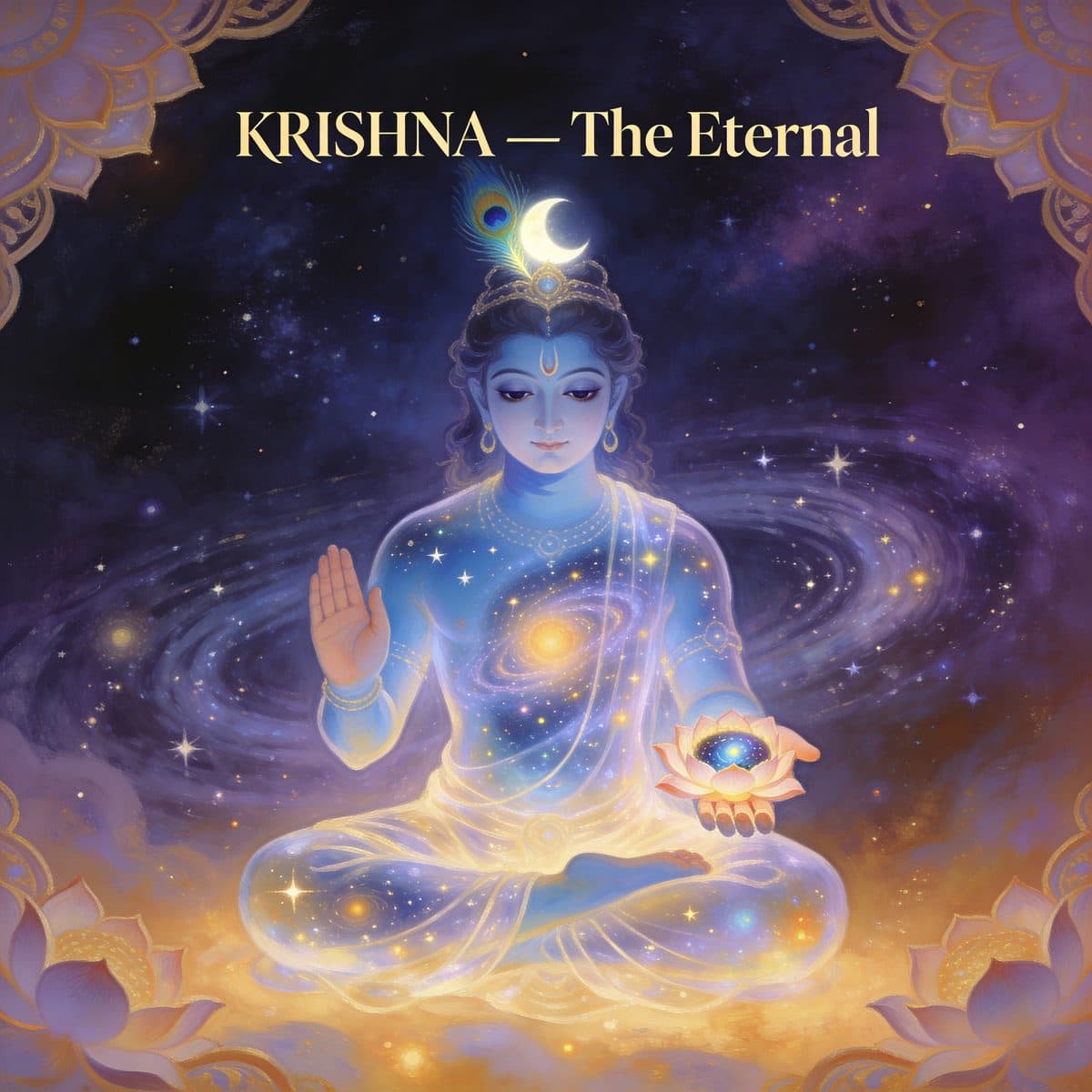
Since I transcend the perishable and am even higher than the imperishable, I am celebrated in the world and in the Vedas as the Purushottama — the Supreme Person.
Krishna now explicitly identifies himself with the Uttama Puruṣa of the previous verse. He transcends both the kṣara (the entire world of changing phenomena) and the akṣara (the unmanifest, immovable substratum) — and because of this dual transcendence, he is known throughout the world and throughout the Vedas as Purushottama — the Supreme among all Persons, the One who is highest. This is the name the chapter earns: Purushottama Yoga, the yoga of knowing, and surrendering to, the Supreme Person. The entire architecture of the inverted tree, the cosmic light, the divine presence in earth and body and heart — all of it has been leading to this self-revelation: Krishna as Purushottama, the ultimate reality behind all appearances.
O Bharata, whoever, free from delusion, thus knows Me as the Supreme Person — that one, all-knowing, worships Me with their whole being.
The fruit of this knowledge is total worship — sarvabhāvena bhajati — worshipping with the whole being, with every mode of consciousness. This is not the worship of one who knows a doctrine; it is the natural, total response of a being who has truly seen the Supreme Person. The qualification is asammūḍha — free from delusion, unclouded by the maya that causes the conditioned mind to miss what is most obvious. Such a person is sarvavid — all-knowing, not because they have memorised everything, but because they know the One from whom all knowledge flows. To know God is to be oriented correctly toward all of reality; that orientation is itself a form of omniscience. And from that knowing, worship — love, service, surrender — arises naturally, as flowers turn toward the sun without being commanded to.
Thus, O sinless one, I have declared the most secret teaching. Understanding this, one becomes truly wise and has fulfilled all that is to be done, O Bharata.
The chapter closes with a seal of completion. Krishna calls this teaching the most secret of all scriptures (guhyatamaṃ śāstram) — not because it is hidden from seekers, but because its depth cannot be fathomed by the superficial mind, and its truth cannot be extracted by mere intellect without inner preparation. He addresses Arjuna as anagha — sinless, pure — recognising the readiness of the one who receives this gift. And the fruit: one who understands this becomes buddhimān (truly wise) and kṛtakṛtya (one who has done all that needed doing). There is nothing left to accomplish, no further scripture to master, no further practice to perform. The one who knows the Purushottama has arrived at the end of all seeking — not because they have stopped living, but because they have found, within life itself, the ground that nothing can disturb.
Key Teachings
- •The material world is like an inverted tree
- •Detachment is needed to cut through illusion
- •The Supreme Person is beyond both perishable and imperishable