
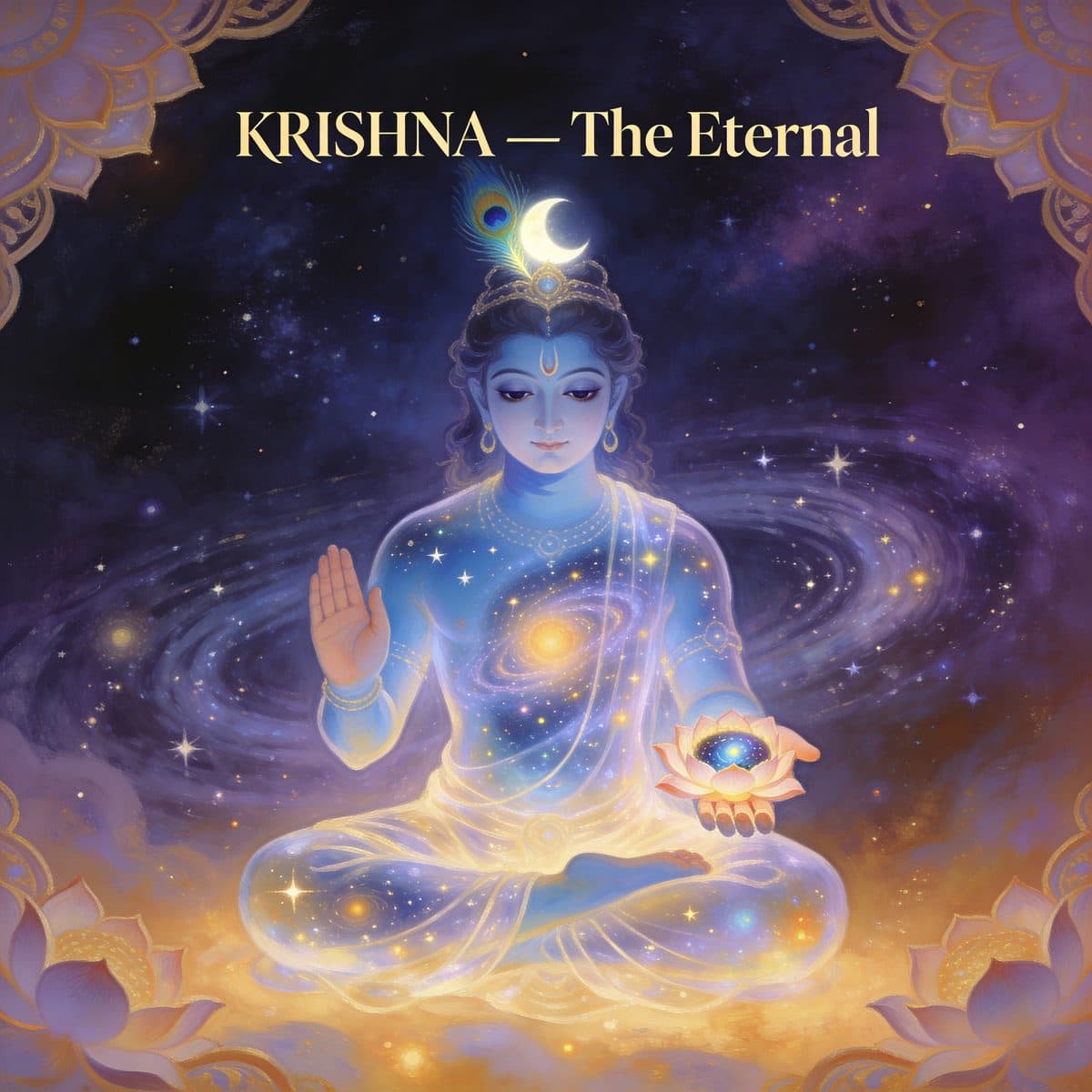
Lord Krishna
Divine TeacherThe Supreme Lord, the charioteer and divine guide of Arjuna. Krishna delivers the eternal wisdom of the Gita, revealing the nature of the soul, duty, and the path to liberation.
Speaking: Chapter 14, Verse 27
Verse 27
Hard VerseThe Yoga of the Three Gunas
For I am the foundation of Brahman — the immortal, the imperishable; of eternal dharma; and of absolute, unending bliss.
Context & Meaning
The chapter's final verse is one of the most majestic in the entire Gita — a declaration of the ultimate ground. Krishna declares Himself to be the very foundation (pratiṣṭhā) of Brahman — of what is immortal and imperishable (amṛtasya avyayasya), of eternal dharma (śāśvatya dharma), and of absolute bliss (sukhasya aikāntikasya — the unambiguous, undiluted happiness that is not mixed with suffering). Even Brahman — the supreme impersonal Absolute — rests on Krishna as its foundation. This is the Gita's deepest metaphysical claim: beyond the impersonal Absolute stands the personal Divine as its innermost ground and support.
Scholar Commentaries
3 commentaries · Public domainAdi Shankaracharya
AdvaitaBrahmaṇo hi pratiṣṭhā aham — I am the foundation of Brahman. Shankara reads this as pointing to the identity between the personal Krishna and the impersonal Brahman: the same reality is described from two perspectives. The impersonal Brahman is the foundation of all reality; and that foundation is none other than the supreme Self that Krishna embodies. There is ultimately no contradiction between the personal and impersonal dimensions of the Divine.
Ramanujacharya
VishishtadvaitaThis final verse elevates the personal God above the impersonal Brahman in the most unambiguous terms. Brahman — often spoken of as the ultimate — rests on Krishna as its own ground. The impersonal is real, but the personal is more ultimate. This is the grand conclusion of the Gita's teaching: beyond knowledge, beyond the guṇas, beyond even Brahman as abstractly conceived, stands the living, loving God as the source of all bliss, all dharma, and all immortality.
Madhvacharya
DvaitaSukhasyaikāntikasya ca — of absolute, unambiguous bliss. The word aikāntika is key: it denotes bliss that is unmixed, undiluted, absolute — not the happiness that comes and goes with circumstance, but the foundational joy of the divine nature itself. The soul who transcends the guṇas and attains the divine nature participates in this absolute joy. This is the final answer to the question of why one should transcend the guṇas: not merely to escape suffering, but to attain the eternal joy of the Divine.