
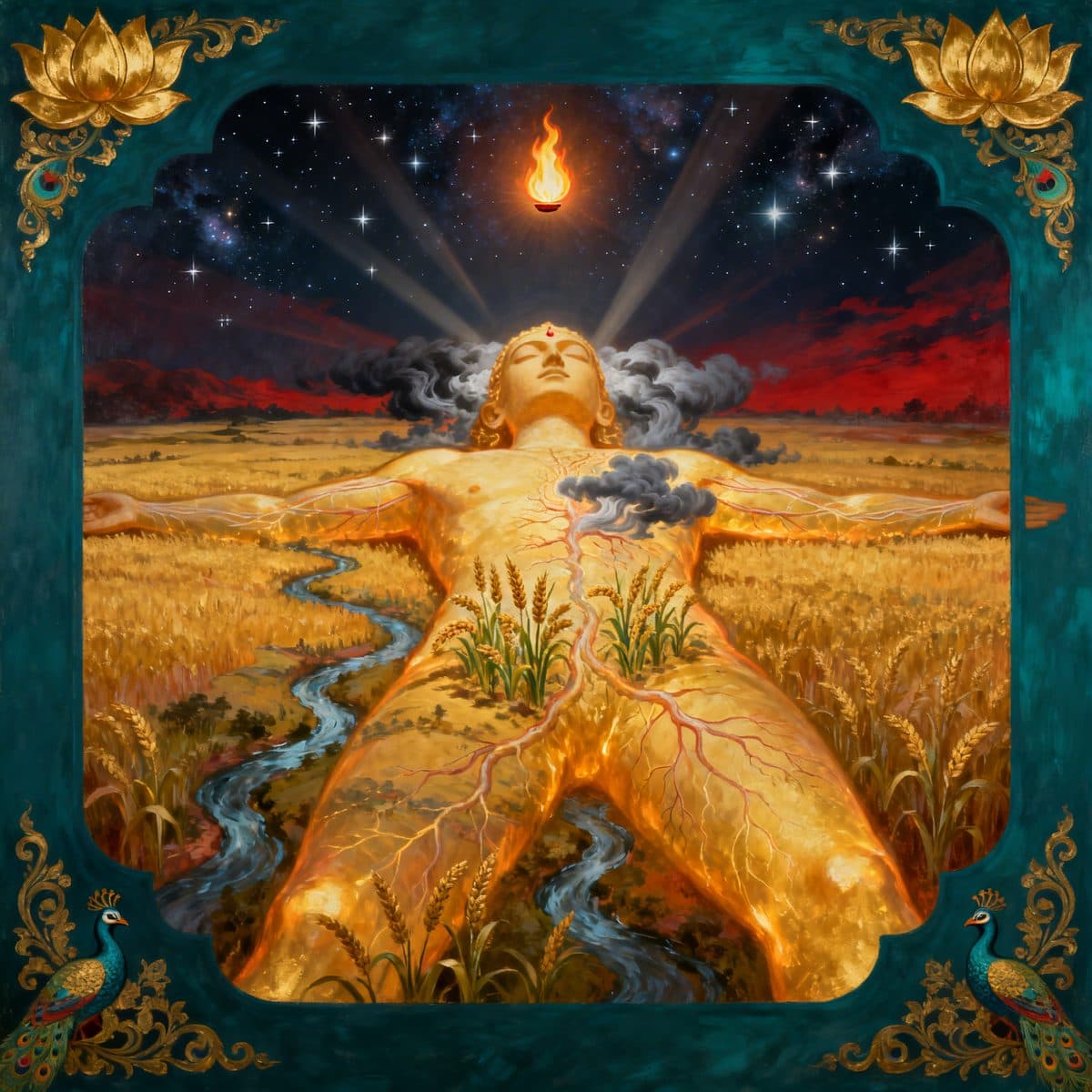
क्षेत्र क्षेत्रज्ञ विभाग योग
The Yoga of the Field and the Knower of the Field
34 VersesDescription
Krishna explains the distinction between Kshetra (the field—the body and material nature) and Kshetrajna (the knower of the field—the soul or consciousness). He describes the components of the field, the qualities of the knower, and the importance of understanding this distinction for liberation. He also explains Prakriti (nature) and Purusha (soul).
Location
Kurukshetra Battlefield
Characters
Watch Chapter Discourse
Video coming soon
Add a YouTube URL to the videoUrl field in chapters.ts
Chapter 13 — The Yoga of the Field and the Knower of the Field
Read Verses
34 of 34 availableArjuna said: O Keshava, I wish to know about Prakriti (Nature) and Purusha (the Self), the field and the knower of the field, knowledge and the object of knowledge.
Arjuna opens Chapter 13 with a fourfold question — one of the most philosophically concentrated inquiries in the entire Gita. He asks about Prakriti and Purusha (the two fundamental principles of Sankhya philosophy), the field and the knower of the field (a different but related conceptual pair), knowledge itself, and its ultimate object. This single verse sets the agenda for the entire chapter. Arjuna is no longer the grief-stricken warrior of Chapter 1; he has grown into a genuine philosopher seeking the deepest understanding of reality.
The Supreme Personality of Godhead said: O son of Kunti, this body is called the field. One who knows this body is called the knower of the field by those who know.
Krishna begins with the foundational distinction of the entire chapter: the body is the field (kṣetra), and the one who knows it is the knower of the field (kṣetrajña). The metaphor of the field is illuminating — a field is something that is cultivated, that produces results, that is known and worked by a farmer who stands apart from it. Just so, the body is the terrain of experience, and the soul is the one who knows and witnesses that terrain. This fundamental distinction — between the known and the knower, between matter and consciousness — is the key to liberation.
Know Me also as the knower of the field in all fields, O descendant of Bharata. To know both the field and the knower of the field — that I consider to be true knowledge.
The most breathtaking sentence in this opening: "Know Me also as the knower of the field in all fields." Krishna declares that He is not just Arjuna's knower-of-the-field — He is the supreme Knower dwelling in every body in the universe. There is one individual knower in each body, but behind all individual knowers is the ultimate witness — the supreme Self, which is Krishna. This verse captures both the unity and the distinction that run throughout the Gita: the individual soul is real, and so is the Supreme Soul, and the relationship between them is the deepest mystery.
Now hear from Me briefly about what the field is, its nature, its transformations, where it comes from, who the knower of the field is, and what his powers are.
Having established the two fundamental categories — field and knower — Krishna now offers to describe them systematically. He will cover the field's nature, its modifications, its source, and the knower's identity and power. This verse is a roadmap for the teaching that follows. It is notable that Krishna promises to speak "briefly" — yet what follows is one of the most comprehensive philosophical analyses in Indian literature, touching Sankhya metaphysics, epistemology, and Vedantic ontology.
This knowledge has been sung by the sages in many ways, in various hymns and also in well-reasoned and conclusive Brahma-sutra aphorisms.
Before describing the field, Krishna grounds his teaching in three streams of ancient authority: the wisdom of the sages (ṛṣibhiḥ), the Vedic hymns (chandas), and the philosophical aphorisms of the Brahma Sutras. This is not a new doctrine invented on a battlefield — it is the crystallized wisdom of a living tradition stretching back to the dawn of human consciousness. Krishna signals that what he is about to say has been realized and confirmed by countless seekers before.
The five great elements, false ego, intelligence, the unmanifested, the ten senses, the mind, and the five sense objects—
Krishna begins enumerating the components of the field — the body and everything associated with it. The five great elements (earth, water, fire, air, space), the false ego (ahaṅkāra — the misidentification with the body), intelligence (buddhi — the faculty of discrimination), the unmanifest primordial nature (avyakta), the ten sense organs (five of perception, five of action), the mind, and the five sense objects (sound, touch, form, taste, smell). Together these twenty-four elements constitute what the Sankhya system calls Prakriti — the entire domain of matter.
Desire, hatred, pleasure, pain, the aggregate, consciousness, and steadfastness — this, in summary, is the field with its modifications.
The enumeration of the field concludes with the psychological and experiential dimensions: desire (icchā), aversion (dveṣa), pleasure (sukha), pain (duḥkha), the aggregate (saṅghāta — the composite whole of body and mind), consciousness as it appears through the field (cetanā), and steadfastness or holding together (dhṛti). These are the experiential modifications of the field — the felt life of a person. Crucially, even consciousness as experienced through the field is listed as part of the field, not as the pure knower. This is one of the most sophisticated moves in the Gita's philosophy.
Humility, absence of pride, non-violence, forbearance, simplicity, service to one's teacher, cleanliness, steadfastness, self-restraint—
Having described the field, Krishna now turns to describe knowledge — not as a body of propositions but as a set of qualities that constitute the knowing mind. True knowledge begins with humility (amānitva — the absence of the desire for honour), freedom from hypocrisy (adambhitva), non-violence (ahiṃsā), patience (kṣānti), straightforwardness (ārjava), service to one's teacher (ācāryopāsana), purity (śauca), steadiness (sthairya), and self-restraint (ātmavinigraha). These are not prerequisites to knowledge — they are themselves expressions of the orientation toward truth that constitutes real jñāna.
Dispassion toward sense objects, absence of ego, and perceiving the evil in birth, death, old age, and disease—
The qualities of knowledge continue: detachment from sense pleasures (vairāgya), the absence of ego (anahaṅkāra), and the clear-sighted perception of the suffering inherent in the cycle of birth, death, old age, and disease. This last quality — seeing the suffering embedded in physical existence — is not pessimism but clarity. The person who sees clearly that the body is subject to birth, aging, sickness, and death naturally loosens their grip on it. This clear perception is itself liberating; it redirects attention from what is transient to what is permanent.
Non-attachment, non-identification with son, wife, home, and so on, and constant equanimity in pleasant and unpleasant occurrences—
Non-attachment (asakti) — the relaxing of the grip on outcomes — and non-identification (anaabhiṣvaṅga — literally, not being entwined) with the roles and relationships of life: son, wife, home. The Gita does not ask us to abandon these relationships but to hold them without being held by them. The test of this detachment is the quality mentioned next: constant equanimity in both pleasant and unpleasant events. The person who has truly loosened their identification with relationships and possessions will neither be elated by gain nor devastated by loss.
Unwavering devotion to Me through exclusive yoga, resorting to secluded places, and aversion to the company of worldly people—
Among the qualities of knowledge, devotion (bhakti) reappears — unwavering, exclusive, without deviation. This is the same avyabhicāriṇī bhakti that will be described in Chapter 18 as the highest form of worship. Along with devotion: a preference for solitude (vivikta-deśa — secluded places) and a natural distancing from excessive social noise (arati-janasaṃsadi — lack of enthusiasm for crowded worldly gatherings). These outer habits reflect an inner orientation — the seeker of truth naturally gravitates toward the conditions that support contemplation.
Constancy in self-knowledge, and clear vision of the object of true knowledge — all this is declared to be knowledge. Whatever is contrary to this is ignorance.
The list of knowledge-qualities culminates here. Constancy in self-knowledge (adhyātma-jñāna-nityatva) — not occasional inquiry but sustained, ongoing investigation of the self. And vision of the object of true knowledge (tattva-jñānārtha-darśana) — the clear perception of ultimate reality. Whatever does not lead toward these — whatever distracts from self-inquiry and obscures the vision of reality — is declared to be ajñāna, ignorance. The Gita here reframes the meaning of knowledge: it is not information but transformation; not data but clarity of seeing.
I shall now describe the object of knowledge, knowing which one attains immortality. The supreme Brahman is beginningless; it is said to be neither being nor non-being.
Having described knowledge and the knower, Krishna now turns to the ultimate object of knowledge — Brahman. The description begins with a paradox: Brahman is neither sat (being) nor asat (non-being). This is not contradiction but precision. Brahman cannot be categorized within the framework of existence and non-existence because it is the ground of that very framework. The word anādimad — beginningless — points to a reality that precedes time itself. This is what the Upanishads call the "fourth" — beyond waking, dreaming, and deep sleep — the ground that makes all experience possible.
Everywhere are Its hands and feet, everywhere Its eyes, heads, and faces; everywhere It has ears. It dwells in the world, pervading everything.
A poetic description of Brahman's omnipresence: hands and feet everywhere, eyes and faces and heads in every direction, ears pervading all space. This is not literal anatomy but philosophical poetry — a way of saying that nothing falls outside Brahman's reach, perception, or presence. The divine is not distant, watching from outside the world — it pervades everything, acts through everything, sees through every set of eyes. The sense organs of all living beings are, in a deeper sense, the organs of the one universal consciousness.
Shining through the functions of all senses, yet without any senses; unattached, yet the sustainer of all; free from the Gunas, yet the experiencer of the Gunas—
A cascade of paradoxes that describe Brahman's unique mode of being: it appears to perceive through all senses yet has no senses of its own; it is completely unattached yet sustains everything in existence; it is beyond the three qualities (nirguṇa) yet is somehow the experiencer of those qualities (guṇabhoktṛ). These paradoxes are not logical failures — they are honest acknowledgments of the limits of ordinary conceptual categories when applied to the infinite. Brahman exceeds every pair of opposites while somehow encompassing both.
It is outside and inside all beings, moving and non-moving. Because of its subtlety it is unknowable; it is far away, and it is also near.
Brahman is simultaneously inside and outside all beings — it is the inner witness of all experience and also the vast ground in which all existence floats. It pervades both the moving (animate beings) and the non-moving (inert matter). Because of its extreme subtlety, it cannot be grasped by ordinary perception — yet it is also the closest thing to us, closer than our own breath. The Kena Upanishad says the same: "It is far for those who seek, near for those who cease seeking." The seeker who chases Brahman as an external object will not find it; the seeker who turns attention to the very ground of their own awareness will find it is already present.
Undivided, yet appearing as if divided among all beings; it is to be known as the sustainer, the absorber, and the creator of all beings.
Brahman is ultimately one and undivided — yet it appears as though divided, distributed among the countless individual beings of the universe. The one light appears in different vessels; the one space appears as many rooms; the one ocean appears as many waves. And this single undivided reality performs three cosmic functions: it sustains all beings (bhūtabhartṛ), absorbs them back at dissolution (grasiṣṇu), and projects them forth in creation (prabhaviṣṇu). Creator, sustainer, and destroyer — all three are the one Brahman.
It is the light of all lights, said to be beyond darkness. It is knowledge, the object of knowledge, and that which is to be attained through knowledge. It is seated in the hearts of all.
The supreme description of Brahman culminates here: it is the light of all lights (jyotiṣām api taj jyotiḥ), beyond all darkness — meaning it is the consciousness that illuminates all other illuminators, including the sun and stars. It is simultaneously jñāna (the knowing faculty), jñeya (the object of knowing), and jñānagamya (the goal that is reached through knowing). Subject, object, and path collapse into one. And this same infinite reality is seated in the heart of every living being — hṛdi sarvasya. The infinite is the intimate. The cosmic is the personal.
Thus I have described the field, knowledge, and the object of knowledge. Understanding this, My devotee becomes worthy of My state.
A transitional verse that summarises the first half of the chapter and announces the result. The field, knowledge, and the object of knowledge have been explained. A devotee who truly comprehends and internalises this teaching becomes worthy of the divine state — madbhāvāya, becoming like God, entering into the divine nature. And the key word is bhakta — devotee. Even in this most philosophical of chapters, the path is ultimately devotional. Knowledge without devotion remains incomplete; knowledge saturated with devotion leads to union.
Know that both Prakriti and Purusha are beginningless. Know also that all modifications and all qualities are born of Prakriti.
The chapter now shifts to the Sankhya framework of Prakriti (nature/matter) and Purusha (consciousness/soul). Both are beginningless — neither came into being at some point in time. This is a significant metaphysical claim: matter and consciousness are both primordial, neither derived from the other. However, all modifications and all qualities (guṇas) arise from Prakriti alone, not from Purusha. The soul is the witness of all that Prakriti produces; it does not produce anything itself. Understanding this prevents the confusion that identifies the soul with the changing modifications of matter.
Prakriti is said to be the cause in the production of effect and cause; Purusha is said to be the cause in the experience of pleasure and pain.
A precise division of causal roles: Prakriti is responsible for all agency — all doing, all cause-and-effect chains in the physical and mental world. Purusha is responsible for experience — it is the experiencer of pleasure and pain, but not their producer. This distinction has profound practical consequences: the suffering I experience is the result of Prakriti's operations; my awareness of that suffering is Purusha. The sufferer is not the pure witness; the pure witness merely knows the suffering without being constituted by it.
The Purusha, dwelling in Prakriti, experiences the qualities born of Prakriti. Attachment to these qualities is the cause of its births in good and evil wombs.
The mechanism of bondage is identified: the soul dwells in Prakriti and experiences the qualities (guṇas) it produces. This experience is natural and not the problem. The problem is attachment (saṅga) — the soul's identification with what it experiences, its mistaking the field for itself. This attachment is what drives the cycle of rebirth, producing good or evil births according to the quality of the attachment. Liberation consists in the soul maintaining awareness while releasing attachment — continuing to witness without being entangled.
Yet in this body dwells the supreme Purusha — the witness, the permitter, the sustainer, the experiencer, the great Lord — who is also called the Paramatma, the Supreme Self.
Having described the individual soul as bound by attachment, Krishna now reveals the other Purusha — the supreme Purusha within the same body. The upadraṣṭā is the witness (literally "the one who sees from nearby"). The anumantā is the permitter or overseer — the one whose presence makes all experience possible. The bhartā is the sustainer; the bhoktā, the experiencer; the maheśvara, the great Lord. This is the Paramātman — the supreme Self — dwelling in the very same body that houses the individual soul. Two birds on the same tree: one eats the fruit, one only watches. The witness is always present; it is only overlooked.
One who knows Purusha and Prakriti together with its qualities — though acting in all ways — is not born again.
The liberating result of this knowledge: one who truly understands the Purusha-Prakriti distinction is free from rebirth, regardless of what they do externally (sarvathā vartamāno'pi — even while acting in all possible ways). This is the Gita's consistent insistence that liberation is not about what you do but about how you know yourself while doing it. The person who knows they are the witness, not the actor — who sees clearly that Prakriti is acting through the body while Purusha merely observes — is already free.
Some perceive the Self within the self through meditation, others through the path of knowledge, and others through the yoga of action.
The Gita's inclusive pluralism: there is no single prescribed path to self-realisation. Some discover the Self through meditation (dhyāna) — the direct, contemplative path. Others through the analytical discrimination of Sankhya (sāṃkhyena yogena) — understanding the nature of Purusha and Prakriti through sustained philosophical inquiry. Others through Karma Yoga (karmayogena) — selfless action that gradually purifies the heart. All three paths are valid. All three lead to the same recognition. The choice of path depends on the temperament and capacity of the seeker.
And others, not knowing thus, worship upon hearing from others. Even they, devoted to what they have heard, certainly cross beyond death.
The most generous and inclusive verse in this section: even those who do not meditate, do not practise Sankhya, do not perform Karma Yoga — but who simply hear the teaching from others and worship accordingly — even they cross beyond death. Śruti-parāyaṇāḥ — those who are devoted to the heard word. This is the path of śravaṇa — listening, receiving, trusting. Faith in the testimony of the liberated is itself a valid path. This verse ensures that no sincere seeker, regardless of their capacity for independent practice, is excluded from liberation.
Know that whatever being is born — stationary or moving — arises from the union of the field and the knower of the field, O best of the Bharatas.
Every being in the universe — from a mountain (stationary) to a human being (moving) — arises from the union of field and knower. This union is the generative principle of all embodied existence. Matter without consciousness is inert; consciousness without matter has no vehicle for experience. Every creature represents a particular intersection of these two primordial principles. Understanding this, one sees the same fundamental structure in all beings — not the surface diversity but the underlying unity of constitution.
One who sees the Supreme Lord dwelling equally in all beings — the imperishable within the perishable — truly sees.
The culminating vision of the chapter: to truly see is to see the same supreme Lord present equally in every being, the imperishable dwelling within the perishable. This is the vision of sameness (samatā) that the Gita returns to again and again — not a moral commandment to treat everyone equally, but a perceptual reality to be realised: the same infinite awareness looks out through every pair of eyes. The one who sees this truly sees (sa paśyati — that one sees). All other seeing is partial, conditioned, distorted by the illusion of separation.
One who sees the Lord established equally everywhere does not harm the Self by the self, and thereby attains the supreme goal.
The one who sees God equally everywhere does not harm the Self by the self — a remarkable phrase. When I see only separate selves, I can harm, exploit, or diminish others. But when I see the one Self in all, to harm another is literally to harm myself. The vision of unity naturally produces ahiṃsā — not as a moral rule but as a perceptual consequence. And from this non-violence of vision flows the supreme goal: liberation. The path to freedom is not through accumulation of virtue but through expansion of vision.
One who sees that all actions are performed by Prakriti alone, and that the Self is truly the non-doer — that one truly sees.
The second occurrence of sa paśyati in this chapter — that one truly sees. This time the vision is of the non-doing of the Self: all actions, in every dimension, are performed by Prakriti — the body, the senses, the mind, the ego. The pure Self does nothing. This is the realisation that dissolves the burden of doership and the resulting karma. When the Self ceases to identify with action, karma no longer accumulates, because karma requires an agent who takes ownership of action. The witness who sees clearly never owns the action.
When one perceives the diverse existence of all beings as resting in the One, and sees their expansion from that One alone — then one attains Brahman.
The moment of Brahman-realisation is described: when one sees all the diversity of beings as resting in the One (ekastham — in a single locus), and sees the entire expansion of the universe as emerging from that One alone — in that moment, one becomes Brahman. This is not a future event but an immediate transformation of perception. The world does not change; the seeing changes. The same universe that appeared as chaos, as multiplicity, as separation — is suddenly seen as the one Brahman expressing itself in an infinity of forms.
Being beginningless and transcendent of the Gunas, O Arjuna, the imperishable Supreme Self — even though dwelling in the body — neither acts nor is tainted.
The supreme Self, even while dwelling in a body, neither acts nor is touched by anything that happens in that body. This is the key to the entire teaching of non-doership: the witness is always untouched. Beginningless (anādi), beyond the qualities of Prakriti (nirguṇa), imperishable (avyaya) — the Paramātman has these three qualities that are the opposite of the field's characteristics. And because of these qualities, dwelling in the body is not the same as being of the body. The lamp illuminates a room without being made of the room.
Just as the all-pervading space is not tainted because of its subtlety, so the Self, though dwelling everywhere in the body, is never tainted.
One of the most beautiful analogies in the Gita: the Self is like space (ākāśa). Space is everywhere — it pervades the inside of a garbage bin and the inside of a temple with complete impartiality, yet it is not tainted by anything it contains. The impurities of the garbage bin do not contaminate the space; the holiness of the temple does not sanctify the space. Space simply is, unaffected by what it contains. So too the Self — present everywhere in the body, touching every experience from birth to death — is never tainted, never modified, never diminished.
Just as the one sun illuminates this entire world, so the lord of the field illuminates the entire field, O descendant of Bharata.
The chapter's final verse delivers its final analogy: the one sun illuminates the entire world — all its multiplicity, all its diversity of objects — with a single light. Similarly, the one lord of the field (kṣetrī — the Self) illuminates the entire field (the body-mind complex with all its contents) with a single awareness. One consciousness, one witness, one light — and because of it, everything is known, everything is experienced, everything is made real. The sun does not become the world in illuminating it; the Self does not become the body in knowing it. Light and matter, awareness and the field — forever distinct, forever related, together constituting the totality of what it means to be alive.
Key Teachings
- •The body is the field, the soul is the knower
- •Understanding this distinction leads to liberation
- •God is the ultimate knower in all fields