
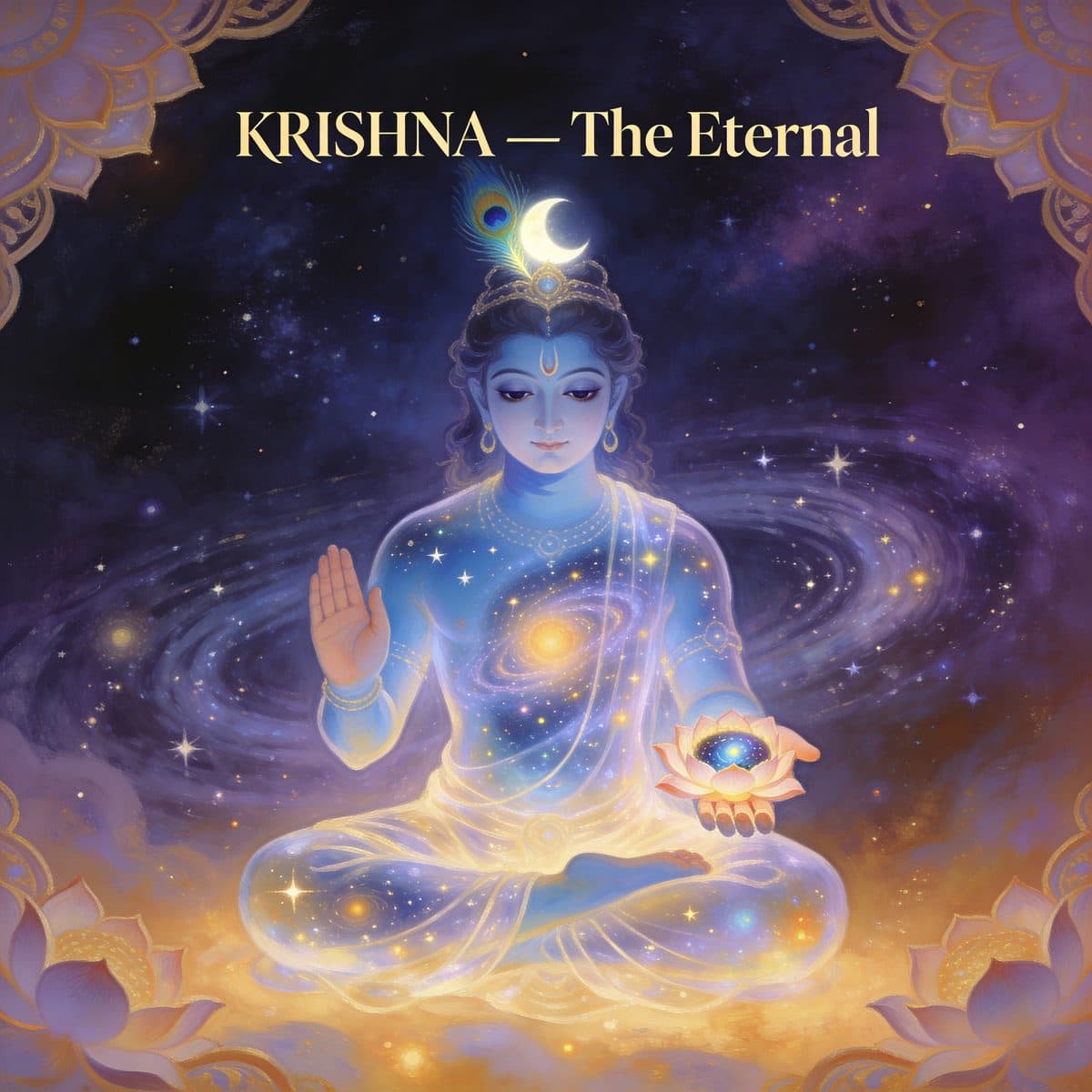
Lord Krishna
Divine TeacherThe Supreme Lord, the charioteer and divine guide of Arjuna. Krishna delivers the eternal wisdom of the Gita, revealing the nature of the soul, duty, and the path to liberation.
Speaking: Chapter 15, Verse 19
Verse 19
The Yoga of the Supreme Person
O Bharata, whoever, free from delusion, thus knows Me as the Supreme Person — that one, all-knowing, worships Me with their whole being.
Context & Meaning
The fruit of this knowledge is total worship — sarvabhāvena bhajati — worshipping with the whole being, with every mode of consciousness. This is not the worship of one who knows a doctrine; it is the natural, total response of a being who has truly seen the Supreme Person. The qualification is asammūḍha — free from delusion, unclouded by the maya that causes the conditioned mind to miss what is most obvious. Such a person is sarvavid — all-knowing, not because they have memorised everything, but because they know the One from whom all knowledge flows. To know God is to be oriented correctly toward all of reality; that orientation is itself a form of omniscience. And from that knowing, worship — love, service, surrender — arises naturally, as flowers turn toward the sun without being commanded to.
Scholar Commentaries
1 commentary · Public domainRamanujacharya
VishishtadvaitaSarvabhāvena — with the whole being. This is the hallmark of perfect bhakti: not the reserved, partial love that offers some of the heart while holding back the rest, but the total orientation of every faculty — intellect, emotion, will, action — toward the Supreme. The word sarvavit (all-knowing) does not mean encyclopaedic knowledge but the knowledge that matters most: the knowledge of what is real, what is highest, what one is, and who one belongs to.