
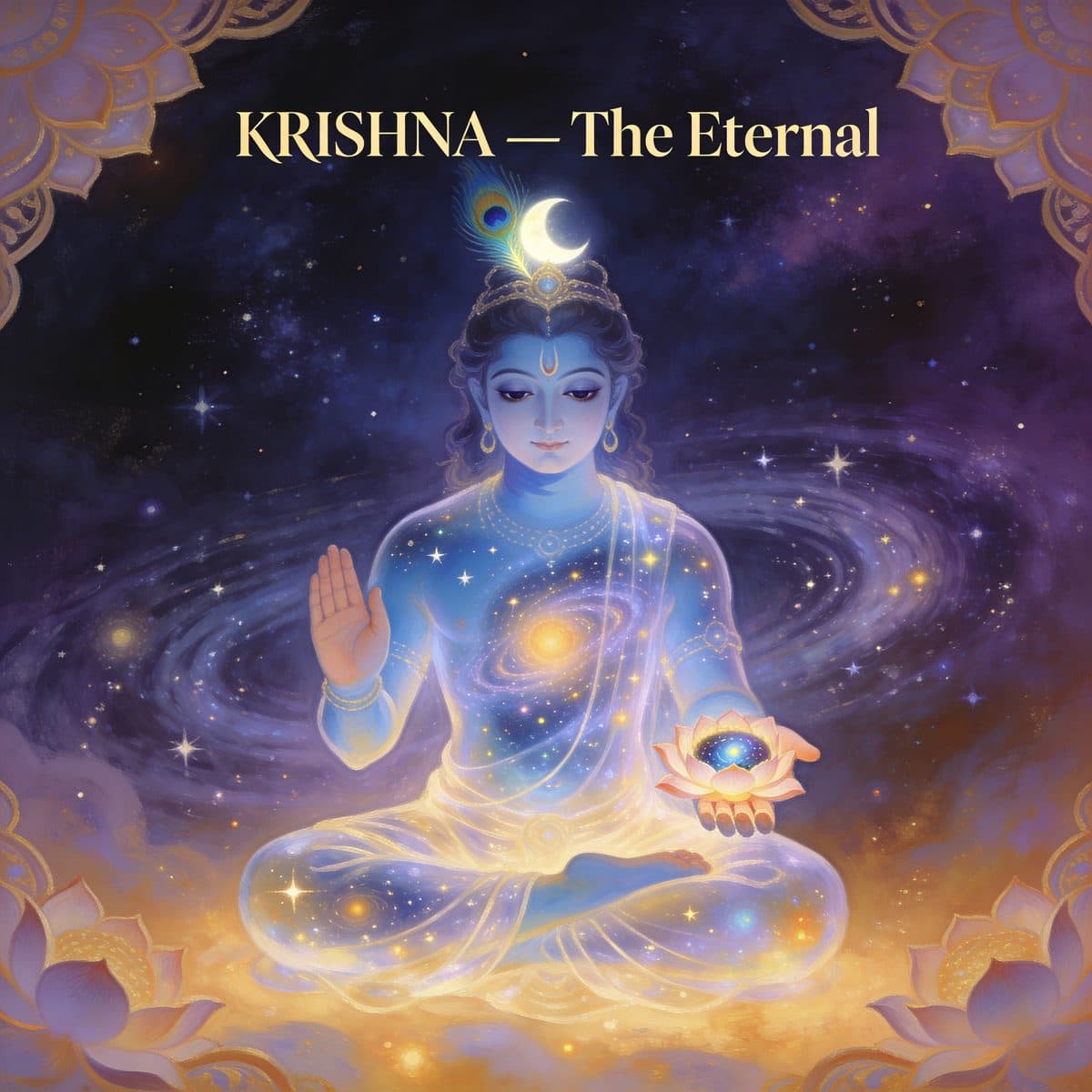
Lord Krishna
Divine TeacherThe Supreme Lord, the charioteer and divine guide of Arjuna. Krishna delivers the eternal wisdom of the Gita, revealing the nature of the soul, duty, and the path to liberation.
Speaking: Chapter 15, Verse 6
Verse 6
The Yoga of the Supreme Person
Neither the sun illuminates it, nor the moon, nor fire. That is My supreme abode, having reached which one does not return.
Context & Meaning
This is perhaps the most luminous verse of Chapter 15. The supreme abode of God requires no external light — not the sun, not the moon, not fire. Why? Because it is itself the source of all light. The sun shines by the light of Brahman; the moon reflects it; fire burns with it — but none of them can illuminate that from which all light ultimately derives. This paradox — that the brightest thing cannot be seen by any lamp — points to the nature of pure consciousness. It is self-luminous (svayaṃ-jyoti), known not by another light but by itself. And from that abode, once reached, there is no return: not because it is a place that traps, but because the seeker has finally arrived at what they always, at the deepest level, already were.
Scholar Commentaries
1 commentary · Public domainAdi Shankaracharya
AdvaitaSun, moon, and fire are the three great illuminators of the material universe. None of them can reach the Self — not because the Self is dark, but because it is the ground of all illumination. To ask what illuminates pure consciousness is like asking what wets water. The Kena Upanishad says: "That which is not thought by the mind, but by which, they say, the mind thinks — that alone is Brahman." This verse is that same teaching.