
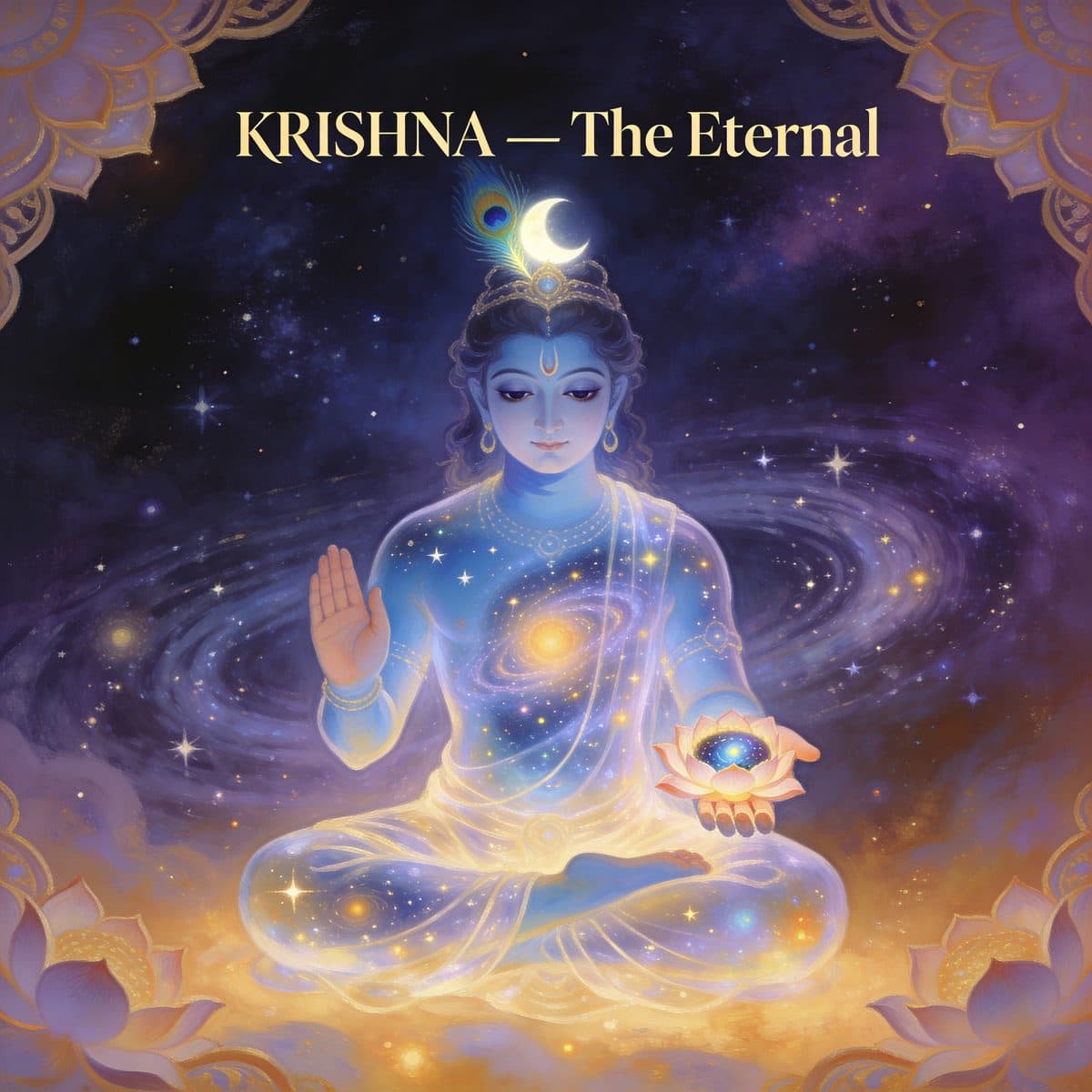
Lord Krishna
Divine TeacherThe Supreme Lord, the charioteer and divine guide of Arjuna. Krishna delivers the eternal wisdom of the Gita, revealing the nature of the soul, duty, and the path to liberation.
Speaking: Chapter 15, Verse 4
Verse 4
The Yoga of the Supreme Person
Then that supreme abode must be sought from which, having gone, one does not return again. One should take refuge in that Primal Person from whom the ancient stream of creation has flowed.
Context & Meaning
Having cut the tree with non-attachment, what then? This verse gives the direction: seek the supreme abode — that state from which there is no return to samsara. But this is not a place to find with coordinates; it is the Primal Person (Ādi Puruṣa), the original source from which all of existence has flowed since before time. The path is prapadye — complete surrender, taking refuge. This is not a resignation but a homecoming: returning to the source from which the ancient stream of creation first arose. The seeker who has severed attachment finds, in that very freedom, the pull toward the origin — the Divine Person who was always the root of the tree.
Scholar Commentaries
1 commentary · Public domainAdi Shankaracharya
AdvaitaThe supreme abode (paraṃ padam) is the state of Brahman — pure awareness without superimposition, from which nothing more needs to be sought and to which nothing more can happen. The word prapadye (I take refuge) indicates complete surrender of the ego that has been maintaining the illusion of separation. Once the ego surrenders to the source, the tree of samsara has no soil left to grow in.