
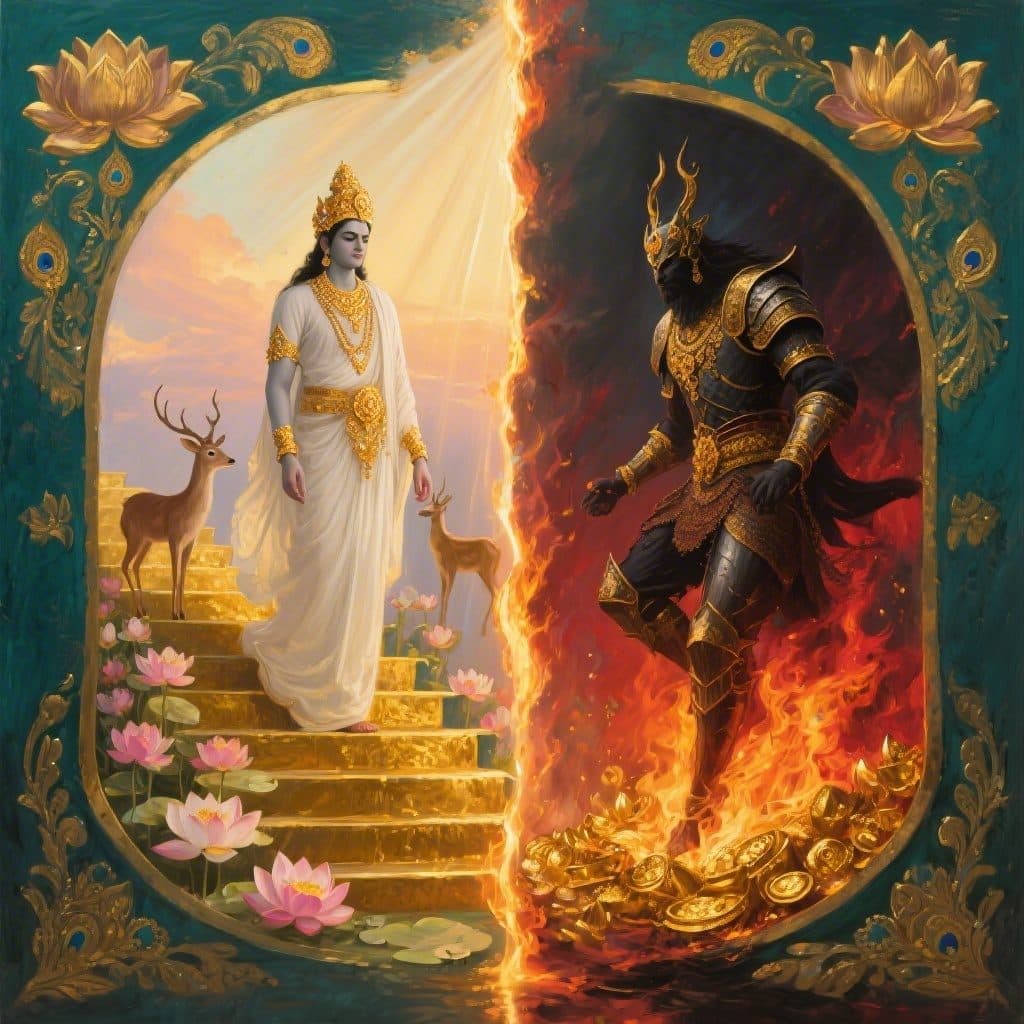
दैवासुर संपद विभाग योग
The Yoga of the Divine and Demonic Natures
24 VersesDescription
Krishna distinguishes between two types of beings—those with divine nature (Daivi Sampad) and those with demonic nature (Asuri Sampad). He lists the qualities of each, urging Arjuna to cultivate divine virtues and avoid demonic traits. He describes the fate of the demonic and the importance of following scriptural guidance.
Location
Kurukshetra Battlefield
Characters


Watch Chapter Discourse
Video coming soon
Add a YouTube URL to the videoUrl field in chapters.ts
Chapter 16 — The Yoga of the Divine and Demonic Natures
Read Verses
24 of 24 availableThe Supreme Lord said: Fearlessness, purity of heart, steadfastness in knowledge and yoga, charity, self-control, sacrifice, study of scripture, austerity, and uprightness —
Chapter 16 opens with one of the Gita's most practical catalogs: the qualities of the divine nature (daivī sampad). Krishna does not begin with metaphysics but with character — with the texture of a life lived rightly. The list begins with abhaya (fearlessness), which is not the absence of danger but the absence of the cringing, self-protective anxiety that distorts judgment and closes the heart. Next comes sattva-saṃśuddhi — purity of being, of motive, of inner atmosphere. Then jñāna-yoga-vyavasthiti — steady abiding in the path of knowledge, not occasional bursts of spiritual interest but a reliable orientation of the whole person toward truth. Dāna (giving), dama (self-restraint), yajña (ritual and sacrifice), svādhyāya (scripture study), tapas (austerity), and ārjava (straightforwardness) follow — each a pillar of the divine character.
Non-violence, truthfulness, freedom from anger, renunciation, tranquillity, absence of fault-finding, compassion for all beings, freedom from greed, gentleness, modesty, and steadiness —
The catalog continues. Ahiṃsā (non-violence) and satya (truthfulness) — foundational to all ethical traditions — are placed together, as they are in many ways two faces of the same commitment: to not harm reality, whether through action or through distorted speech. Akrodha (freedom from anger) is the mastery of the reactive impulse that, when indulged, burns the one who harbours it more than any external target. Tyāga (renunciation) and śānti (tranquillity) point to an inner freedom from grasping and turbulence. Apaiśunam — absence of fault-finding and slander — is a quality rarely listed in ethical frameworks yet devastatingly important: the person who habitually seeks flaws in others is revealing their own inner disorder. Dayā (compassion), aloluptva (freedom from greed), mārdava (gentleness), hrī (modesty), and acāpala (steadiness of mind and body) complete the picture.
Vigour, forgiveness, fortitude, purity, freedom from hatred, and absence of excessive pride — these are the endowments of those born to the divine nature, O Bharata.
The catalog of divine qualities concludes with six more. Tejas (vigour, radiance) — the inner fire of a person of character, the quality that lights up a room not through display but through genuine presence. Kṣamā (forgiveness) — not weak toleration but the active choice to release the claim against those who have wronged us, freeing both parties from the chain of grievance. Dhṛti (fortitude) — the steady resolve that does not collapse under pressure. Śauca (purity) — outer and inner cleanliness, the maintenance of the human instrument in a condition worthy of its divine content. Adroha (freedom from malice) — the absence of the poisonous wish to see others fail. And nātimānitā — not excessive pride, the humility that holds one's own importance in correct proportion. Together these three verses constitute the fullest portrait the Gita offers of what a human being can become.
Hypocrisy, arrogance, conceit, anger, harshness, and ignorance — these are the endowments of those born to the demonic nature, O Partha.
Having painted the divine portrait across three verses, Krishna now sketches the demonic character in a single verse — and the compression is itself a statement. Six qualities suffice to define the demonic type: dambha (hypocrisy — presenting a false image of virtue), darpa (arrogance — the inflated sense of one's own importance), abhimāna (conceit — identification with one's ego as the centre of the universe), krodha (anger — the reactive rage that destroys relationships and clarity), pāruṣya (harshness — cruelty in speech and action), and ajñāna (ignorance — not merely lack of information but the deep spiritual blindness that cannot see what is real). These are not sins committed occasionally but character orientations — the default settings of a consciousness that has turned away from the light and is living by the distortions that follow.
The divine endowment is said to lead to liberation; the demonic to bondage. Do not grieve, O Pandava — you are born to the divine nature.
The stakes are made explicit: divine qualities lead toward liberation (vimokṣa), demonic qualities toward bondage (nibandha). These are not arbitrary moral preferences but descriptions of spiritual mechanics — the divine qualities loosen the grip of ego, desire, and delusion, opening the person toward freedom; the demonic qualities tighten every knot of conditioning, driving the person deeper into the prison of their own compulsions. Then Krishna does something tender: he reassures Arjuna. Do not grieve — you are born to the divine nature. This is not flattery but diagnosis. Arjuna's paralysis on the battlefield arose from an excess of sensitivity, compassion, and attachment — not from cruelty, greed, or hypocrisy. His problem was an overdeveloped heart, not an absent one. He is on the right side of this fundamental division.
There are two types of created beings in this world — the divine and the demonic. The divine has been described at length. Now hear from Me about the demonic, O Partha.
Krishna establishes a binary that runs through all of human history: there are two orientations of being — the divine and the demonic — and every human life tends toward one or the other. This is not a claim about fixed destiny but about direction — the consistent trajectory of choices, habits, and orientations that shape a character over time. The divine nature has been described in detail; now Krishna turns to a fuller account of the demonic. The word śṛṇu (hear, listen) is an invitation to careful attention — not because the demonic is entertaining, but because clear-eyed recognition of what degrades is itself a protection against it. You cannot avoid what you cannot name.
The demonic do not know what to do and what not to do. Neither purity, nor right conduct, nor truth is found in them.
The demonic nature is described here at its root: a fundamental confusion about pravṛtti and nivṛtti — what to engage with and what to withdraw from, what to pursue and what to renounce. This is not merely bad decision-making but a disorientation at the level of values itself. When the inner compass is broken, no amount of external information corrects the course. And the three consequent deficiencies follow logically: no śauca (purity — the maintenance of inner and outer cleanliness), no ācāra (right conduct — the behavioural expression of ethical understanding), and no satya (truth — the commitment to reality over self-serving distortion). A being without these three lacks the basic infrastructure of moral life.
They say: "The world is without truth, without a moral foundation, without God — born of mutual union, driven by desire alone. What other cause is there?"
Here Krishna gives us the philosophical underpinning of the demonic worldview — and it is worth recognising it because it is a worldview that appears in sophisticated forms in every age. Its three pillars are: asatya (the world is without ultimate truth — there is no Dharma written into reality), apratiṣṭha (no moral foundation — there is no objective basis for ethical claims), and anīśvara (no God — no ordering intelligence, no cosmic governance). The consequence is stated bluntly: the world arose from "mutual union" — from random biological processes — and the only cause of anything is kāma (desire). There is nothing beyond appetite. This is not merely atheism but a particular aggressive materialism that uses the absence of God to justify the supremacy of desire as the only honest principle of action.
Holding to this view, these lost souls of small intelligence rise up with cruel actions as enemies of the world, working for its destruction.
The consequence of the demonic worldview is not merely personal degradation but social and cosmic destruction. Those who hold the view that the world is without truth, foundation, or God — and act consistently from that view — become naṣṭātmā (lost souls, those who have lost themselves), alpabuddhi (of stunted intelligence, unable to perceive anything beyond the immediate and material), and ugrakarmāṇa (engaged in cruel and violent actions). They become ahita — adversarial to the world's wellbeing — and their energy goes toward kṣaya, destruction. This is the Gita's analysis of what drives history's great destroyers: not mere wickedness, but a coherent worldview from which wickedness flows logically once the premise of a godless, purposeless universe is accepted.
Taking refuge in insatiable desire, filled with hypocrisy, pride, and arrogance, they cling to false notions through delusion and proceed with impure resolves.
A detailed portrait of the demonic psychology in motion. They take refuge in kāma — desire — specifically duṣpūra, insatiable desire, the kind that cannot be filled because it grows with feeding. This is the fundamental trap: using desire as a refuge creates an ever-deepening dependency, because desire satisfied becomes desire amplified. The demonic person is characterised by the trio of dambha (hypocrisy), māna (pride), and mada (arrogance) — the three distortions of self-perception that make honest relationship with oneself and others impossible. Through moha (delusion) they cling to asad-grāha — false conceptions, wrong views seized as certainties. And their vows (vrata) are aśuci — impure, oriented not toward the good but toward the self's aggrandisement.
Beset by immeasurable anxieties that end only at death, regarding the gratification of desire as the highest goal, certain that this is all there is —
The demonic existence is characterised by a paradox that every honest observer of human life can recognise: the pursuit of unlimited pleasure produces unlimited anxiety. Cintā aparimeyā — immeasurable anxiety — is the constant companion of those who have staked everything on the satisfaction of desire. The anxiety ends only at death (pralayāntā) — there is no relief within the system, because the system is self-defeating. They are kāmopabhoga-paramā — those for whom the enjoyment of desire is the supreme good — and they are niścita (certain, fixed) that etāvat (this is all there is). This certainty is the prison: as long as the person believes that pleasure-seeking is the only rational project, they cannot step outside the cycle that is destroying them.
Bound by hundreds of cords of hope, devoted to desire and anger, they strive to accumulate wealth for the sake of sensory enjoyment by unjust means.
The demonic person is bound — āśā-pāśa-śataiḥ, by hundreds of cords of hope. The image is precise: each desire generates a hope, and each hope is a cord of binding. The person who desires many things is bound in many directions simultaneously, pulled this way and that, unable to move with freedom or clarity. They are kāma-krodha-parāyaṇa — devoted entirely to desire and the anger that arises when desire is frustrated. And from this orientation flows a willingness to accumulate wealth by anyāya — unjust means. When desire is the supreme value and conscience has been dismantled, the only remaining question is what one can get away with. The means become whatever the ends require.
"This has been gained by me today; this desire I shall also fulfil. This wealth is mine, and this too shall be mine in the future."
Krishna quotes the inner monologue of the demonic mind directly — a literary technique that makes the teaching visceral and recognisable. The internal voice of greed is rendered with precision: "This I have gained today... this desire I will also fulfil... this is mine... and this too will be mine." The tense structure is revealing: past acquisition, present possession, future accumulation — all of it centred on a single personal pronoun: me, mine. The demonic consciousness collapses the entire universe into the gravitational field of the self, turning everything into a potential acquisition or a present holding. This is the voice not of extraordinary evil but of ordinary greed — and its ordinariness is what makes it so dangerous.
"That enemy has been slain by me, and I shall slay others too. I am the lord; I am the enjoyer; I am perfect, powerful, and happy."
The inner monologue continues, now revealing the demonic mind's attitude toward power and identity. Enemies are named and eliminated, others are marked for future elimination. And then the self-declarations: "I am the lord (īśvara), I am the enjoyer (bhogī), I am perfected (siddha), I am powerful (balavān), I am happy (sukhī)." The irony of these declarations is total: each claim is false. The demonic person is not truly a lord — they are enslaved by desire. Not a true enjoyer — they are consumed by anxiety. Not perfected — deeply incomplete. Not happy — profoundly restless. These declarations are not descriptions of reality but compensatory fantasies maintained against the truth of inner poverty.
"I am wealthy and well-born. Who else is equal to me? I will perform sacrifice, I will give charity, I will rejoice." — deluded by ignorance.
The inner monologue takes on social dimensions. Wealth and birth (āḍhya — rich; abhijanavān — of noble lineage) are elevated into proofs of superiority: "Who else is equal to me?" Then, crucially, the demonic type resolves to perform sacrifice, give charity, and rejoice — actions that are outwardly virtuous. But notice: these are performed in the context of the monologue about personal superiority. They are not offerings born from love or dharma but performances of status, ways of reinforcing the fiction of one's own greatness. The scripture is clear that this is ajñāna-vimohita — complete delusion through ignorance. Ritual and charity, when performed from ego, are demonic activity wearing divine clothing.
Bewildered by many thoughts, enmeshed in the net of delusion, deeply attached to the enjoyment of desires, they fall into a foul hell.
The trajectory of the demonic life is described: aneka-citta-vibhrānta — bewildered by many thoughts, the mind scattered in countless directions, unable to settle or focus. This is the natural consequence of insatiable desire: the mind that wants everything cannot rest anywhere. They are enveloped in moha-jāla — the net of delusion — trapped within a web they cannot see from inside. Deeply attached (prasaktāḥ) to sensory enjoyment, they fall into naraka — usually translated as hell, but which can be understood both literally and as the hellish states of consciousness created by this very trajectory. The fall is not a punishment imposed from outside but the natural terminus of the demonic direction.
Self-conceited, stubborn, filled with the intoxication of wealth and pride, they perform sacrifice in name only, with hypocrisy, disregarding prescribed rules.
The demonic type even performs religious observance — but corrupted at the root. They are ātma-sambhāvita (self-conceited, those who have given themselves the highest estimation), stabdha (stubborn, unable to receive correction or learn), and drunk with wealth and pride (dhana-māna-mada). The sacrifices they perform are nāma-yajña — sacrifices in name only, rituals stripped of their inner content and performed purely as social performance. They are done with dambha (hypocrisy) and avidhipūrvakam — without following the prescribed methods, because genuine method would require surrender of ego, which the demonic type cannot offer. This is religion as theatre, spirituality as brand management.
Taking shelter in ego, power, arrogance, desire, and anger, these envious people hate Me dwelling in their own bodies and in the bodies of others.
Here the spiritual consequence of the demonic nature is stated with stark directness: they hate Me — the Divine — dwelling in their own bodies and in the bodies of others. This is the deepest form of the demonic condition: not merely the rejection of God as a philosophical position but an active hatred of the divine presence that is everywhere, including within themselves. When they mistreat themselves through their vices, they are hating God within. When they mistreat others, they are hating God in those others. The five supports of their existence — ego, power, arrogance, desire, anger — are the five walls of a prison they have constructed to avoid the encounter with the Real. And the Real, being everywhere, is the thing they most resent.
These hateful, cruel, and vile people — the lowest of humanity — I continually hurl into demonic wombs in the cycle of rebirth.
Krishna states the consequence of the fully demonic life without softening: such beings are hurled (kṣipāmi — a forceful verb, cast, thrown) back into demonic births in the cycle of rebirth. This is not a sadistic punishment but a description of spiritual mechanics. The soul takes on the nature it has cultivated. A person who has spent a lifetime reinforcing demonic qualities — cruelty, hatred, arrogance, falsehood — becomes an instrument of those qualities. The next birth matches the instrument. The word ajasram (continually) suggests this is not a single punishment but an ongoing dynamic: as long as the demonic orientation persists, the births that express it continue. The door out is always the same: the turn toward the divine.
Entering demonic wombs birth after birth, these deluded ones, failing to reach Me, O son of Kunti, sink to the lowest condition.
The downward spiral is described: birth after birth in demonic conditions, each reinforcing the orientation that led to it. And the thread that runs through all of them is mām aprāpya — failing to reach Me. This is the one constant in the demonic trajectory: the non-encounter with the Divine. Not because the Divine withdraws — God dwells in the heart of every being, including the most deeply demonic — but because the demonic orientation is precisely the orientation away from that inner presence. The result is adhamā gati — the lowest state of existence. Not merely suffering, but the degradation of the soul itself, which sinks further from its own nature with each demonic birth.
There are three gates to this hell that destroy the soul: desire, anger, and greed. Therefore one must abandon these three.
One of the Gita's most practically useful verses: three gates to hell (and simultaneously, three destroyers of the soul) — kāma (desire, lust), krodha (anger), and lobha (greed). They are called gates because they are entry points: passing through any one of them leads into the territory described in the preceding verses. They are also nāśanam ātmanaḥ — destroyers of the Self, forces that progressively erode one's connection to one's own deepest nature. The instruction is simple and total: tyajet — abandon these three. Not manage them, not moderate them, not indulge them in moderation — abandon them. This does not mean the suppression of desire, the denial of anger's information, or the elimination of all material motivation, but rather the freedom from being driven by them as masters.
The person who is freed from these three gates of darkness, O son of Kunti, acts for the welfare of the Self and thereby attains the supreme destination.
The positive consequence of abandoning the three gates: freedom (vimuktaḥ — completely freed), right action (ācaraty ātmanaḥ śreyas — acts for the true welfare of the Self, not for its indulgence), and the attainment of the supreme destination (parā gati). The phrase ātmanaḥ śreyas is precise: not acting for the ego's pleasure (sukha) but for the Self's genuine welfare (śreyas). This distinction — between what the ego wants and what the Self truly needs — is the axis of the entire Gita's ethical teaching. The freed person acts from this deeper wisdom, and the direction of their life naturally curves toward liberation.
One who, having cast aside the injunctions of scripture, acts under the impulse of desire, attains neither perfection, nor happiness, nor the supreme goal.
Having established the positive path — following scriptural guidance and abandoning the three gates — Krishna now closes with its negation. The person who discards scriptural injunctions (śāstra-vidhi) and acts purely from kāma-kārata (the impulse of desire, the dictation of personal appetite) achieves nothing of lasting value: not siddhi (perfection, accomplishment), not sukha (genuine happiness), and not parā gati (the supreme destination). The three negations mirror the three things the freed person attains. Śāstra here is not arbitrary religious law but the accumulated wisdom of countless generations of seers who discovered, through experience and practice, how human beings can live with least suffering and greatest flourishing. To discard it in favour of raw desire is to choose navigating by mood rather than by map.
Therefore, let scripture be your authority in determining what should be done and what should not be done. Having understood the injunctions of scripture, you should act accordingly here.
The chapter closes with a clear, practical instruction: let śāstra (scripture, the body of received wisdom) be your pramāṇa — your authority, your standard of proof — in determining what to do and what not to do. Kārya-akārya — what is to be done and what is not to be done — is the fundamental ethical question that the demonic person cannot answer (as established in verse 7) because they have no reliable standard. The divine person answers it by reference to something beyond their own desires: the accumulated testimony of those who have walked the path. This is not blind obedience but the humility of the learner who recognises that the tradition has more to offer than the untrained ego. The final word is arhasi — you are worthy, you ought, it is fitting for you. A note of dignity: not command but invitation.
Key Teachings
- •Divine qualities lead to liberation
- •Demonic qualities lead to bondage
- •Follow scripture to determine right action