
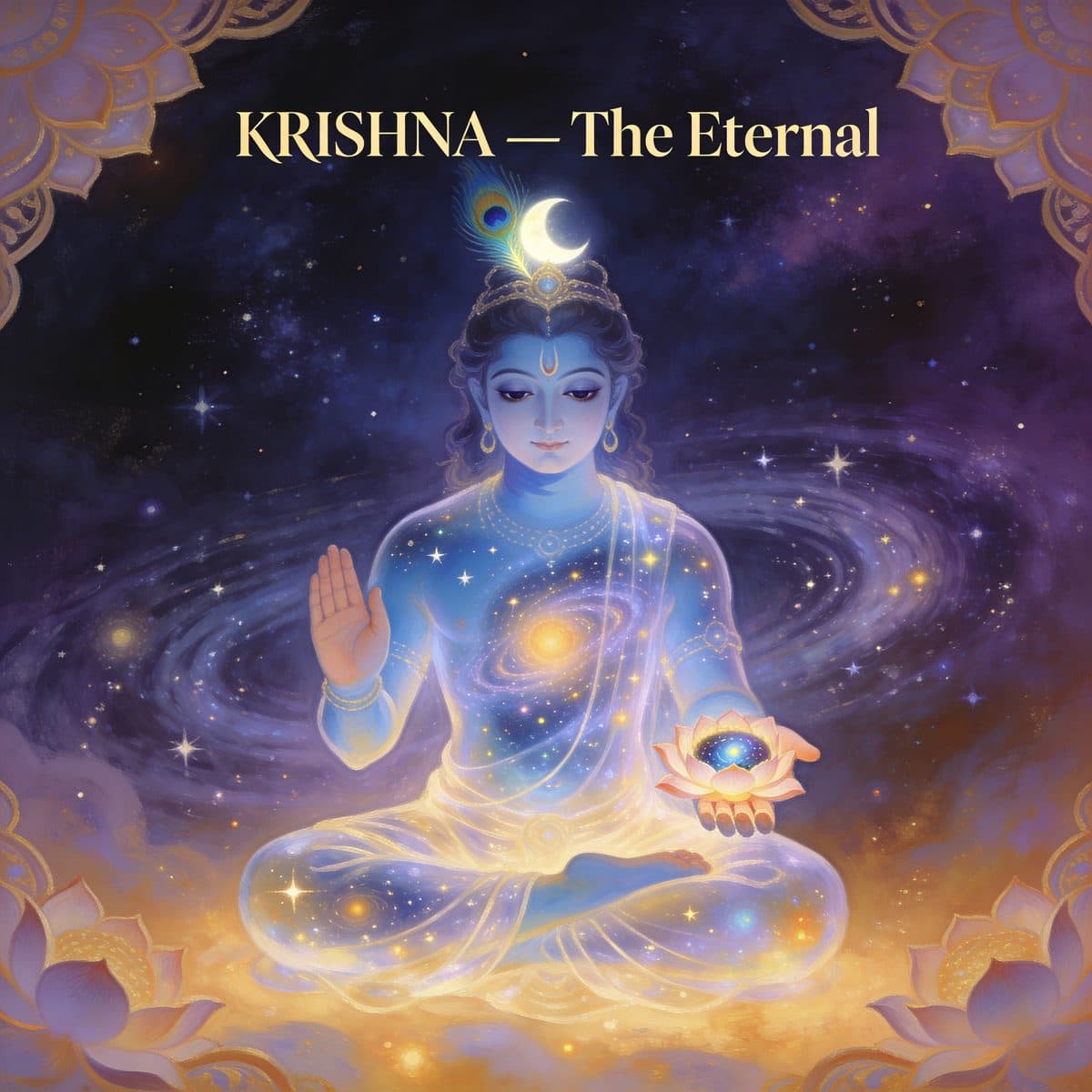
Lord Krishna
Divine TeacherThe Supreme Lord, the charioteer and divine guide of Arjuna. Krishna delivers the eternal wisdom of the Gita, revealing the nature of the soul, duty, and the path to liberation.
Speaking: Chapter 15, Verse 5
Verse 5
The Yoga of the Supreme Person
Free from pride and delusion, having conquered the fault of attachment, ever dwelling in the Self, with desires fully withdrawn, liberated from the pairs of opposites such as pleasure and pain — the undeluded reach that imperishable abode.
Context & Meaning
Here Krishna paints the portrait of one who reaches the imperishable abode. Five qualities mark them: free from pride and delusion (the ego's twin illusions); having overcome the defect of attachment; continuously established in the Self (adhyātma-nitya — not occasional meditation but a steady orientation of consciousness); desires fully withdrawn from objects; and liberated from the pairs of opposites — pleasure and pain, heat and cold, honour and dishonour — those forces that pull the ordinary mind like tides. Such a person, described as amūḍha (undeluded, clear-sighted), moves naturally toward the imperishable. It is not effort that takes them there; it is the natural movement of a mind no longer dragged away from itself.
Scholar Commentaries
1 commentary · Public domainRamanujacharya
VishishtadvaitaThese five qualifications are not achieved in sequence — they arise together as a single disposition of consciousness purified by devotion and practice. Adhyātmanityā — ever dwelling in the Self — is the key: it is the orientation of the whole being toward the Divine that gradually dissolves pride, attachment, desire, and reactivity. The undeluded see reality as it is and therefore move toward it naturally.