
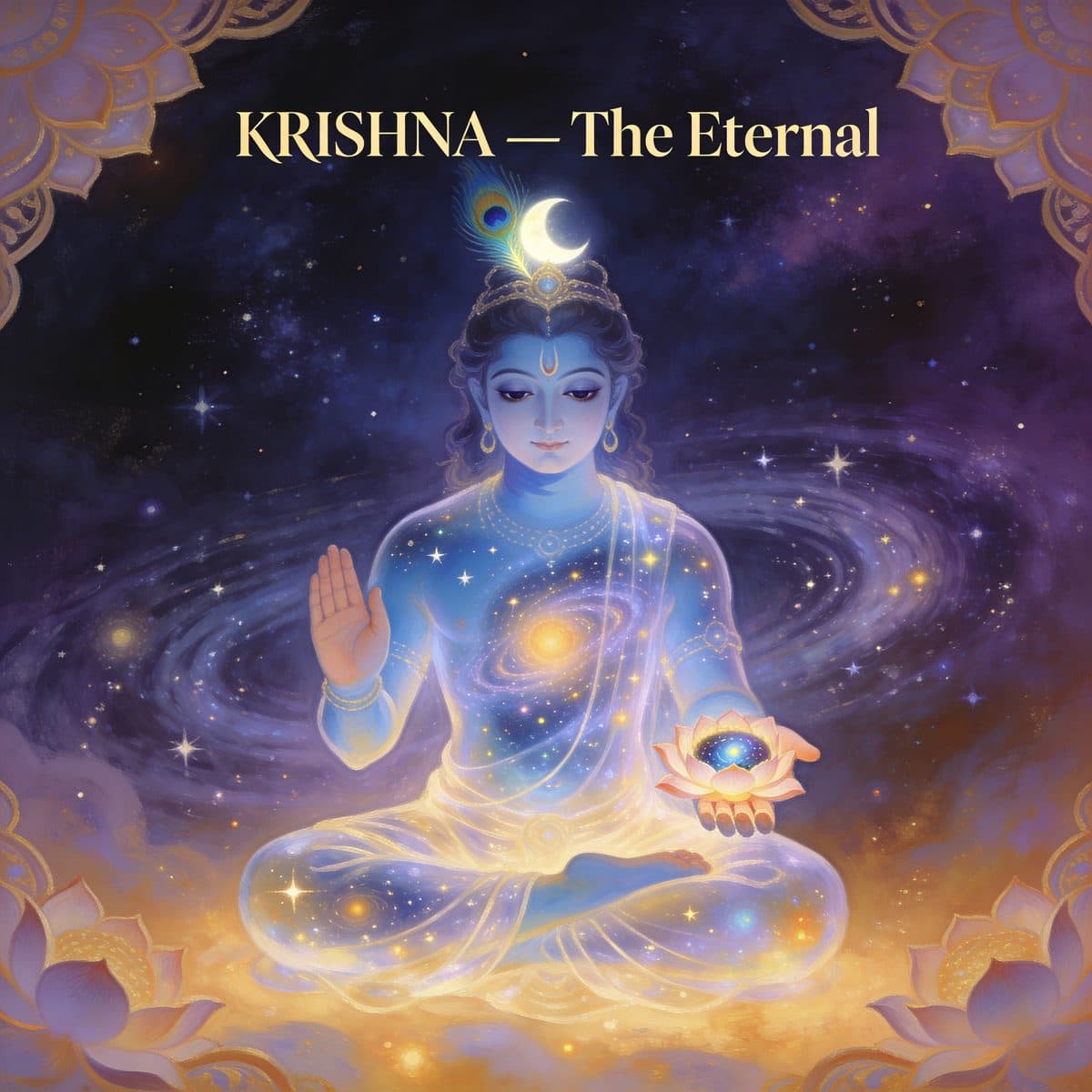
Lord Krishna
Divine TeacherThe Supreme Lord, the charioteer and divine guide of Arjuna. Krishna delivers the eternal wisdom of the Gita, revealing the nature of the soul, duty, and the path to liberation.
Speaking: Chapter 15, Verse 16
Verse 16
The Yoga of the Supreme Person
There are two persons in this world — the perishable and the imperishable. All beings are the perishable; that which stands immovably at the summit is called the imperishable.
Context & Meaning
Krishna introduces the philosophical framework for the chapter's climactic teaching. Two great categories of existence: the kṣara (perishable) — all embodied beings, all manifestations that come into form and pass away — and the akṣara (imperishable) — the unmanifest, the kūṭastha, the one who stands unmoved at the summit of all existence, like an anvil on which all change is hammered without itself being deformed. This second category is often understood as māyā-śakti or the unmanifest Prakriti — the totality of the potential from which all manifestation arises. Both are real; both are categorically distinct. But there is a third category — beyond both — which this teaching is building toward.
Scholar Commentaries
1 commentary · Public domainRamanujacharya
VishishtadvaitaKṣara is the world of all individual souls in their embodied condition — caught in change, subject to birth and death, shaped by the gunas. Akṣara is the collective unmanifest — the steady matrix of potential that underlies all manifestation. Neither is ultimate; both are subordinate to the Purushottama who will be introduced in the next verse. Ramanuja sees this tripartite scheme as fundamental to understanding God's transcendence over both his manifest and unmanifest aspects.