
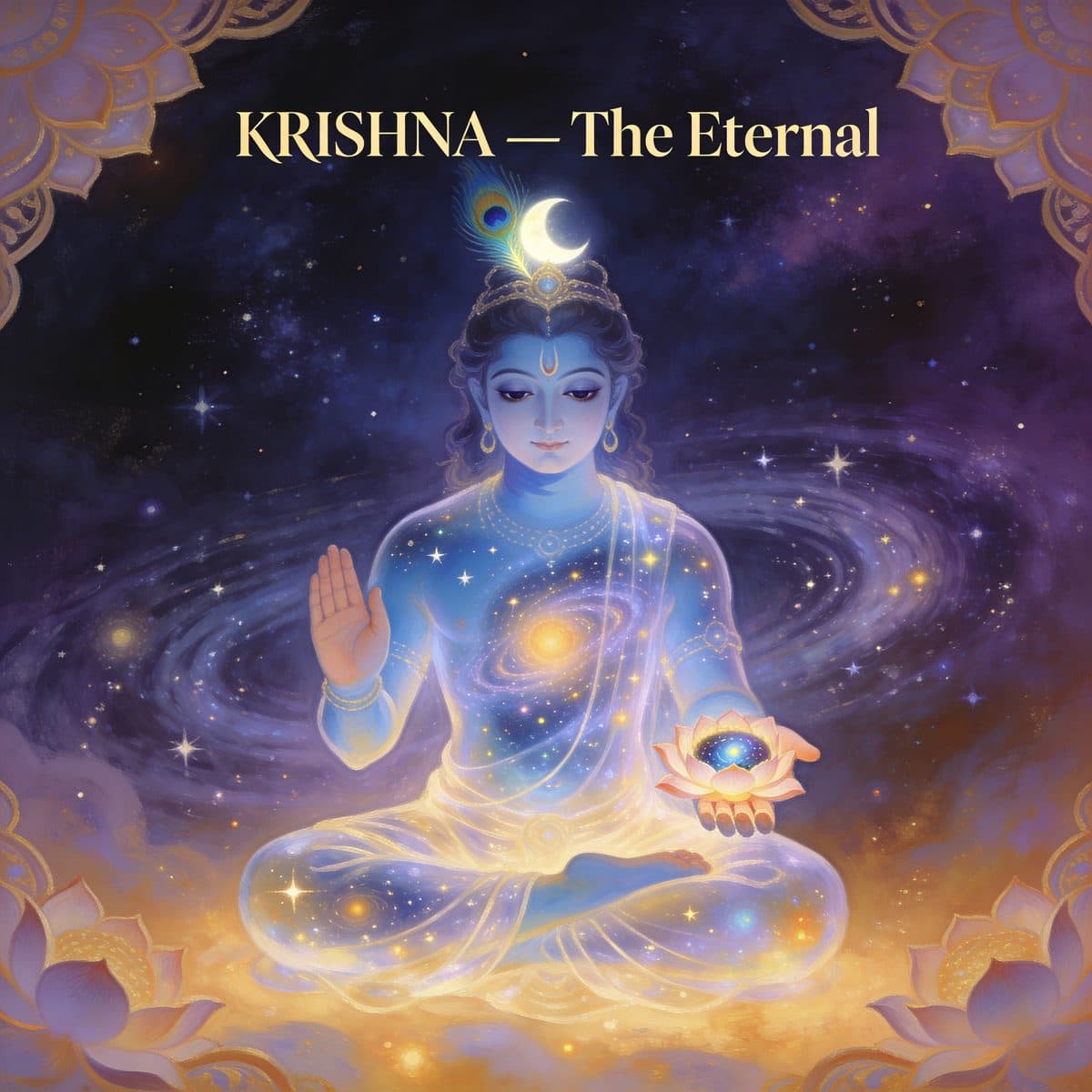
Lord Krishna
Divine TeacherThe Supreme Lord, the charioteer and divine guide of Arjuna. Krishna delivers the eternal wisdom of the Gita, revealing the nature of the soul, duty, and the path to liberation.
Speaking: Chapter 15, Verse 7
Verse 7
The Yoga of the Supreme Person
An eternal portion of Me alone becomes the individual soul in the world of the living. Drawing to itself the six senses including the mind, which abide in Prakriti.
Context & Meaning
This verse contains one of the Gita's most intimate revelations: the individual soul (jīva) is an eternal portion (sanātana aṃśa) of God Himself. Not a temporary emanation, not an illusion, not a mechanical product of matter — but an eternal fragment of the Divine. Yet in taking embodied form, this fragment draws to itself the six senses — the five senses plus the mind — which belong to Prakriti (nature). The result is the familiar human experience: a divine spark dressed in a natural instrument, pulled in multiple directions, often forgetting its own origin. This verse is a diagnosis of the human condition: divine in nature, but obscured by the machinery of sense and mind that the soul has, in some sense, chosen to operate.
Scholar Commentaries
1 commentary · Public domainMadhvacharya
DvaitaMamaivaṃśaḥ — an eternal part of Me alone. The individual soul is real, distinct from God, and eternally so. The word sanātana (eternal) confirms that the jīva's individuality is not a temporary error to be dissolved but an eternal reality. The soul's relationship with God is thus one of eternal loving distinction — the bhakta and the Beloved are always two, joined by love, never merged into indistinction.