
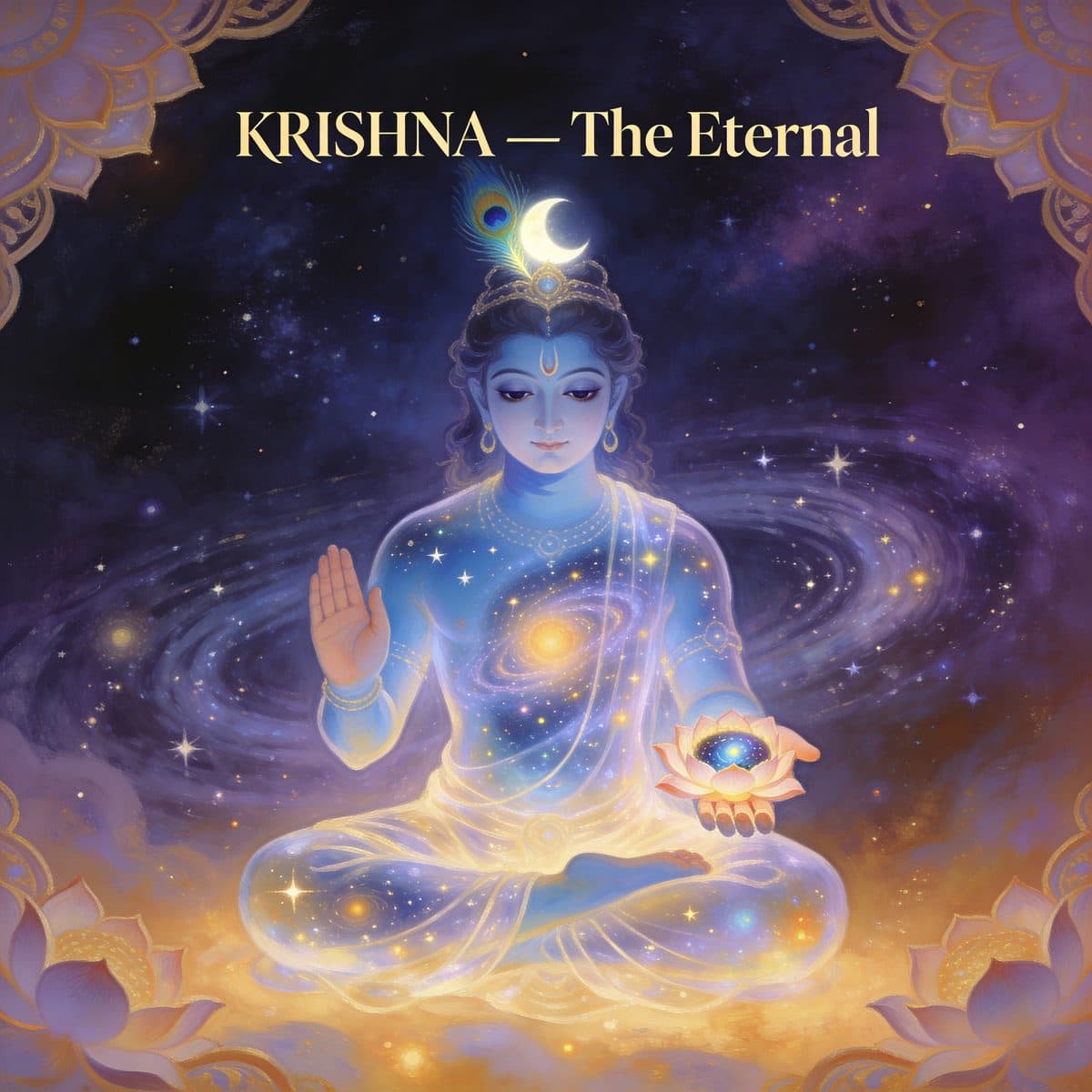
Lord Krishna
Divine TeacherThe Supreme Lord, the charioteer and divine guide of Arjuna. Krishna delivers the eternal wisdom of the Gita, revealing the nature of the soul, duty, and the path to liberation.
Speaking: Chapter 16, Verse 8
Verse 8
The Yoga of the Divine and Demonic Natures
They say: "The world is without truth, without a moral foundation, without God — born of mutual union, driven by desire alone. What other cause is there?"
Context & Meaning
Here Krishna gives us the philosophical underpinning of the demonic worldview — and it is worth recognising it because it is a worldview that appears in sophisticated forms in every age. Its three pillars are: asatya (the world is without ultimate truth — there is no Dharma written into reality), apratiṣṭha (no moral foundation — there is no objective basis for ethical claims), and anīśvara (no God — no ordering intelligence, no cosmic governance). The consequence is stated bluntly: the world arose from "mutual union" — from random biological processes — and the only cause of anything is kāma (desire). There is nothing beyond appetite. This is not merely atheism but a particular aggressive materialism that uses the absence of God to justify the supremacy of desire as the only honest principle of action.
Scholar Commentaries
1 commentary · Public domainRamanujacharya
VishishtadvaitaAnīśvaram — without God. The demonic worldview denies not merely the existence of a creator but the existence of any ordering principle that would impose obligations on the individual. If there is no God, there is no dharma; if there is no dharma, desire is the only honest master. Ramanuja sees this as the philosophical foundation that makes possible all the cruelties that follow. It is not ignorance in the ordinary sense but a deliberate rejection of the governance of the Real.