
विभूति योग
The Yoga of Divine Glories
42 VersesDescription
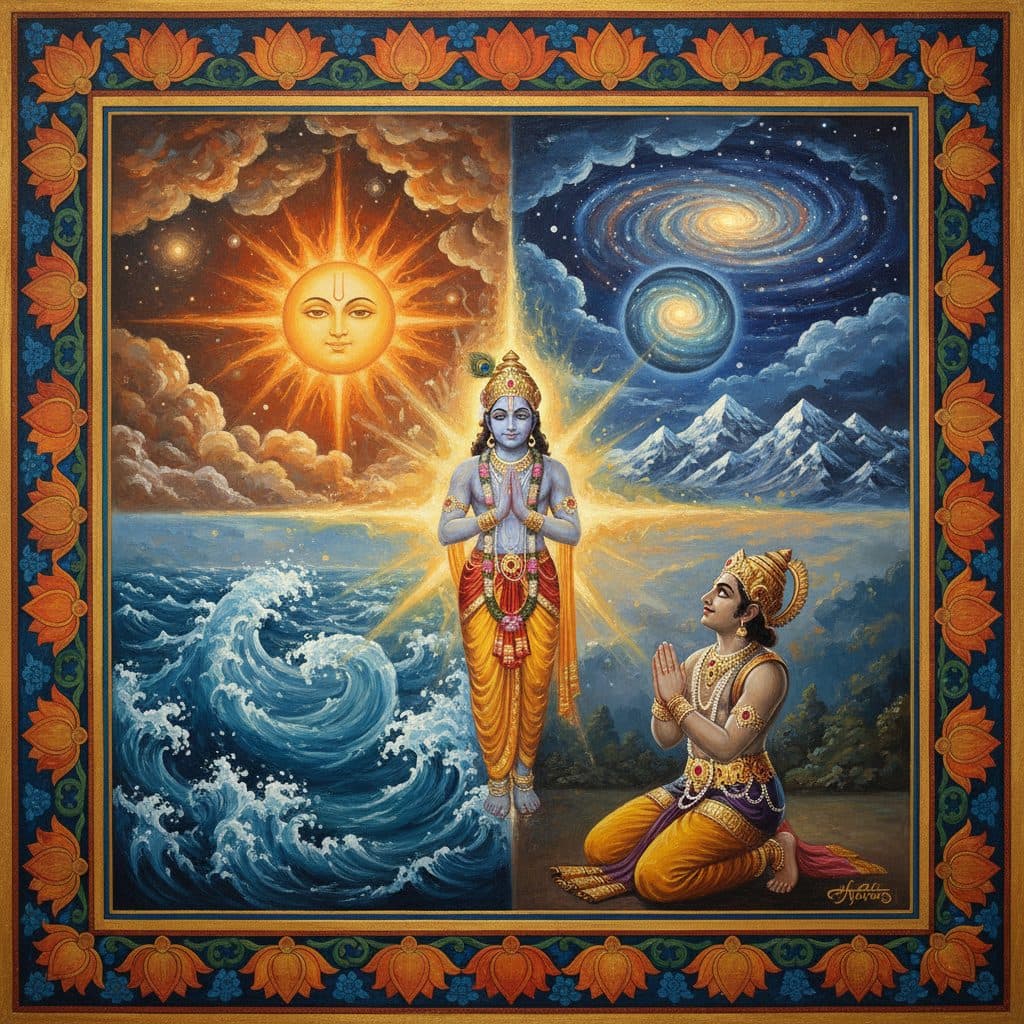
Krishna reveals his divine glories (Vibhutis) throughout creation. He declares that nothing exists that is not pervaded by him. He lists specific examples of his manifestations—among the Adityas he is Vishnu, among lights he is the sun, among senses he is the mind, among waters he is the ocean, and many more.
Location
Kurukshetra Battlefield
Characters
Watch Chapter Discourse
Video coming soon
Add a YouTube URL to the videoUrl field in chapters.ts
Chapter 10 — The Yoga of Divine Glories
Read Verses
42 of 42 availableThe Supreme Personality of Godhead said: Listen again, O mighty-armed Arjuna. Because you are My dear friend, for your benefit I shall speak to you further, giving knowledge that is better than what I have already explained.
Krishna opens Chapter 10 with an act of pure generosity. He has not been asked — He offers. And the reason He gives is tender: because you are My dear friend, and I want what is good for you. This is the spirit of a teacher who loves the student. The highest teaching flows not from obligation but from affection.
Neither the hosts of demigods nor the great sages know My origin or opulences, for, in every respect, I am the source of the demigods and sages.
Even the gods do not know the origin of the Divine — for the simple reason that the Divine is their origin. The effect cannot fully comprehend its cause. The gods and the great sages arise from Krishna; they cannot trace Him back to something prior. There is no "before" the Absolute.
He who knows Me as the unborn, as the beginningless, as the Supreme Lord of all the worlds — he only, among men, is undeluded and he is freed from all sins.
Three qualities define the complete knowledge of the Divine: unborn (aja), beginningless (anādi), supreme lord of all worlds (lokamaheśvara). The one among mortals who truly knows these three is free from delusion and released from all accumulated karma. This knowledge is not intellectual — it is transformative.
Intelligence, knowledge, freedom from doubt and delusion, forgiveness, truthfulness, control of the senses, control of the mind, happiness and distress, birth, death, fear, fearlessness —
The first half of a two-verse list of twenty qualities of inner life — from the highest (intelligence, knowledge) to the most basic (fear, fearlessness). All of these arise from the Divine. This verse begins a profound revelation: every inner state, every quality of consciousness — even the negative ones — has its source in the Supreme.
Nonviolence, equanimity, contentment, austerity, charity, fame and infamy — all these various qualities of living beings are created by Me alone.
The list concludes: non-violence, equanimity, contentment, austerity, generosity, fame, and even infamy — all arise from the one Source. Fame and infamy both. The Divine is not the author only of the good qualities but of the full spectrum of experience. Everything that occurs within consciousness is ultimately rooted in the Divine ground.
The seven great sages and before them the four other great sages and the Manus came from Me, born from My mind, and all the living beings populating the various planets descended from them.
The entire lineage of creation — the primordial sages, the Manus (progenitors of humanity), and through them all living beings across all worlds — traces back to the Divine mind. The family tree of existence has one root. Every being alive is a descendant of the Supreme.
One who is actually convinced of this opulence and mystic power of Mine engages in unalloyed devotional service; of this there is no doubt.
Knowing the divine glories in truth — not as intellectual information but as living conviction — naturally gives rise to unwavering yoga. The connection is direct: when you truly see the Divine in all things, devotion is the only response. Understanding and love are not separate; genuine understanding of the Divine becomes love.
I am the source of all spiritual and material worlds. Everything emanates from Me. The wise who perfectly know this engage in My devotional service and worship Me with all their hearts.
Everything — spiritual and material, subtle and gross, sacred and mundane — emanates from the one Source. The wise, knowing this, worship the Source with their whole being (bhāvasamanvitāḥ — endowed with feeling and love). This is one of the clearest statements of divine origin in all of scripture.
The thoughts of My pure devotees dwell in Me, their lives are fully devoted to My service, and they derive great satisfaction and bliss from always enlightening one another and conversing about Me.
A beautiful portrait of the devotional community: minds anchored in the Divine, lives surrendered to service, hearts constantly sharing and deepening each other's understanding. The joy described — tuṣyanti (satisfaction) and ramanti (delight) — is not the forced cheerfulness of spiritual performance but the natural bliss of a soul living in its element.
To those who are constantly devoted to serving Me with love, I give the understanding by which they can come to Me.
The most intimate gift: the Divine itself gives the intelligence needed to reach the Divine. The devoted soul does not have to earn or manufacture this understanding — it is given from within, by the very One being sought. This is the inner guru, the divine intelligence that blooms in the sincere heart. Seeking and finding are not separate acts.
To show them special mercy, I, dwelling in their hearts, destroy with the shining lamp of knowledge the darkness born of ignorance.
Out of compassion (anukampā), Krishna Himself destroys the darkness of ignorance from within the devotee's own heart with the blazing lamp of knowledge. The image is extraordinarily tender: the Supreme, dwelling as the innermost Self, personally illuminates what obscures itself. The seeker does not ultimately find God — God finds the seeker, from the inside.
Arjuna said: You are the Supreme Personality of Godhead, the ultimate abode, the purest, the Absolute Truth. You are the eternal, transcendental, original person, the unborn, the greatest.
Arjuna erupts in recognition and praise. This is not a student answering an exam — it is a human heart overwhelmed by the direct presence of the Divine. His words are not theology but testimony: "You are all this. I see it now." The devotee has become the knower.
All the great sages like Narada, Asita, Devala, and Vyasa proclaim this of You, and now You Yourself are declaring it to me.
Arjuna calls upon the authority of the greatest seers: Narada, Asita, Devala, Vyasa — and then adds the most powerful testimony of all: "and now You Yourself are telling me." The sages saw it from a distance; Arjuna is receiving it directly, personally, in this very moment. This is the incomparable privilege of immediate presence.
O Krishna, I totally accept as truth all that You have told me. Neither the demigods nor the demons, O Lord, can understand Your personality.
Arjuna offers complete acceptance — not skeptical analysis but total trust. And he understands why: neither gods nor demons can fully comprehend the Divine personality. The student who says "I totally believe you" is not being naive — he is recognizing that some truths transcend the reach of ordinary reasoning and can only be received through the open heart.
Indeed, You alone know Yourself by Your own internal potency, O Supreme Person, origin and Lord of all beings, God of gods, Lord of the universe!
Only the Divine knows itself completely through its own power. No external means — no scripture, no inference, no tradition — can exhaust the knowledge of the Supreme. It knows itself by itself. And yet it chooses to share that self-knowledge with the beloved devotee. The teaching of the Gita is therefore a divine act of self-disclosure.
Please tell me in detail of Your divine glories by which You pervade all these worlds and abide in them.
Arjuna asks for the full account of the divine glories (vibhūtis) — the specific, named ways in which the Supreme pervades and sustains all worlds. This question opens the heart of the chapter: an extraordinary catalogue of divine manifestations across every domain of existence.
How should I meditate on You? In what various forms are You to be thought of, O Blessed Lord?
A deeply practical question from a devotee: give me something to hold onto. In the midst of daily life and meditation, in what specific forms can I recognize and contemplate You? Arjuna is asking for the handles by which an ordinary mind can grasp the Infinite. The answer will be the great catalogue of divine glories that follows.
Tell me again in detail, O Janardana, of Your mystic power and glories, for I never tire of hearing Your nectar-like words.
Arjuna calls Krishna's words amṛtam — nectar, the drink of immortality. He cannot get enough. This is the sign of genuine spiritual thirst: hearing the truth about the Divine does not satisfy the craving — it deepens it. Each word about the Supreme opens a greater hunger for the next.
The Blessed Lord said: Yes, I will tell you of My splendorous manifestations, but only of those which are prominent, O best of the Kurus, for My opulence is limitless.
Krishna gives a remarkable concession: even He cannot enumerate all His manifestations exhaustively — for His glory is literally limitless. What follows is a selection of the most prominent, a representative sample from an infinite catalogue. This humility within omnipotence is itself a teaching.
I am the Self, O Gudakesa, seated in the hearts of all creatures. I am the beginning, the middle and the end of all beings.
Before listing external manifestations, Krishna names the most intimate one: I am the Self seated in every heart. Not an external power or a distant deity — but the innermost reality of every single being. And I am their beginning, middle, and end. The Divine is not somewhere in the list of things — it is the ground on which the list stands.
Of the Adityas I am Vishnu; of lights I am the radiant sun; of the Maruts I am Marichi; and among the stars I am the moon.
The catalogue of divine glories begins. Among the solar deities: Vishnu — the all-pervading. Among lights: the sun — the supreme luminary. Among the storm-gods: Marichi — the swiftest. Among the stars: the moon — the sovereign of the night sky. In each domain, the Supreme is the most excellent, the most powerful, the most radiant representative.
Of the Vedas I am the Sama Veda; of the demigods I am Indra, the king of heaven; of the senses I am the mind; and in living beings I am the living force (consciousness).
Among the Vedas: the Sama Veda — the Veda of sacred song and melody, the most musical and devotional. Among the gods: Indra — the king of heaven. Among the senses: the mind — the master sense that commands all others. Among living beings: consciousness itself — the life force that makes life possible.
Of all the Rudras I am Lord Shiva; of the Yakshas and Rakshasas I am the Lord of wealth, Kuvera; of the Vasus I am fire; and of mountains I am Meru.
Among the Rudras: Shiva — the great destroyer and bestower of grace. Among the wealth-spirits: Kuvera — the lord of all riches. Among the eight Vasus: fire (Pavaka) — the purifying, transforming force. Among mountains: Meru — the cosmic axis, the golden peak at the center of the universe. The greatest of every category.
Of priests, O Arjuna, know Me to be the chief, Brihaspati. Of generals I am Kartikeya, and of bodies of water I am the ocean.
Among priests and preceptors: Brihaspati — the divine teacher, wisdom itself. Among generals and commanders: Skanda (Kartikeya) — the divine warrior, embodiment of victorious power. Among bodies of water: the ocean — vast, deep, containing multitudes. Each manifestation is the most supreme in its sphere.
Of the great sages I am Bhrigu; of vibrations I am the transcendental Om; of sacrifices I am the chanting of the holy names, and of immovable things I am the Himalayas.
Among the great sages: Bhrigu — the eldest, most powerful. Among all sounds and vibrations: Om — the primordial syllable of the universe. Among all sacrifices: japa (silent repetition of the divine name) — considered the highest form of worship. Among immovable things: the Himalayas — eternal, towering, a symbol of permanence and the spiritual quest.
Of all trees I am the Ashvattha tree; of the divine sages I am Narada; of the Gandharvas I am Chitraratha; and among perfected beings I am the sage Kapila.
Among trees: the Ashvattha (sacred fig / Bodhi tree) — the tree of life, under which the Buddha attained enlightenment, sacred across traditions. Among divine sages: Narada — the celestial musician and supreme devotee, who carries divine love across all worlds. Among Gandharvas: Chitraratha — the most beautiful musician of heaven. Among perfected sages: Kapila — founder of the Sankhya system of philosophy.
Of horses know Me to be Uccaihshrava, produced during the churning of the ocean; of lordly elephants I am Airavata; and among men I am the monarch.
Among horses: Uccaihshrava — the divine white horse born from the churning of the cosmic ocean, emblem of speed and purity. Among elephants: Airavata — Indra's magnificent white elephant, foremost of all elephants. Among human beings: the monarch, the king — the one who bears the fullest responsibility and the highest power. The greatest of each kind.
Of weapons I am the thunderbolt; among cows I am the surabhi. Of causes for procreation I am Kandarpa, the god of love; and of serpents I am Vasuki.
Among weapons: the thunderbolt (vajra) — the weapon forged from the bones of a sage, symbol of invincible divine power. Among cows: Kamadhenu — the wish-fulfilling divine cow. Among the forces of creation: Kamadeva — the god of love, the creative impulse. Among serpents: Vasuki — the great cosmic serpent who served as the churning rope of the universe.
Of the many-hooded Nagas I am Ananta; of the aquatic deities I am Varuna. Of departed ancestors I am Aryama; and among the dispensers of law I am Yama, the lord of death.
Among the Nāgas (great serpent beings): Ananta — the infinite, the serpent on whom Vishnu rests, whose very name means "without end." Among ocean deities: Varuna — the ancient god of cosmic order. Among the ancestors: Aryama — the noble one who governs the ancestral realm. Among the dispensers of justice: Yama — the god of death who keeps the cosmic moral order.
Among the Daityas I am the devoted Prahlada, among subduers I am time, among beasts I am the lion, and among birds I am Garuda.
Among the demonic Daityas: Prahlada — the great devotee who could not be destroyed even by his own demon father, whose love for Vishnu burned through every trial. Among all that conquers: Time — the great leveler that subdues everything. Among animals: the lion — sovereign of the forest. Among birds: Garuda — the divine eagle, vehicle of Vishnu, the king of all birds.
Of purifiers I am the wind; of the wielders of weapons I am Rama; of fishes I am the shark; and of flowing rivers I am the Ganges.
Among purifiers: the wind (Pavana, literally "the purifier") — which cleanses everything it touches. Among warriors who bear weapons: Rama — the ideal king, the embodiment of dharma, the perfect warrior-devotee. Among fish: the Makara — the great sea creature, symbol of the unfathomable deep. Among rivers: the Ganges — most sacred, most purifying, source of spiritual life.
Of all creations I am the beginning and the end and also the middle, O Arjuna. Of all sciences I am the spiritual science of the Self, and among logicians I am the conclusive truth.
Among all created things: the beginning, middle, and end — the entire arc of existence. Among all forms of knowledge: adhyātma-vidyā — the science of the Self, the inner knowledge that leads to liberation. Among all forms of reasoning and debate: the conclusive truth (vāda) — not argument for its own sake, but the reasoning that arrives at and rests in reality.
Of letters I am the letter A, and among compound words I am the dual compound. I am also inexhaustible time, and of creators I am Brahma.
Among letters: "A" — the first sound, the root of all speech, the very beginning of language in Sanskrit. Among compound words: the dvandva (dual compound, "A and B") — the most balanced, most natural form. Among all that measures and governs: inexhaustible Time itself. Among creators: Brahma — the four-faced creator of the universe.
I am all-devouring death, and I am the generating principle of all that is yet to be. Among women I am fame, fortune, fine speech, memory, intelligence, steadfastness and patience.
Among forces that pervade all things: all-consuming death AND the generating principle of all future beings — the full sweep of time from dissolution to creation. Among the noblest qualities of womanhood: fame, beauty, eloquent speech, memory, intelligence, steadfastness, and patience. The Divine is the best of every quality, the fullest expression of every virtue.
Of the hymns in the Sama Veda I am the Brihatsama; of poetry I am the Gayatri. Of months I am Margashirsha (November-December), and of seasons I am flower-bearing spring.
Among the Sama Veda hymns: the Brihat-sama — the grandest, most solemn chant. Among all poetic meters: the Gayatri — the most sacred verse of the Vedas, the mother of all meters. Among the months: Margashirsha — considered the most auspicious, when the harvest is complete and the weather is clear. Among the seasons: spring — when the earth blooms and life renews.
I am also the gambling of cheats, and of the splendid I am the splendor. I am victory, I am adventure, and I am the strength of the strong.
A striking inclusion: among those who deceive, even deception at its most cunning belongs to the Divine. Among the radiant, the very quality of radiance. Among all outcomes, victory itself. Among all enterprises, the boldness to attempt. Among the strong, the quality of strength. Even what we call negative — deception — has a divine counterpart: the cosmic creative māyā of the Supreme.
Of the descendants of Vrishni I am Vasudeva, and of the Pandavas I am Arjuna. Of the sages I am Vyasa, and among great thinkers I am Usana.
Among the Vrishni clan: Vasudeva (Krishna Himself — a rare moment of self-reference in the list). Among the Pandavas: Arjuna — who is both the student and now named a divine manifestation. Among all sages: Vyasa — the compiler of the Vedas and author of the Mahabharata. Among all visionary poets and thinkers: Usana (Shukracharya) — the most brilliant. Krishna names Arjuna as a divine glory — perhaps the deepest compliment in the entire text.
Among all means of suppressing lawlessness I am punishment; among those who seek victory I am morality; of secret things I am silence, and of the wise I am wisdom.
Among all corrective forces: righteous punishment — the discipline that restores order. Among strategies of victory: ethics, right conduct — the morality that sustains lasting triumph. Among secrets: silence — the deepest secret of all, beyond words. Among the wise: wisdom itself — not information, but the living understanding that sees through appearances to truth.
Furthermore, O Arjuna, I am the generating seed of all existences. There is no being — moving or nonmoving — that can exist without Me.
The summary principle behind the entire catalogue: I am the seed of all beings. There is nothing — in all of existence, animate or inanimate, moving or still — that exists without Me. The list of vibhūtis is not exhaustive but illustrative. The underlying truth is total: there is no corner of reality in which the Divine is absent.
O mighty conqueror of enemies, there is no end to My divine manifestations. What I have spoken to you is but a mere indication of My infinite opulences.
The list ends not with a conclusion but with an admission of incompleteness. There is no end to divine manifestations. What has been shared is a sample — a finger pointing at the moon. The entire catalogue, vast as it has been, is only an introduction to a glory that has no boundary.
Know that all opulent, beautiful and glorious creations spring from but a spark of My splendor.
The most practical teaching of the chapter: wherever you encounter beauty, excellence, splendor, or power in any form — know it as a spark of the Divine. You do not need to read a list. Train the eye to see: magnificence is always a trace of the Source. Every sunrise, every act of genius, every moment of deep beauty — a spark of the Supreme.
But what need is there, Arjuna, for all this detailed knowledge? With a single fragment of Myself I pervade and support this entire universe.
The magnificent closing of Chapter 10. After forty verses of divine catalogue, Krishna waves it all aside with a single, breathtaking statement: what use is all this detail? Know only this — with a single fragment of Myself, I pervade and sustain the entire universe. The immensity of the catalogue was itself just a hint at something even more immense. The whole of creation is held by just one portion of the Divine.
Key Teachings
- •God pervades everything in creation
- •The best in every category is a manifestation of God
- •Knowing these glories helps one realize God