
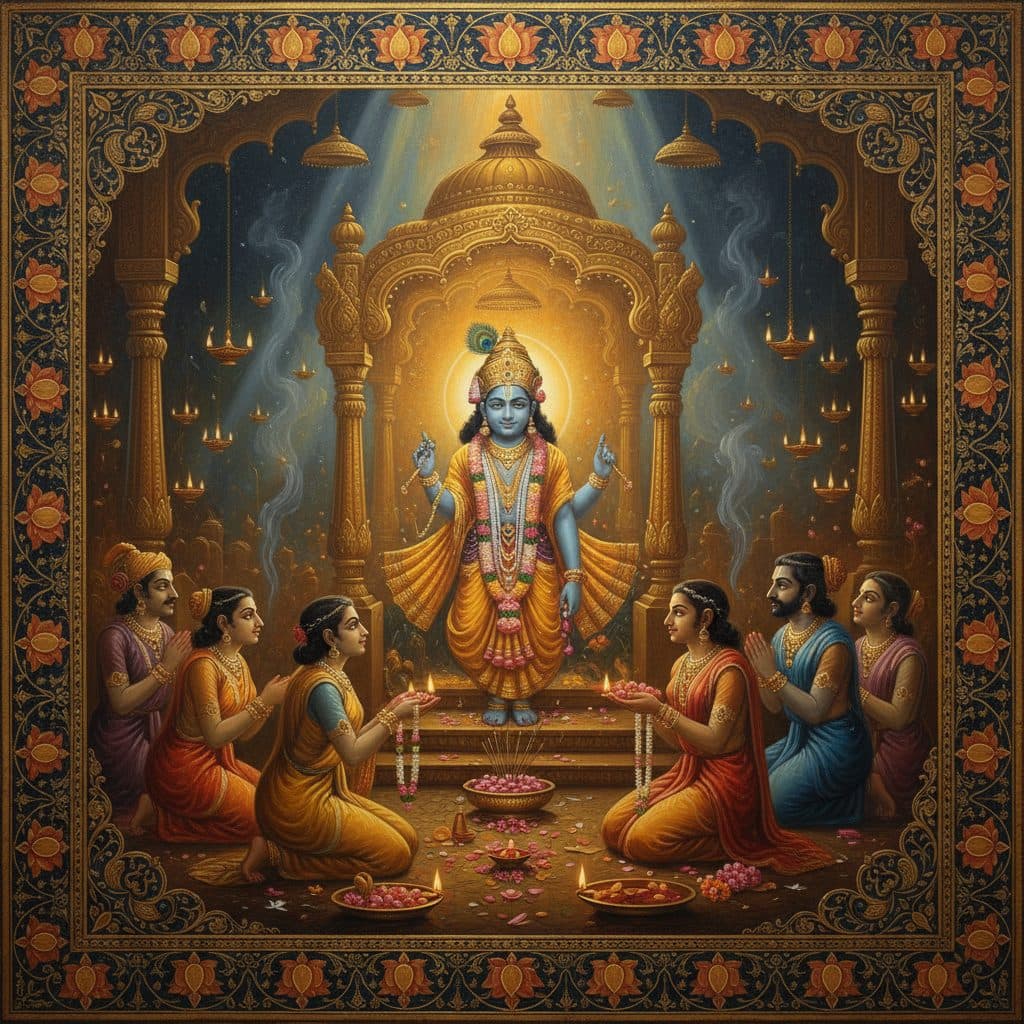
भक्ति योग
The Yoga of Devotion
20 VersesDescription
Arjuna asks whether it is better to worship the personal form of God or the impersonal Brahman. Krishna explains that while both paths lead to liberation, the path of devotion to the personal God is easier and more direct. He describes the qualities of an ideal devotee—free from hatred, compassionate, forgiving, equal-minded in joy and sorrow, and devoted to God.
Location
Kurukshetra Battlefield
Characters

Watch Chapter Discourse
Video coming soon
Add a YouTube URL to the videoUrl field in chapters.ts
Chapter 12 — The Yoga of Devotion
Read Verses
20 of 20 availableArjuna said: Of those who are ever steadfast and worship You with devotion, and those who worship the imperishable and the unmanifest—which of these have the greater knowledge of Yoga?
Coming immediately after the cosmic vision of Chapter 11, Arjuna poses one of the most practical questions of the entire Gita: is it better to worship the personal God — the Krishna who stands before him — or the impersonal, formless Absolute? This is not an abstract philosophical puzzle; it is the question of which path of practice is highest. The question reflects a genuine seeker's desire to know the most efficient route to liberation.
The Supreme Personality of Godhead said: Those who fix their minds on Me and worship Me with steadfast faith and devotion—I consider them to be the most perfect in Yoga.
Krishna answers directly and without hesitation: devotion to the personal God is the highest form of Yoga. The three qualities He highlights are: fixing the mind on Him (māyyāveśya manaḥ), being ever united (nityayuktāḥ), and possessing supreme faith (śraddhayā parayā). Together these describe a life completely absorbed in the Divine — not as a philosophy but as an ongoing reality of consciousness.
But those who worship the imperishable, the undefinable, the unmanifest, the omnipresent, the inconceivable, the immovable, the eternal—
This verse begins a two-verse description of the path of the unmanifest Absolute (akṣara-upāsanā). The qualities listed — undefinable, unmanifest, omnipresent, inconceivable, immovable, eternal — describe Brahman as it is beyond all attributes. This path is real and leads to liberation, but its characteristics already hint at the difficulty: how does one relate to what is inconceivable? How does one love what cannot be defined?
Controlling all the senses, even-minded everywhere, engaged in the welfare of all beings—they too attain Me.
Those who follow the path of the unmanifest also attain the Divine — but notice the qualifications: complete sense control, equanimity everywhere, and active dedication to the welfare of all beings. These are extremely demanding conditions. Krishna does not deny the validity of this path; He affirms that it leads to Himself. But the very qualifications He lists reveal that this path demands a completeness of discipline that is rare.
For those whose minds are attached to the unmanifest, the path is very difficult. The goal of the unmanifest is very hard to reach for embodied beings.
Krishna delivers the decisive verdict with compassion rather than judgment: the path of the unmanifest is harder for embodied beings. The reason is philosophical and practical. The unmanifest has no form, no name, no qualities — nothing for the embodied mind to hold onto. Human consciousness is built for relationship, for encounter, for love of a Someone. The effort to sustain meditation on something formless and inconceivable is genuinely arduous — not because the path is wrong, but because embodied consciousness gravitates toward form.
But those who worship Me with exclusive devotion, surrendering all actions to Me, meditating on Me with undivided yoga—
Having acknowledged the difficulty of the impersonal path, Krishna now describes his preferred devotees more fully. Two characteristics stand out: they surrender all actions to Him (sarva-karmāṇi mayi saṃnyasya) and they worship with undivided, exclusive devotion (ananyena yogena). These are not two separate requirements but one: when all action is surrendered to God, the mind naturally becomes undivided. The surrender of action is the mechanism of devotional yoga.
For those whose minds are set on Me, O Arjuna, I am the swift deliverer from the ocean of death-bound existence.
This is one of the most direct and personal promises in all of scripture: "I will save you." Krishna does not describe an abstract process of liberation; He declares Himself to be the active agent of deliverance. The word samuddhartā means "one who lifts up completely" — not partial rescue but total upliftment from the ocean of repeated birth and death. And the timeframe: nacirāt — swiftly, without delay. The personal God promises not just eventual liberation but swift liberation.
Fix your mind on Me alone, rest your intellect in Me. You will live in Me hereafter. Of this there is no doubt.
The instruction is beautifully simple: mind on Me, intellect in Me. Nothing else is required. And the outcome is stated without qualification: you will dwell in Me — na saṃśayaḥ, there is no doubt. In a text that often acknowledges the complexity and difficulty of spiritual practice, this verse stands as a moment of absolute certainty. The simplicity of the instruction is itself the teaching: do not complicate the path. Rest everything in the Divine.
If you cannot fix your mind steadily on Me, then seek to reach Me through the practice of repeated effort, O Arjuna.
Recognizing that not everyone can immediately achieve one-pointed concentration, Krishna descends to meet the practitioner where they are. If immediate absorption is not possible, then abhyāsa — disciplined, repeated practice — is the path. Abhyāsa is the yoga of again and again: the mind wanders, you bring it back; it wanders, you bring it back. No frustration, no judgment — just patient, steady repetition. This verse is deeply compassionate; it acknowledges the reality of the struggling seeker without abandoning them.
If you are unable even to practice, be intent on doing works for My sake; performing actions for Me, you will attain perfection.
Krishna descends another step. If sustained meditation practice is beyond reach, then karma — dedicated action — is the path. Do everything as an offering to God. This is not a lesser teaching but an alternative entry point into the same realization. The householder who cooks as an offering, the artisan who crafts as worship, the parent who raises children as seva — all can attain perfection through this path. The key is the orientation: madartham — for My sake.
If you are unable to do even this, taking refuge in union with Me, perform all actions, giving up their fruits, with self-restraint.
And if even dedicated action is difficult, there is still a path: simply give up the fruits of all action. This is the Karma Yoga of Chapter 3, here positioned as the beginning step for those who cannot yet orient their actions as offerings. Renunciation of fruits (phala-tyāga) removes the ego's investment in outcomes and begins the gradual purification of the heart. This is the bottom rung of a ladder that reaches to the highest. No one is left without a way.
Better is knowledge than practice; better than knowledge is meditation; better than meditation is renunciation of the fruit of action, for peace immediately follows renunciation.
This verse offers a hierarchy in an unexpected direction: it places renunciation of fruits above meditation, and meditation above mere knowledge. Practice without understanding is mechanical; knowledge without meditation remains intellectual; meditation without renunciation of fruits can still harbor subtle ambition. But renunciation of fruits — genuine surrender of the outcome — produces immediate peace. The word anantaram means "immediately after" — peace is not distant, not conditional on some future enlightenment. It is the immediate consequence of genuine letting go.
One who has no hatred toward any being, who is friendly and compassionate, free from possessiveness and ego, equal in pain and pleasure, forgiving—
Here begins one of the most beautiful passages in the Gita — a seven-verse portrait of the ideal devotee. These are not prescriptions to follow but descriptions of what a person naturally becomes when they are established in God. Absence of hatred toward any being, active friendliness and compassion, freedom from possessiveness and ego, equanimity in pleasure and pain, and the capacity to forgive — these qualities arise spontaneously from genuine devotion. They are not forced virtues but natural expressions of a transformed heart.
Ever content, the yogi who is self-controlled, of firm conviction, with mind and intellect dedicated to Me—such a devotee is dear to Me.
The verse concludes with the direct declaration: sa me priyaḥ — this one is dear to Me. Contentment (santuṣṭaḥ) is emphasized as perpetual, not occasional. The yogi is self-controlled, firm in conviction, and has offered both mind and intellect to God. This is total surrender — not just action (as in verse 10), not just fruits (as in verse 11), but the very instruments of knowing and willing are dedicated to the Divine. And God calls such a person dear.
One who does not disturb the world, and who is not disturbed by the world, who is free from joy, envy, fear, and anxiety—that person is dear to Me.
A remarkable balance: this person neither disturbs others nor is disturbed by others. They have achieved what might be called spiritual non-reactivity — not indifference or coldness, but the stability of one rooted in the Divine. The freedom from harṣa (elation), amarṣa (anger/envy), bhaya (fear), and udvega (anxiety) describes a person who has transcended the ordinary oscillations of emotional life — not by suppression, but by having found a deeper source of wellbeing.
One who is free from dependency, pure, efficient, unconcerned, free from suffering, who has given up all undertakings for personal gain—that devotee is dear to Me.
The portrait deepens: this person needs nothing (anapekṣaḥ), is internally and externally pure (śuciḥ), is capable and efficient in whatever must be done (dakṣaḥ), remains uninvested in outcomes (udāsīnaḥ), and is free from existential anxiety (gatavyathaḥ). Most strikingly, they have abandoned all undertakings motivated by personal gain (sarvārambha-parityāgī). This does not mean they do nothing — it means everything they do is offered, not accumulated. They are active without agenda.
One who neither rejoices nor grieves, who neither laments nor desires, who has given up both auspicious and inauspicious things, and who is full of devotion—is dear to Me.
The fourfold freedom: no excessive rejoicing, no hatred, no grief over the past, no craving for the future. This is not emotional flatness but the equanimity of one who is anchored in the eternal. Most striking is the phrase śubhāśubha-parityāgī — one who has given up both the auspicious and the inauspicious. This means the devotee is beyond the framework of results altogether. They do not pursue good outcomes and avoid bad ones; they act from devotion, leaving the categorization of results to God.
Equal toward enemy and friend, in honor and dishonor, in cold and heat, in pleasure and pain, free from attachment—
The equanimity described here is comprehensive: equal toward enemy and friend (the social dimension), equal in honor and dishonor (the reputational dimension), equal in heat and cold, pleasure and pain (the physical dimension). And overarching all: saṅga-vivarjitaḥ — free from attachment. This is not indifference to others but freedom from the ego's investment in how others regard oneself. The person who can be equally present to enemy and friend has transcended the self-protective partitioning of experience.
One who is equal in criticism and praise, silent, content with anything, homeless, steady-minded, and full of devotion—that person is dear to Me.
The final qualities of the ideal devotee are intensely practical. They are equal toward praise and criticism — unmoved by both the flattering and the hostile word. They are mauni — not necessarily physically silent, but inwardly still, not agitated by words. They are content with whatever comes (santuṣṭo yena kenacit). They are aniketaḥ — without a fixed home, attached to no particular place or situation. And sthira-mati — steady of mind, unwavering in conviction. Together these paint a portrait of radical inner freedom.
Those who honor this immortal teaching of dharma as described, endowed with faith and devoted to Me as the supreme goal—those devotees are exceedingly dear to Me.
The chapter concludes with a benediction. Those who receive this teaching with faith, who honor it not merely intellectually but through lived practice, and who regard God as the supreme goal — these are atīva priyāḥ — exceedingly, supremely dear. The word amṛtam — immortal, nectar — applied to the teaching is significant. This is not merely good advice; it is the nectar of immortality. To absorb and live by this teaching is itself a form of liberation. The chapter ends where it begins: in the intimacy between the devotee and God.
Key Teachings
- •Devotion to the personal God is the easiest path
- •True devotion transcends ritualistic worship
- •The ideal devotee is dear to God