
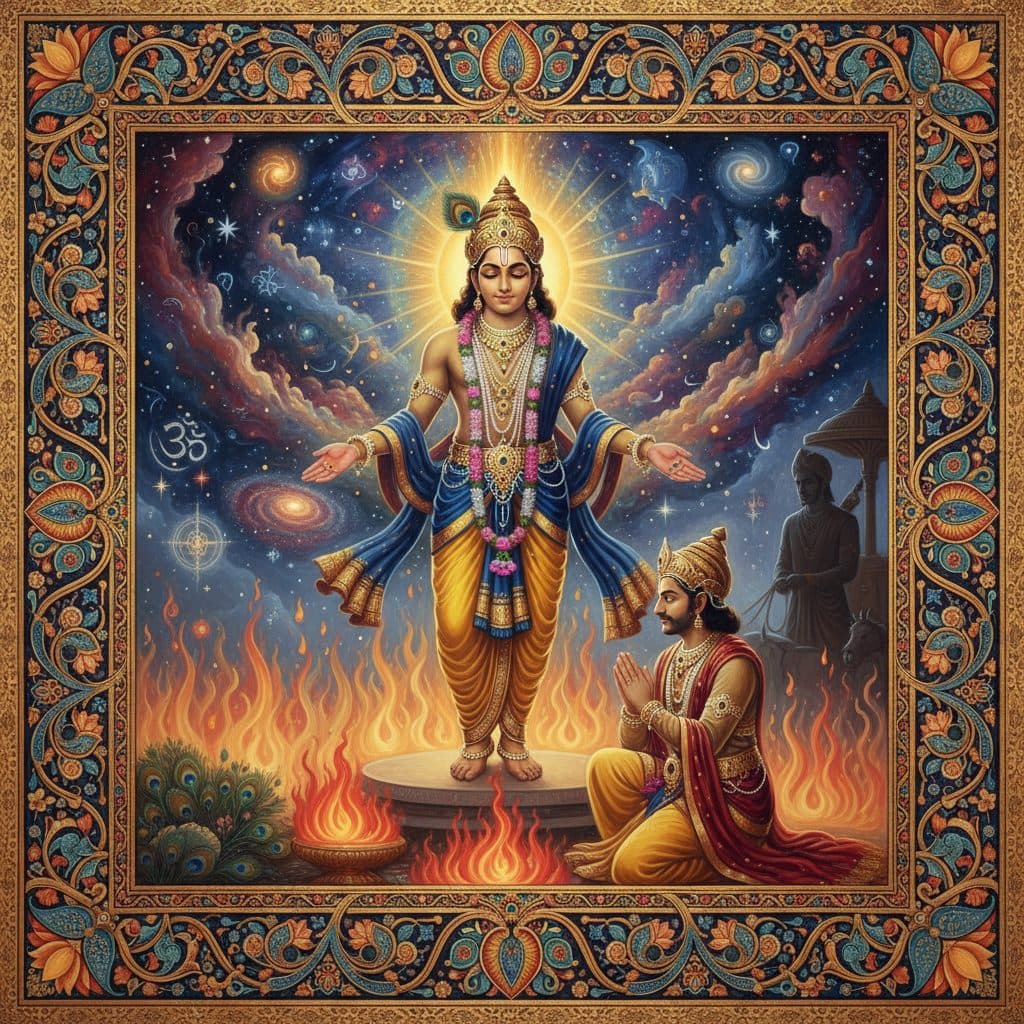
ज्ञान कर्म संन्यास योग
The Yoga of Knowledge and Action
42 VersesDescription
Krishna reveals the ancient lineage of this knowledge and declares that he incarnates in every age to restore dharma. He explains different types of sacrifices (Yajnas) and the superiority of knowledge over ritualistic sacrifices. The chapter concludes with the famous verse urging Arjuna to destroy ignorance with the sword of knowledge.
Location
Kurukshetra Battlefield
Characters
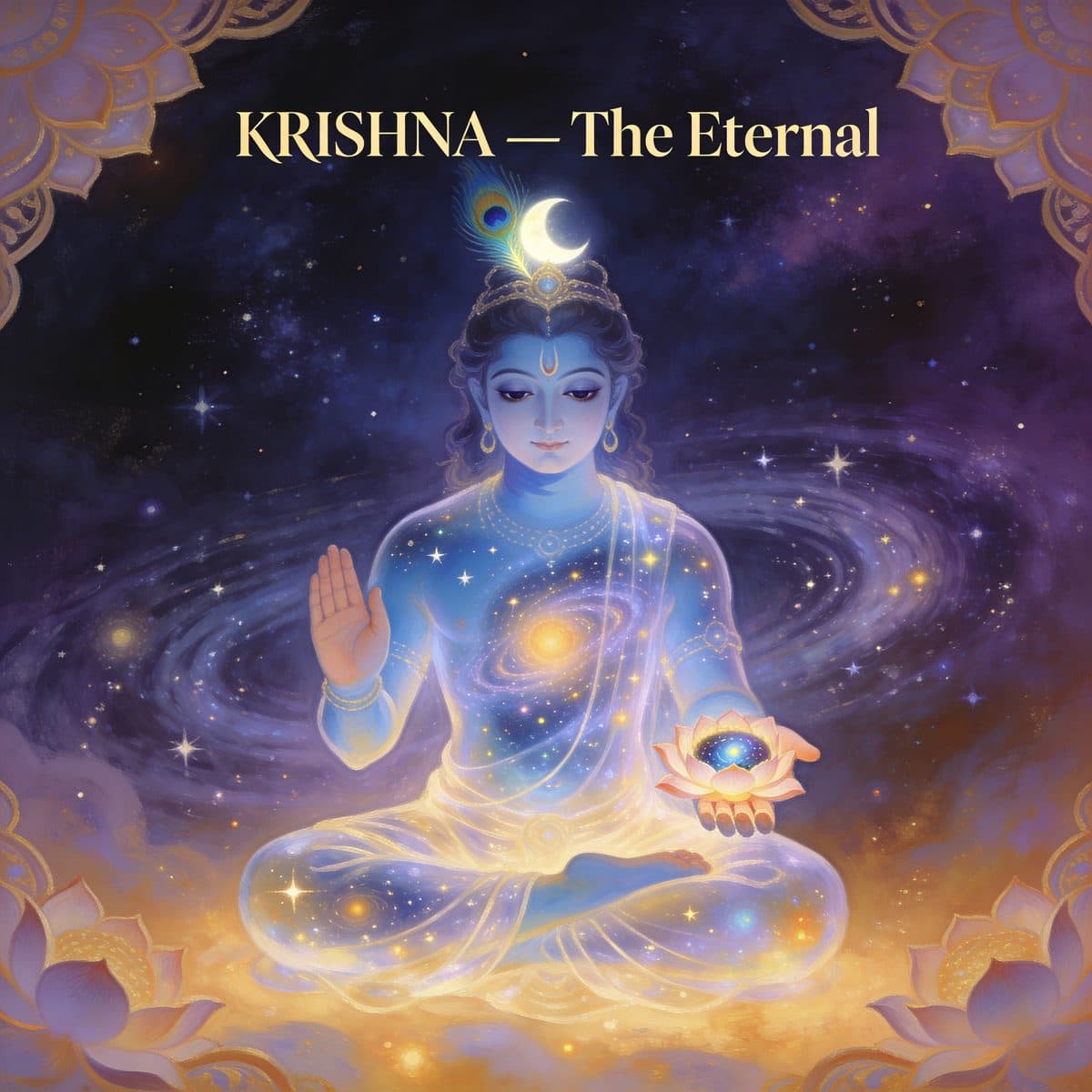
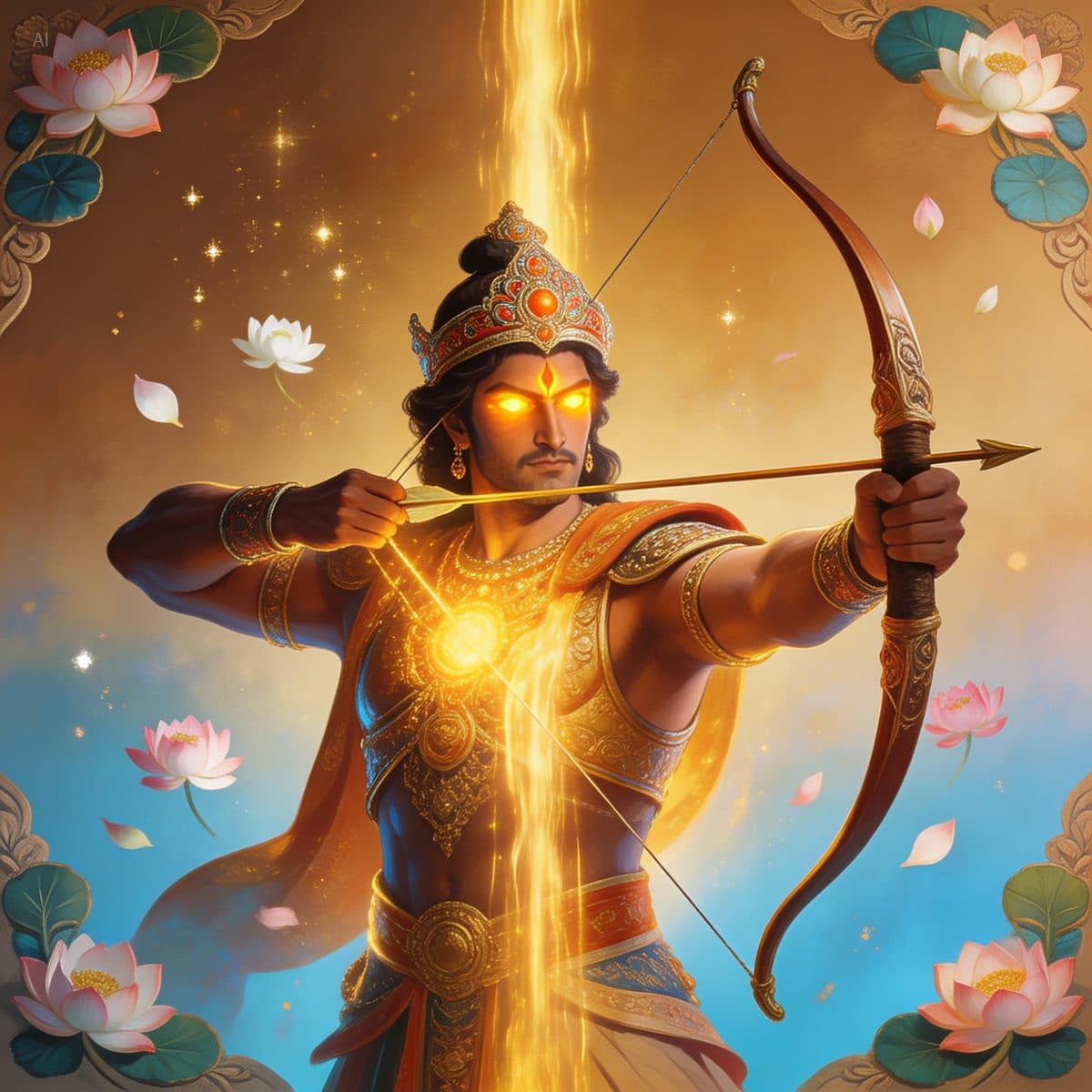
Watch Chapter Discourse
Video coming soon
Add a YouTube URL to the videoUrl field in chapters.ts
Chapter 4 — The Yoga of Knowledge and Action
Read Verses
42 of 42 availableThe Supreme Lord said: I instructed this imperishable science of yoga to the sun-god Vivasvan, and Vivasvan instructed it to Manu, the father of mankind, and Manu in turn instructed it to Ikshvaku.
Krishna reveals that this ancient wisdom was first imparted to the sun-god Vivasvan, passed through a lineage of kings, and has now been renewed for Arjuna.
This supreme science was thus received through the chain of disciplic succession, and the saintly kings understood it in that way. But in course of time the succession was broken, and therefore the science as it is appears to be lost.
The knowledge was passed through a line of royal sages, but over time the chain of disciplic succession was broken and the teaching was lost.
That very ancient science of the relationship with the Supreme is today told by Me to you because you are My devotee as well as My friend and can therefore understand the transcendental mystery of this science.
Krishna revives this ancient teaching specifically for Arjuna because of his devotion and friendship — the highest form of qualification for receiving this knowledge.
Arjuna said: The sun-god Vivasvan is senior by birth to You. How am I to understand that in the beginning You instructed this science to him?
Arjuna is puzzled: Vivasvan, the sun-god, is ancient. How could the seemingly mortal Krishna have taught him at the beginning of time?
The Supreme Lord said: Many, many births both you and I have passed. I can remember all of them, but you cannot, O subduer of the enemy!
Krishna explains that both he and Arjuna have had countless past births. Krishna remembers all of them; Arjuna does not — the difference between the divine and the conditioned soul.
Although I am unborn and My transcendental body never deteriorates, and although I am the Lord of all living entities, I still appear in every millennium in My original transcendental form.
Though eternal and unborn, Krishna takes birth through His own divine power (yoga-maya), not compelled by karma as ordinary souls are — His appearance is a free, conscious act of grace.
Whenever and wherever there is a decline in religious practice, O descendant of Bharata, and a predominant rise of irreligion—at that time I descend Myself.
Whenever dharma (righteousness) declines and adharma (unrighteousness) rises, Krishna manifests on Earth. This is the divine law of cyclical renewal.
To deliver the pious and to annihilate the miscreants, as well as to reestablish the principles of religion, I Myself appear, millennium after millennium.
Krishna takes birth in every age for three purposes: protecting the good, destroying evil, and reestablishing dharma. This is the threefold mission of every divine descent.
One who knows the transcendental nature of My appearance and activities does not, upon leaving the body, take his birth again in this material world, but attains My eternal abode, O Arjuna.
Whoever truly understands the divine nature of Krishna's birth and deeds is liberated from the cycle of rebirth at death and reaches Krishna's eternal abode.
Being freed from attachment, fear and anger, being fully absorbed in Me and taking refuge in Me, many, many persons in the past became purified by knowledge of Me—and thus they all attained transcendental love for Me.
Many have already attained liberation by taking refuge in Krishna, purified by knowledge and austerity, free from attachment, fear, and anger.
All of them—as they surrender unto Me—I reward accordingly. Everyone follows My path in all respects, O son of Pritha.
Krishna meets every person exactly where they are — whatever path they approach Him by, He reciprocates in kind. All genuine spiritual paths ultimately lead to the same divine source.
Men in this world desire success in fruitive activities, and therefore they worship the demigods. Quickly, of course, men get results from fruitive work in this world.
Those who worship lesser gods for quick material results do receive them — but such results are limited and temporary. Krishna notes this without condemning it, simply pointing to a higher path.
According to the three modes of material nature and the work associated with them, the four divisions of human society are created by Me. And although I am the creator of this system, you should know that I am yet the non-doer, being unchangeable.
The four-fold social order (varnas) was established by Krishna based on qualities (gunas) and work (karma), not birth. Yet Krishna remains the non-doer — the system operates through nature, not personal involvement.
There is no work that affects Me; nor do I aspire for the fruits of action. One who understands this truth about Me also does not become entangled in the fruitive reactions of work.
Karma does not bind Krishna because He has no desire for its fruits. One who understands and emulates this divine non-attachment is similarly freed from karmic bondage.
All the liberated souls in ancient times acted with this understanding of My transcendental nature. Therefore you should perform your duty, following in their footsteps.
The great sages who sought liberation before Arjuna all acted with knowledge of Krishna's transcendental nature. Arjuna is urged to follow their example — act, but act with wisdom.
Even the intelligent are bewildered in determining what is action and what is inaction. Now I shall explain to you what action is, knowing which you shall be liberated from all misfortune.
Even the learned are confused about the true nature of action, inaction, and forbidden action. Krishna promises to clarify this, as its understanding leads to liberation.
The intricacies of action are very hard to understand. Therefore one should know properly what action is, what forbidden action is, and what inaction is.
Three categories must be understood: karma (prescribed action), vikarma (forbidden action), and akarma (inaction). The way of action is deep and subtle.
One who sees inaction in action, and action in inaction, is intelligent among men, and he is in the transcendental position, although engaged in all sorts of activities.
The truly wise person sees inaction within action — recognizing that the Self (Atman) is never the doer — and sees potential action even within apparent stillness. This is the highest understanding of karma.
One is understood to be in full knowledge whose every endeavor is devoid of desire for sense gratification. He is said by sages to be a worker for whom the reactions of work have been burned up by the fire of perfect knowledge.
The truly learned person acts without personal desire — the fire of self-knowledge burns up all karmic reactions. Such a person's actions leave no bondage behind.
Abandoning all attachment to the results of his activities, ever satisfied and independent, he performs no fruitive action, although engaged in all kinds of undertakings.
One who has surrendered attachment to results, is always content, and has no dependence on outcomes — though fully engaged in activity — truly does nothing in the karmic sense.
Such a man of understanding acts with mind and intelligence perfectly controlled, gives up all sense of proprietorship over his possessions, and acts only for the bare necessities of life. Thus working, he is not affected by sinful reactions.
The liberated person acts only for what is necessary, without craving or possessiveness, with full mental control — and accumulates no sin, no karmic burden.
He who is satisfied with gain which comes of its own accord, who is free from duality and does not envy, who is steady in both success and failure, is never entangled, even though he acts.
Contentment with whatever comes naturally, freedom from the pairs of opposites, absence of envy, and equanimity in success and failure — one with these qualities acts freely without being bound.
The work of a man who is unattached to the modes of material nature and who is fully situated in transcendental knowledge merges entirely into transcendence.
For one who is free from attachment and whose mind rests in knowledge, all action performed as sacrifice (yajna) completely dissolves — it creates no karma.
A person who is fully absorbed in Krishna consciousness is sure to attain the spiritual kingdom because of his full contribution to spiritual activities, in which the consummation is absolute and that which is offered is of the same spiritual nature.
In the highest sacrifice, everything is Brahman: the act of offering, the substance offered, the fire, the one who offers — all are Brahman. Such a person attains Brahman through this all-pervading vision.
Some yogis perfectly worship the demigods by offering different sacrifices to them, and some of them offer sacrifices in the fire of the Supreme Brahman.
Different practitioners perform different kinds of sacrifice — some worship the divine through ritual offerings to deities; others offer the very act of sacrifice into the fire of Brahman itself.
Some [who are engaged in the path of self-realization] sacrifice the hearing process and the senses in the fire of the controlled mind, and others sacrifice the objects of the senses, such as sound, in the fire of sacrifice.
Some yogis offer the senses themselves into the fire of self-restraint; others offer the sense-objects into the fire of the senses — treating every sensory experience as a sacrifice.
Others, who are interested in achieving self-realization through control of the mind and senses, offer the functions of all the senses, and of the life breath, as oblations into the fire of the controlled mind.
Some offer all the activities of the senses and the vital breath into the fire of yoga of self-restraint, kindled by the light of knowledge — making daily life itself a continuous yajna.
Having accepted strict vows, some become enlightened by sacrificing their possessions, and others by performing severe austerities, by practicing the yoga of eightfold mysticism, or by studying the Vedas to advance in transcendental knowledge.
Many forms of sacrifice exist: material sacrifice, austerity, yoga practice, and the sacrifice of study and knowledge. All are valid paths when performed with sincerity and discipline.
Still others, who are inclined to the process of breath restraint to remain in trance, practice by offering the movement of the outgoing breath into the incoming, and the incoming breath into the outgoing, and thus at last remain in trance, stopping all breathing.
Pranayama practitioners offer the outgoing breath into the incoming and vice versa — controlling the life force until the mind merges into stillness. Breath control is itself treated as a form of sacrifice.
Others, who engage in yoga practice by restricting their food intake, offer the life breath into itself as a sacrifice. All these performers who know the meaning of sacrifice become cleansed of sinful reactions.
Even regulated eating is a form of sacrifice. All sincere practitioners — whatever their method — are purified by their sacrifice. No valid path of effort goes unrewarded.
O best of the Kuru dynasty, without sacrifice one cannot live happily on this planet or in this life. What then of the next?
Those who partake of the remnants of sacrifice — whatever is left after offering — attain the eternal Brahman. Without some form of sacrifice and giving, no good life is possible here or hereafter.
All these different types of sacrifice are approved by the Vedas, and all of them are born of different types of work. Knowing them as such, you will become liberated.
The many forms of sacrifice described in the Vedas all arise from action. Understanding this — that the universe is sustained by sacrifice at every level — brings liberation.
O chastiser of the enemy, the sacrifice performed in knowledge is better than the mere sacrifice of material possessions. After all, O son of Pritha, all sacrifices of work culminate in transcendental knowledge.
The sacrifice of knowledge is superior to all material sacrifices. Ultimately all actions and all offerings find their fulfillment in jnana — self-knowledge. Knowledge is the highest offering.
Just try to learn the truth by approaching a spiritual master. Inquire from him submissively and render service unto him. The self-realized souls can impart knowledge unto you because they have seen the truth.
Seek a realized teacher with humility, sincere inquiry, and service. Only those who have themselves seen the truth can transmit it. This is the guru-shishya relationship.
Having obtained real knowledge from a self-realized soul, you will never fall again into such illusion, for by this knowledge you will see that all living beings are but part of the Supreme, or, in other words, that they are Mine.
With this knowledge, Arjuna will see all beings in the Self and in Krishna — the vision of unity that permanently ends delusion and the grief that flows from perceiving separation.
Even if you are considered to be the most sinful of all sinners, when you are situated in the boat of transcendental knowledge, you will be able to cross over the ocean of miseries.
No amount of past sin can withstand the power of true self-knowledge. Like a boat crossing the ocean, knowledge carries even the most fallen soul safely across the sea of suffering.
As a blazing fire turns firewood to ashes, O Arjuna, so does the fire of knowledge burn to ashes all reactions to material activities.
Just as fire reduces all wood to ash, the fire of self-knowledge reduces all karma — the accumulated weight of all past actions — to ash, leaving nothing behind to produce further bondage.
In this world, there is nothing so sublime and pure as transcendental knowledge. Such knowledge is the mature fruit of all mysticism. And one who has become accomplished in the practice of devotional service enjoys this knowledge within himself in due course of time.
Nothing in existence is as purifying as knowledge of the Self. This knowledge matures naturally within the sincere practitioner — it cannot be forced, but comes in its own time through dedicated practice.
A faithful man who is dedicated to transcendental knowledge and who subdues his senses is eligible to achieve such knowledge, and having achieved it he quickly attains the supreme spiritual peace.
Three qualities are needed to receive knowledge: shraddha (faith and sincere aspiration), dedication to the path, and sense control. With these, knowledge comes — and with knowledge, supreme peace comes quickly.
But ignorant and faithless persons who doubt the revealed scriptures do not attain God consciousness; they fall down. For the doubting soul there is happiness neither in this world nor in the next.
The ignorant, the faithless, and the chronically doubting — those who never commit to any path — find neither worldly nor spiritual happiness. Doubt as a tool of inquiry is valuable; doubt as an identity is destructive.
Therefore, one who has renounced the fruits of his action through devotional service and who has dispersed his doubts with the sword of knowledge is not bound by his works, O conquerer of riches.
One who has surrendered all actions through yoga, who has cut all doubt with the sword of knowledge, and who is self-possessed — for that person, actions no longer bind. This is the liberated life.
Therefore the doubts which have arisen in your heart out of ignorance should be slashed with the weapon of knowledge. Armed with yoga, O Bharata, stand and fight.
The final call to action: cut through the doubt in your heart — born of ignorance — with the sword of knowledge. Then, armed with yoga, arise and act. This is the concluding charge of Chapter 4.
Key Teachings
- •God incarnates to restore dharma
- •Knowledge is the highest purifier
- •See the same Self in all beings