
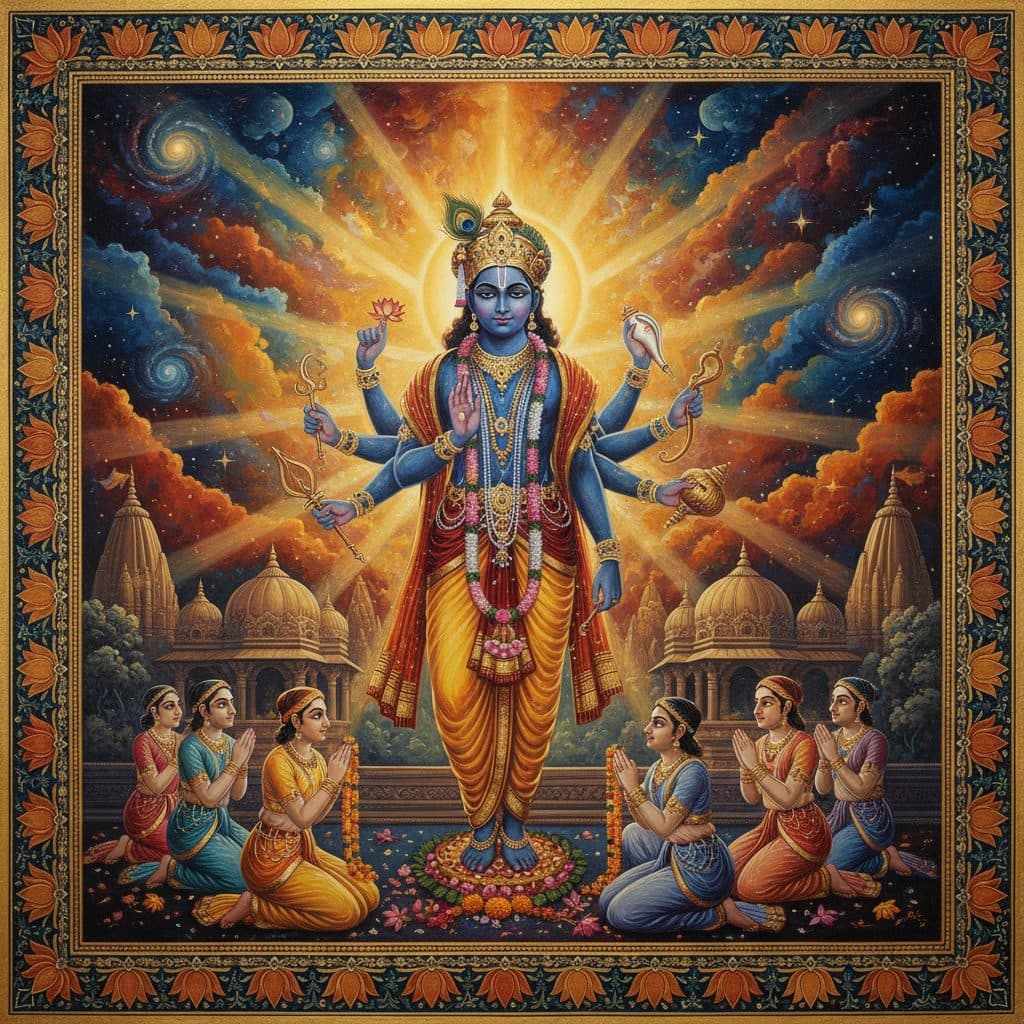
राज विद्या राज गुह्य योग
The Yoga of Royal Knowledge and Royal Secret
34 VersesDescription
Krishna declares this chapter to contain the most secret and sacred knowledge—the king of all knowledge. He describes how everything exists in him, yet he is independent of all. He explains the glory of devotion (Bhakti) and how even the worst sinner can attain salvation through sincere devotion.
Location
Kurukshetra Battlefield
Characters
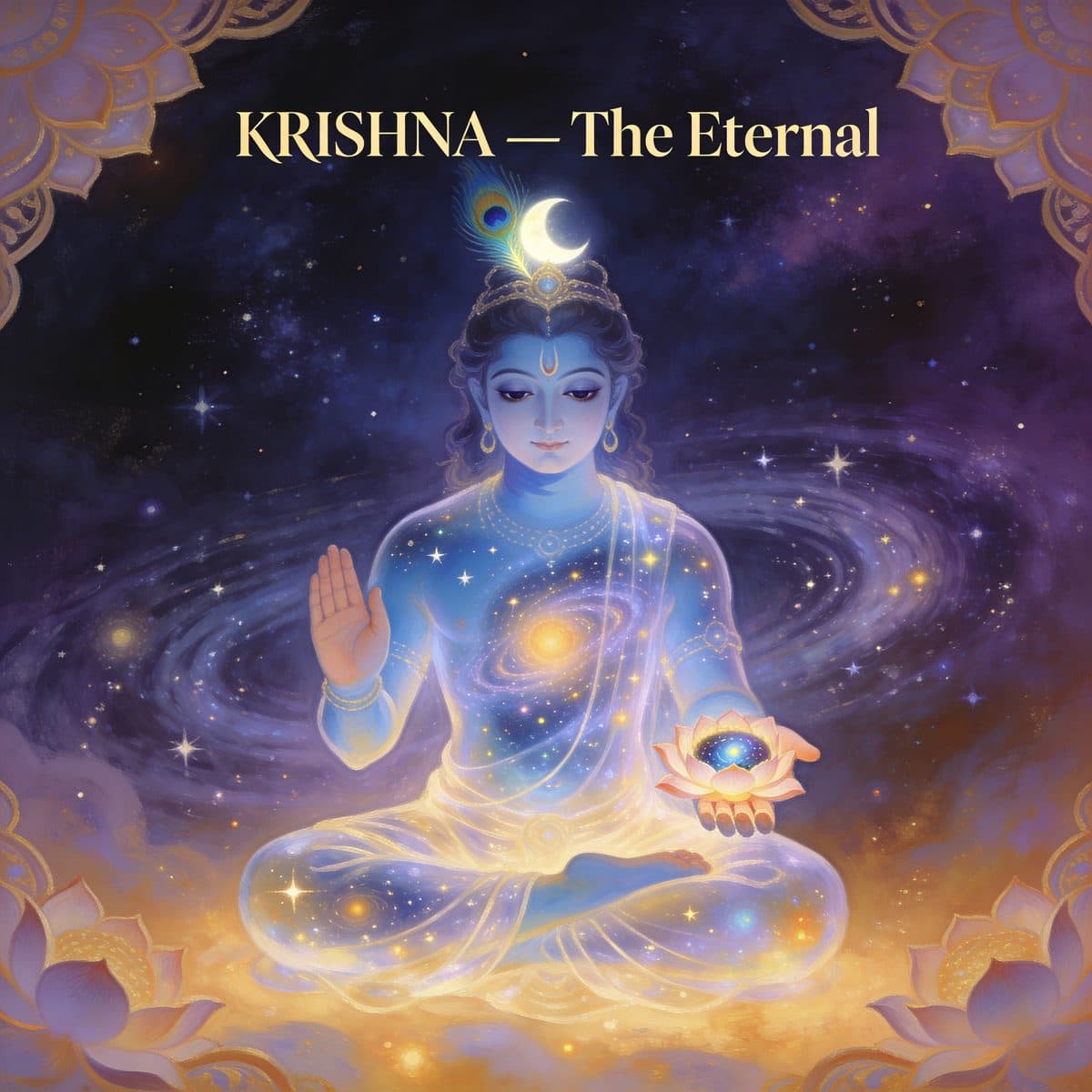
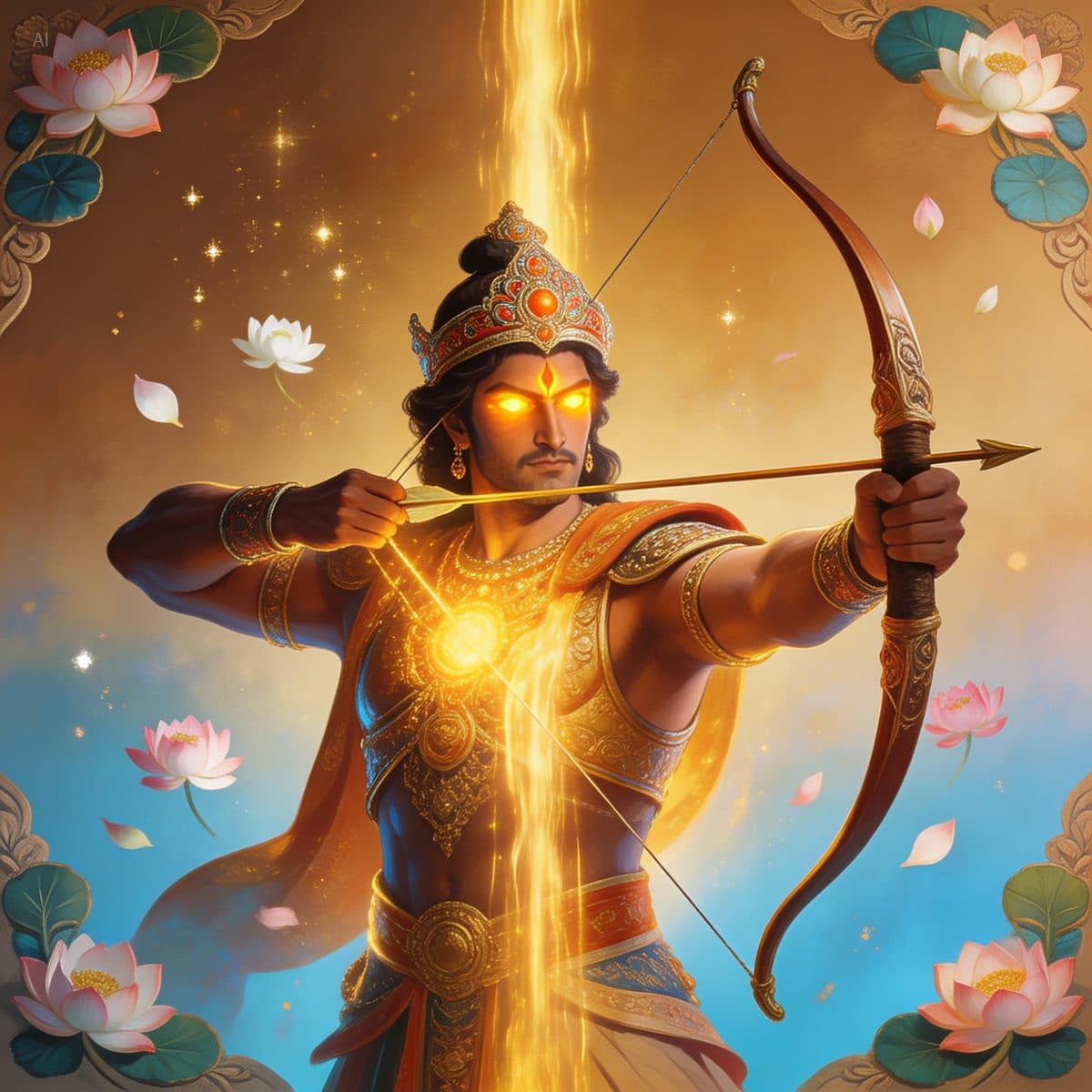
Watch Chapter Discourse
Video coming soon
Add a YouTube URL to the videoUrl field in chapters.ts
Chapter 9 — The Yoga of Royal Knowledge and Royal Secret
Read Verses
34 of 34 availableThe Supreme Personality of Godhead said: My dear Arjuna, because you are never envious of Me, I shall impart to you this most secret wisdom, knowing which you shall be relieved of the miseries of material existence.
Krishna opens this exalted chapter by naming the precondition for receiving the highest teaching: non-envy (anasūya). Not great learning, not austerity — simply the absence of resentment and jealousy toward the Divine. This knowledge is freely given to the open heart. The "most secret" is not hidden from everyone — only from those not yet ready to receive it.
This knowledge is the king of education, the most secret of all secrets. It is the purest knowledge, and because it gives direct perception of the self by realization, it is the perfection of religion. It is everlasting, and it is joyfully performed.
Seven qualities distinguish this knowledge: it is the sovereign of all sciences, the most secret, the most purifying, the highest, directly perceivable through experience, the perfection of dharma, and easy to practice with joy. No other knowledge combines these qualities. This is not a difficult path reserved for the elite — it is accessible, blissful, and imperishable.
Those who are not faithful in this devotional service cannot attain Me, O conqueror of enemies. Therefore they return to the path of birth and death in this material world.
The single disqualifier is śraddhā — faith. Without it, even the greatest philosophy remains inert. Those who approach this path with doubt and disbelief cannot reach the Divine and remain on the wheel of birth and death. Faith here is not blind belief but the living trust that makes practice possible.
By Me, in My unmanifested form, this entire universe is pervaded. All beings are in Me, but I am not in them.
A profound paradox: all beings exist within the Divine, yet the Divine is not contained within them. God pervades everything with His unmanifest presence — like space that fills a pot without the pot containing space. The Divine is both the ground of all existence and infinitely beyond it. This is the mystery of divine immanence and transcendence held in a single breath.
And yet everything that is created does not rest in Me. Behold My mystic opulence! Although I am the maintainer of all living entities and although I am everywhere, I am not part of this cosmic manifestation, for My Self is the very source of creation.
The mystery deepens. Even saying "all things rest in Me" is not complete. Behold the Divine wonder — yogam aiśvaram. The Supreme sustains all without being touched by any. He is the source and maintainer of creation without being bound by it. This is not a contradiction to be resolved but a mystery to be held in awe.
Understand that as the mighty wind, blowing everywhere, rests always in the sky, so all created beings rest in Me.
A luminous analogy: the wind moves through all of space, yet always remains in space — it cannot exist apart from it. Similarly, all beings move through the Divine, live within the Divine, and cannot exist outside of it. The sky is unchanged by the wind; the Divine is unchanged by creation. This image makes the abstract tangible.
O son of Kunti, at the end of the millennium all material manifestations enter into My nature, and at the beginning of another millennium, by My potency, I create them again.
At the end of a cosmic cycle, all creation dissolves back into the primordial nature of the Divine — like waves returning to the ocean. Then, at the dawn of a new cycle, Krishna sends them forth again. Creation and dissolution are not catastrophes but the rhythmic breathing of the Infinite.
The whole cosmic order is under Me. Under My will it is automatically manifested again and again, and under My will it is annihilated at the end.
Krishna presides over the entire creative process with absolute sovereignty. Creation flows from His will, not from chance or necessity. The word avaśam — helplessly, without will — describes all beings caught in this cosmic cycle. Only by turning toward the Divine can one step out of this automatic current.
O Dhananjaya, all this work cannot bind Me. I am ever detached from all these material activities, seated as though neutral.
Though Krishna creates and dissolves entire universes, He is not bound by these actions. He sits like a witness — unattached, uninvolved at the deepest level, unmoved by the vast drama He sets in motion. This is the model for the ideal yogi: fully active in the world, yet inwardly free from all of it.
This material nature, which is one of My energies, is working under My direction, O son of Kunti, producing all moving and nonmoving beings. Under its rule this manifestation is created and annihilated again and again.
Nature (prakṛti) is not autonomous — it operates under divine oversight. The entire display of the natural world, all living and non-living things, all the cycles of creation and destruction, happen under the Supreme's watchful direction. The world is not a mechanical accident but a divinely supervised unfolding.
Fools deride Me when I descend in the human form. They do not know My transcendental nature as the Supreme Lord of all that be.
When the Supreme appears in human form, those who see only the surface miss the depth entirely. They see a man and miss God. This is not a failure of intelligence but of spiritual vision — of the inner eye that perceives what the outer eye cannot. The incarnation is simultaneously the greatest concealment and the greatest revelation.
Those who are thus bewildered are attracted by demonic and atheistic views. In that deluded condition, their hopes for liberation, their fruitive activities, and their culture of knowledge are all defeated.
When the Divine is mocked or dismissed, everything built upon that dismissal becomes hollow: hopes become futile, actions become meaningless, and even knowledge leads nowhere. The one who rejects the foundation cannot build anything that lasts. This is not a curse but a consequence of the inner alignment chosen.
O son of Pritha, those who are not deluded, the great souls, are under the protection of the divine nature. They are fully engaged in devotional service because they know Me as the Supreme Personality of Godhead, original and inexhaustible.
In contrast to those who deride the incarnate Divine, the mahātmās — great souls — take shelter in the divine nature and worship with undivided minds, knowing Krishna as the primordial, inexhaustible source. Their greatness is not social status or extraordinary achievement; it is this clear-eyed recognition and the love that flows from it.
Always chanting My glories, endeavoring with great determination, bowing down before Me, these great souls perpetually worship Me with devotion.
Four practices define the great souls: ceaseless glorification, resolute striving, humble prostration, and devoted worship. These are not occasional acts but the continuous texture of their lives. The devotee's whole existence becomes an act of worship — not confined to a shrine but spread across every waking moment.
Others, who engage in sacrifice by the cultivation of knowledge, worship the Supreme Lord as the one without a second, as diverse in many, and in the universal form.
The Divine is approached through multiple valid pathways: as the one undivided Absolute (Advaita), as the many-in-one cosmic form (Vishishtadvaita), and as the many distinct divine manifestations (Dvaita). Krishna honors all three approaches here. No single lens exhausts the truth of the Divine — the Supreme is spacious enough for every sincere mode of seeing.
But it is I who am the ritual, I the sacrifice, the offering to the ancestors, the healing herb, the transcendental chant. I am the butter and the fire and the offering.
Krishna reveals Himself as every element of sacred ritual: the ceremony, the sacrifice, the offering, the herb, the mantra, the clarified butter, the fire, and the act of oblation itself. There is no part of any worship that is not the Divine. Every element of the sacred is the Sacred itself in disguise.
I am the father of this universe, the mother, the support and the grandsire. I am the object of knowledge, the purifier and the syllable om. I am also the Rig Veda, Sama Veda and the Yajur Veda.
The Divine is not a distant monarch but the most intimate presence imaginable: father, mother, grandfather, foundation of life. And simultaneously the ultimate object of all knowing, the purifier of everything, the sacred syllable Om, and the very scriptures themselves. Close as family, vast as eternity.
I am the goal, the sustainer, the master, the witness, the abode, the refuge, and the most dear friend. I am the creation and the annihilation, the basis of everything, the resting place and the eternal seed.
Twelve names of the Divine in two verses — each one a complete spiritual world. Krishna is the destination, the sustainer on the journey, the master, the witness, the home we return to, the refuge in fear, the dearest friend, origin, dissolution, foundation, resting place, and imperishable seed. Every human longing finds its ultimate answer in one of these names.
O Arjuna, I give heat, and I withhold and send forth the rain. I am immortality, and I am also death personified. Both spirit and matter are in Me.
The Divine holds all opposites within itself: heat and rain, immortality and death, being and non-being. This is not contradiction but completeness. Life and death are both expressions of the one Divine reality. There is nothing outside the Supreme — not even death, not even the absence of things.
Those who study the Vedas and drink the soma juice, seeking the heavenly planets, worship Me indirectly. Purified of sinful reactions, they take birth on the pious, heavenly planet of Indra, where they enjoy godly delights.
Those who follow the Vedic rituals with sincere devotion, seeking heaven as their reward, do reach exalted realms. They are purified, they enjoy divine pleasures, and their path is honorable. And yet — as the next verse will reveal — it is not the highest path, for it leads to a destination that, however glorious, is still temporary.
When they have thus enjoyed vast heavenly sense pleasure and the results of their pious activities are exhausted, they return to this mortal planet again. Thus those who seek sense enjoyment by adhering to the principles of the three Vedas achieve only repeated birth and death.
The honest, sobering truth: when the merit runs out, the soul falls back to earth. Heavenly pleasure, however vast, is spent pleasure — it ends. The one who works for rewards, even divine rewards, is on a treadmill of going and returning (gatāgatam). Only the one who seeks the Seeker of all rewards escapes the cycle entirely.
But those who always worship Me with exclusive devotion, meditating on My transcendental form — to them I carry what they lack, and I preserve what they have.
One of the most beloved promises in all the Gita. For the devotee who thinks of the Divine with undivided attention, who worships without turning elsewhere — the Supreme Himself becomes the provider and the protector. Yoga (obtaining what is needed) and kṣema (protecting what is obtained) — both are taken up by Krishna. The devoted one is never truly alone.
Those who are devotees of other gods and who worship them with faith actually worship only Me, O son of Kunti, but they do so in a wrong way.
Even those who worship other deities with sincere faith are, without knowing it, worshipping the Supreme — for there is only one ultimate source of all divinity. Yet the path is described as avidhi-pūrvakam — not in the proper way — because by aiming at a limited target, they receive a limited result. Sincerity of heart is recognized; precision of direction determines the destination.
I am the only enjoyer and master of all sacrifices. Therefore, those who do not recognize My true transcendental nature fall down.
All sacrifice, from the smallest prayer to the grandest Vedic ritual, has only one ultimate recipient: the Supreme. Not knowing this, worshippers of limited deities fall short — not condemned, but simply unable to reach what they haven't aimed at. True knowledge of the nature of the Supreme is what aligns the direction of worship with its highest destination.
Those who worship the demigods will take birth among the demigods; those who worship the ancestors go to the ancestors; those who worship ghosts and spirits will take birth among such beings; and those who worship Me will live with Me.
A clean, symmetrical law: the devotee reaches the object of devotion. Worship of the limited leads to the limited; worship of the Unlimited leads to the Unlimited. It is not a judgment but a description of how spiritual trajectories work. The path taken and the destination reached are mirror images of each other.
If one offers Me with love and devotion a leaf, a flower, fruit or water, I will accept it.
Perhaps the most tender verse in the entire Gita. The Supreme, who is the source of all creation, asks for nothing grand. A leaf. A flower. A fruit. Water. The offering matters less than the love with which it is given. Bhaktyā — with devotion — is the only condition. The poorest person in the world can satisfy the Divine completely.
Whatever you do, whatever you eat, whatever you offer or give away, and whatever austerities you perform — do that, O son of Kunti, as an offering to Me.
This may be the most practical verse in the Gita. No need to change what you do — change the spirit in which you do it. Every meal, every action, every gift, every discipline: offered to the Divine. Life itself becomes the liturgy. The entire day becomes worship. This is yoga without interruption.
In this way you will be freed from bondage to work and its auspicious and inauspicious results. With your mind fixed on Me in this principle of renunciation, you will be liberated and come to Me.
The fruit of the previous verse's practice: when all action is offered to the Divine, neither good nor bad karma accumulates. The soul is freed from the entire mechanism of karmic bondage — not by withdrawing from action but by transforming it through dedication. This is the sannyāsa of the heart, available to anyone, anywhere.
I am equal to all beings — no one is hateful to Me, no one is especially dear. Yet those who worship Me with devotion are in Me, and I am in them.
Divine love is equanimous — not playing favorites, not excluding anyone. And yet, a mysterious intimacy arises with the devotee: "they are in Me and I am in them." This is not contradiction but the nature of love — equally available to all, yet uniquely real in the one who opens to it. The sun shines equally on everything, but only the flower turned toward it blooms.
Even if one commits the most abominable action, if he is engaged in devotional service he is to be considered saintly because he is properly situated in his determination.
One of the most radical and merciful verses in scripture. Even the worst sinner — if they have turned wholeheartedly to the Divine with undivided devotion — should be regarded as saintly, because the direction of their soul is right. The past does not determine the future when the entire being has turned toward the light. This is the revolutionary promise of bhakti.
He quickly becomes virtuous and attains lasting peace. O son of Kunti, declare it boldly that My devotee never perishes.
The one who turns to the Divine is quickly transformed — dharmic, peaceful, imperishable. And then comes a remarkable instruction: "Declare it boldly, Arjuna." Krishna asks His devotee to become His spokesperson, to proclaim to the world: My devotee never perishes. This is both a promise and a commission.
O son of Pritha, those who take refuge in Me — be they women, merchants, or laborers — all attain the supreme destination.
This verse is one of the most radical and beautiful declarations in the entire Gita: the path of devotion belongs to everyone. Krishna opens the door of liberation to all — not just those born into privilege or scholarship. Any person, of any background, who sincerely takes refuge in the Lord reaches the highest goal. The great acharyas of all three Vedantic traditions are unanimous on this: grace does not calculate birth or status. It responds to the heart. The path of devotion (bhakti) is the great equaliser — the one path that has never had a gate.
How much more so the righteous Brahmanas, the devoted saints and the royal sages — having come to this temporary, miserable world, engage in loving service unto Me.
If even the lowborn can reach the Supreme through devotion, how much more certain is the path for the righteous, the scholarly, and the noble? The logic is compassionate: if the door is open to all, it is especially open to those with greater advantages. But the conclusion is urgent for everyone: this world is impermanent and full of suffering — waste no time. Worship now.
Engage your mind always in thinking of Me, become My devotee, worship Me, and offer your homage unto Me. Thus you will come to Me without fail. I promise you this because you are My very dear friend.
The great chapter closes with four simple instructions: think of Me, be My devotee, worship Me, bow to Me. And then the most intimate word in the entire Gita: "you are My very dear friend." Not a servant, not a student, not a subject — a dear friend. This is where all the theology, cosmology, and philosophy of Chapter 9 arrive: in the warmth of personal love between the soul and its Source.
Key Teachings
- •God pervades the entire universe
- •Devotion is the easiest path to God
- •God accepts even a leaf or flower offered with love