
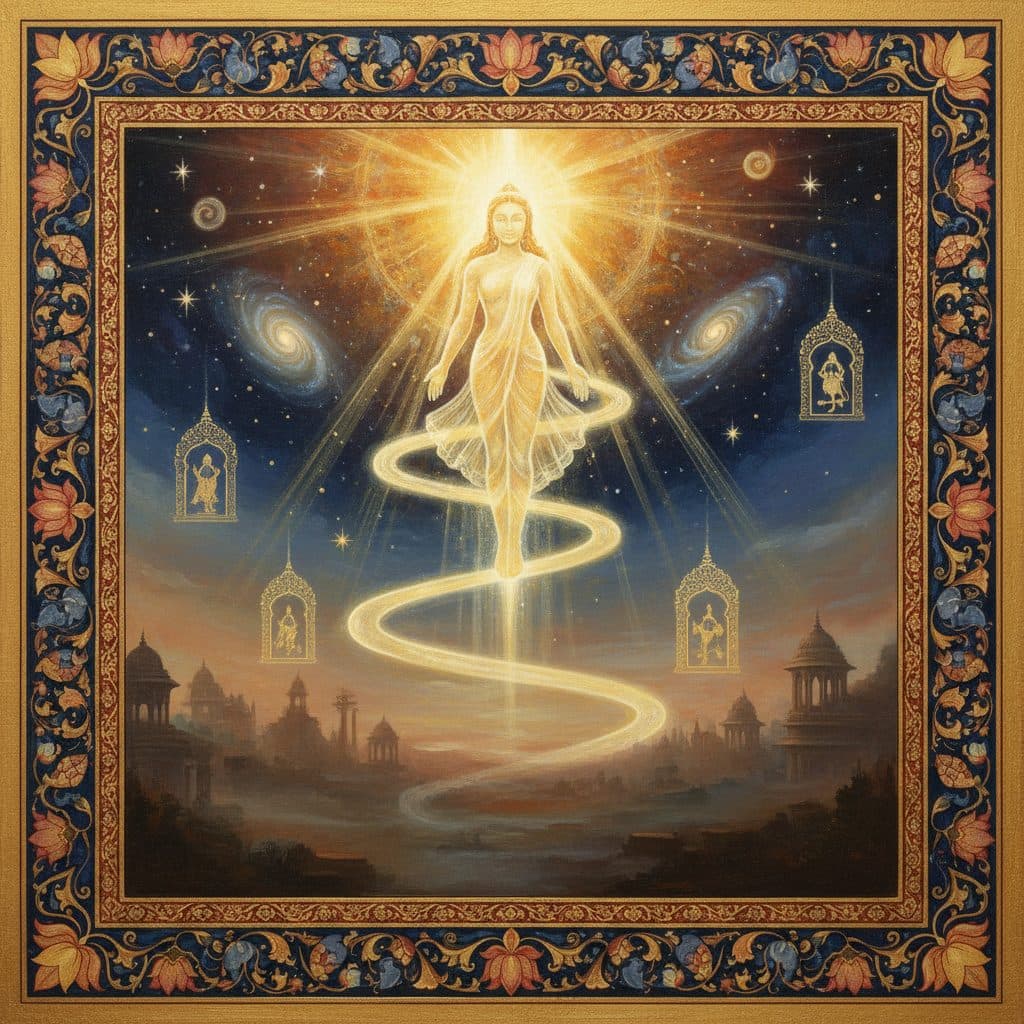
अक्षर ब्रह्म योग
The Yoga of the Imperishable Brahman
28 VersesDescription
Krishna explains the concepts of Brahman (the imperishable), Adhyatma (the individual self), Karma (action), Adhibhuta (physical elements), Adhidaiva (divine beings), and Adhiyajna (the Supreme in the body). He describes the paths of light and darkness that souls take after death and emphasizes the importance of remembering God at the time of death.
Location
Kurukshetra Battlefield
Characters
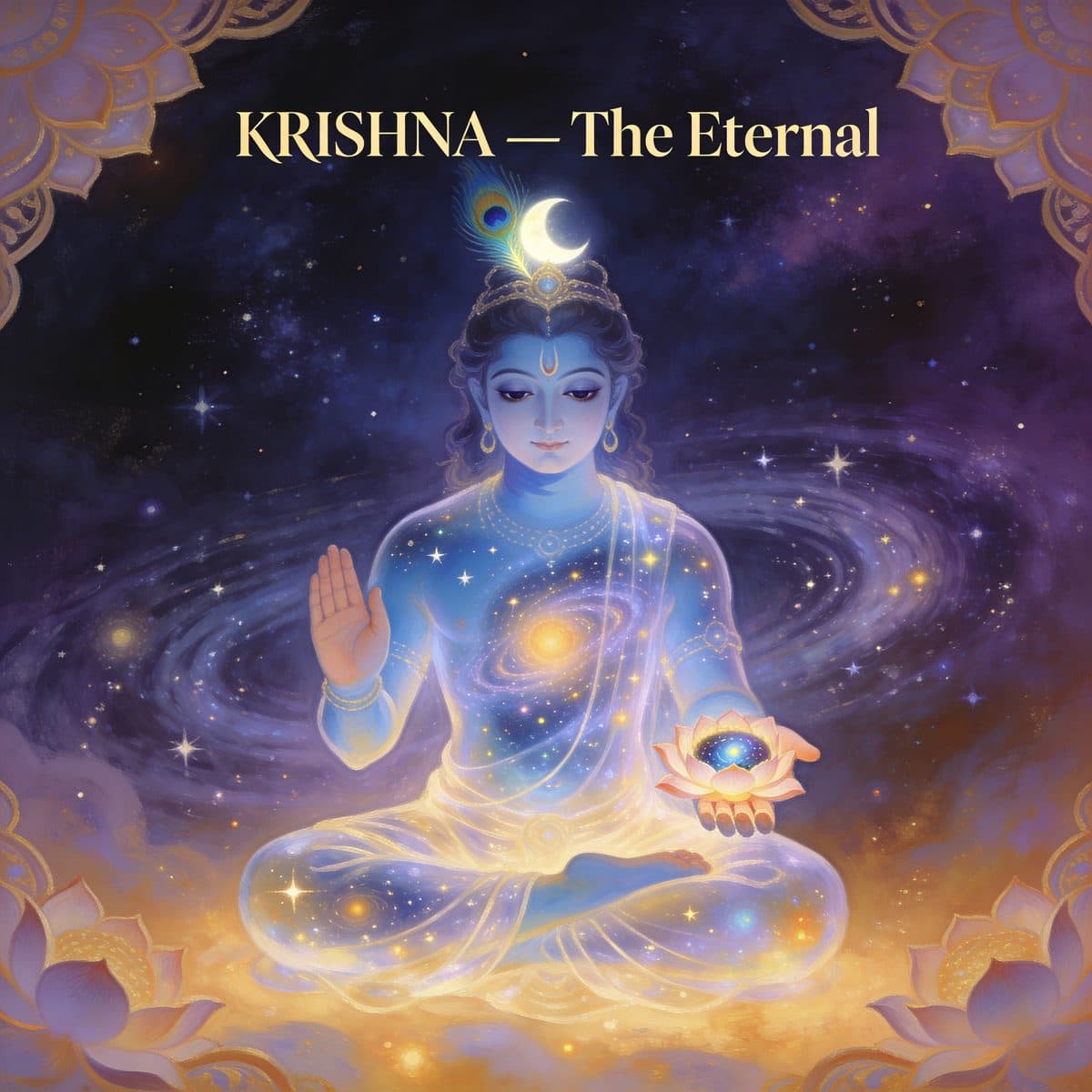
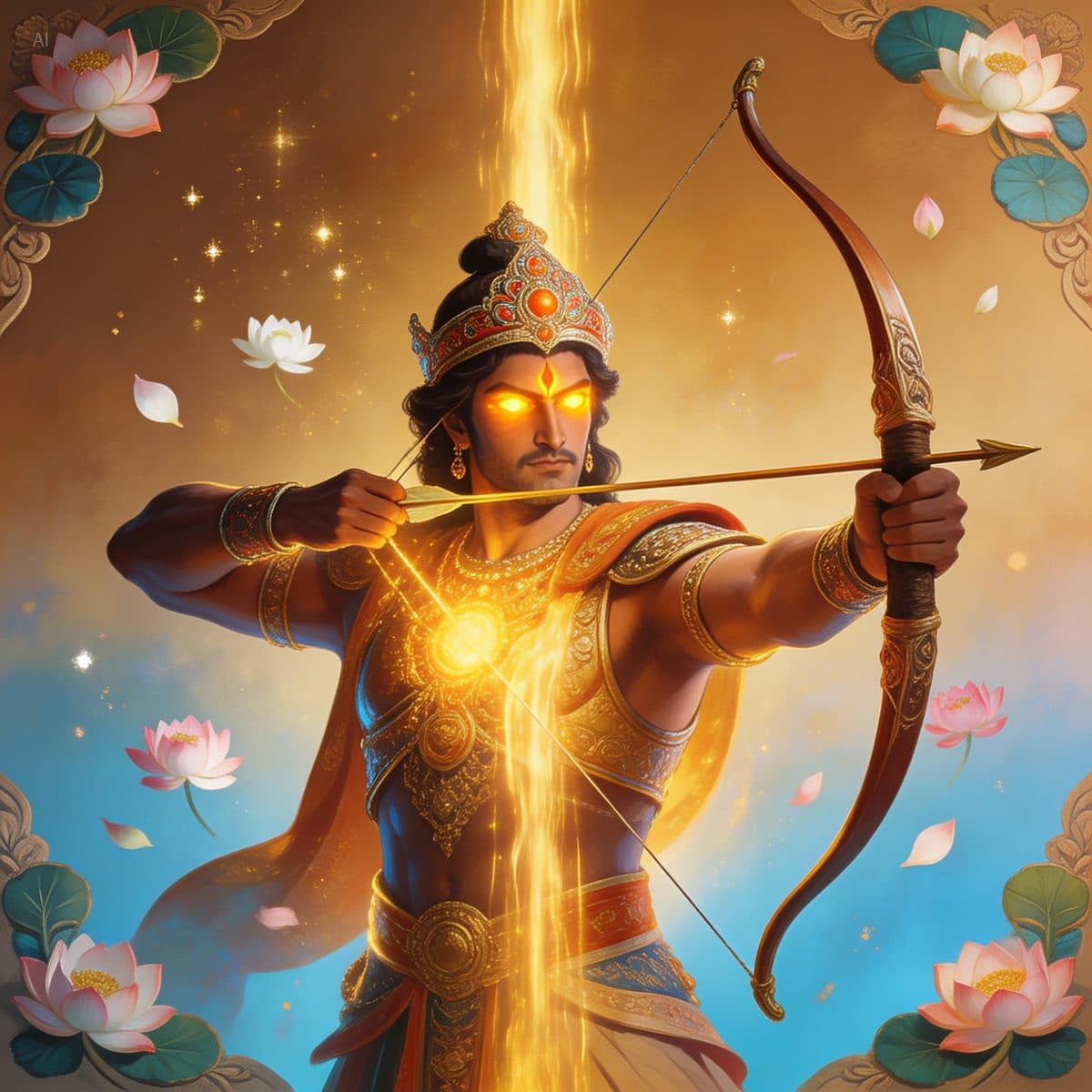
Watch Chapter Discourse
Video coming soon
Add a YouTube URL to the videoUrl field in chapters.ts
Chapter 8 — The Yoga of the Imperishable Brahman
Read Verses
28 of 28 availableArjuna said: O Supreme Person, what is Brahman? What is the self? What is karma? What is the material manifestation? And what are the demigods? Please explain all of this to me.
Chapter 7 ended with Krishna using five key terms — Brahman, adhyātma, karma, adhibhūta, and adhidaiva — and Arjuna, a diligent student, immediately asks for their definitions. This is the mark of a true seeker: when the teacher opens a door, the student walks through it.
Who is the Lord of sacrifice, and how does He live in the body, O Madhusudana? And how can those engaged in devotional service know You at the time of death?
Arjuna adds a sixth question — the most urgent one: how can the Divine be known at the very moment of death? This is not an abstract inquiry. The answer Krishna is about to give will shape the entire chapter and carry profound practical weight for every sincere practitioner.
The Supreme Personality of Godhead said: The indestructible, transcendental living entity is called Brahman, and its eternal nature is called adhyatma, the self. Action pertaining to the development of the material bodies of the living entities is called karma, or fruitive activities.
Krishna answers with precision. Brahman is the imperishable supreme. The individual self's own inner nature is adhyātma. And karma — often misunderstood as mere fate — is specifically the creative action that brings material bodies into being. These three are distinct but deeply interrelated.
Physical nature, which is constantly changing, is called adhibhuta. The universal form of the Lord, which includes all the demigods, like those of the sun and moon, is called adhidaiva. And I, the Supreme Lord, represented as the Supersoul in the heart of every embodied being, am called adhiyajna.
The perishable, ever-changing physical world is adhibhūta. The cosmic divine form encompassing all deities is adhidaiva. And the Supreme dwelling within every body as the Inner Witness — that is adhiyajña, and it is Krishna Himself. God is not merely above creation; He is its innermost presence.
And whoever, at the end of his life, quits his body remembering Me alone, at once attains My nature. Of this there is no doubt.
This is one of the most important promises in the entire Gita: whoever leaves the body with the mind resting on Krishna alone reaches Krishna's own nature. No doubt is left. The moment of death is the ultimate examination — and this verse reveals the secret to passing it.
Whatever state of being one remembers when he quits his body, O son of Kunti, that state he will attain without fail.
The principle is universal: the mind takes its final, strongest impression and carries it forward into the next existence. Whatever absorbs the consciousness most completely throughout life will naturally arise at death. You become what you most deeply are — what you have most consistently thought about.
Therefore, Arjuna, you should always think of Me in the form of Krishna and at the same time carry out your prescribed duty of fighting. With your activities dedicated to Me and your mind and intelligence fixed on Me, you will attain Me without doubt.
The practical instruction: do both. Fight — fulfill your duty in the world — and remember Me. Action and remembrance are not opposites; they are two hands of the same devotion. By offering mind and intelligence to Krishna while fully engaging with the world, the devotee lives a seamless spiritual life.
He who meditates on Me as the Supreme Personality of Godhead, his mind constantly engaged in remembering Me, undeviated from the path, he, O Partha, is sure to reach Me.
The method is clear: persistent practice (abhyāsa yoga) with an undistracted mind, meditating consistently on the Supreme. Not a burst of intensity followed by forgetfulness — but steady, unwavering return of attention to the Divine. This is the practice that makes the final moment effortless.
One should meditate upon the Supreme Person as the one who knows everything, who is the oldest, who is the controller, who is smaller than the smallest, who is the maintainer of everything, who is beyond all material conception, who is inconceivable, and who is always a person. He is luminous like the sun, and He is transcendental, beyond this material nature.
A meditation object of profound richness: the Supreme is the all-knowing ancient poet of creation, subtler than the atom, the sustainer of all, of inconceivable form, radiant as the sun, and transcendent to all darkness. To hold this vision in meditation is to be transformed by it.
One who, at the time of death, fixes his life air between the eyebrows and, by the strength of yoga, with an unmoving mind engaged in devotion, meditates upon the Supreme Personality of Godhead, will certainly attain to the Supreme.
A precise yogic instruction for the moment of death: withdraw the life-force (prāṇa) to the space between the eyebrows, hold the mind in perfect stillness through the power of accumulated yoga practice, and rest in devotion to the Supreme. This is the culminating act of a life fully lived in spiritual practice.
Persons who are learned in the Vedas, who utter the omkara, and who are great sages in the renounced order, enter into Brahman. Desiring such perfection, one practices brahmacharya. I shall now briefly explain to you this process by which one may attain salvation.
The great sages, the knowers of the Vedas, those who have renounced all desire — they all seek this same supreme destination. The practice of brahmacharya (disciplined, celibate focus of energy) is the path to it. Krishna offers to explain this path concisely — a sign of the chapter's deepening.
The yogic situation is that of detachment from all sensual engagements. Closing all the doors of the senses and fixing the mind on the heart and the life air at the top of the head, one establishes himself in yoga.
The mechanics of the final practice: close all sense-gates, withdraw the mind into the heart, and then draw the life-force (prāṇa) upward to the crown. This is the body of yogic mastery — the ability to consciously withdraw from the outer world and gather oneself inward at will.
After being situated in this yoga practice and vibrating the sacred syllable om, the supreme combination of letters, if one thinks of the Supreme Personality of Godhead and quits his body, he will certainly reach the spiritual planets.
Om is the sound-body of Brahman — the one syllable that encapsulates the totality of existence. To depart from the body while sounding Om inwardly, with the mind resting on the Supreme, is to take the highest possible exit. The syllable and the Supreme are, at this moment, one and the same.
For one who always remembers Me without deviation, I am easy to obtain, O son of Pritha, because of his constant engagement in devotional service.
One of the most tender promises in the entire Gita. For the devotee whose mind never strays from Krishna — not just in meditation but through the whole of daily life — the Supreme becomes sulabha: easy to reach, readily available. The greatest treasure becomes accessible to the one who never stops seeking it.
After attaining Me, the great souls, who are yogis in devotion, never return to this temporary world, which is full of miseries, because they have attained the highest perfection.
The world is here described honestly: duḥkhālaya — a place of suffering, and aśāśvata — impermanent. Not as a condemnation but as a clear-eyed diagnosis. The mahātmās who reach the Supreme are freed from this cycle forever. Liberation is not just peace — it is the end of all returning to pain.
From the highest planet in the material world down to the lowest, all are places of misery wherein repeated birth and death take place. But one who attains to My abode, O son of Kunti, never takes birth again.
Even the highest heavens — even Brahmaloka, the abode of the creator — are impermanent. All cosmic planes within material existence are subject to dissolution and return. Only the Supreme abode is truly eternal. This is a radical statement: no worldly achievement, however exalted, equals liberation.
By human calculation, a thousand ages taken together form the duration of Brahma's one day. And such also is the duration of his night.
Krishna frames the staggering scale of cosmic time. One day of Brahma — the creator — equals one thousand yugas (ages), and his night is equally vast. What we call eternity is still within time. Even the lifespan of the universe is finite. Only the Supreme endures beyond it all.
At the beginning of Brahma's day, all living entities become manifest from the unmanifest state, and thereafter, when the night falls, they are merged into the unmanifest again.
Like the rhythm of day and night, creation pulses between manifestation and dissolution. At Brahma's dawn, all beings emerge from the unmanifest; at his dusk, they dissolve back into it. This cosmic rhythm is the heartbeat of existence — and the wise seeker longs to step beyond it entirely.
Again and again, when Brahma's day arrives, all living entities come into being, and with the arrival of Brahma's night they are helplessly annihilated.
The word avaśaḥ — helplessly — is the key. Beings do not choose to be born or dissolved; they are carried by the cosmic tide. Without liberation, every soul is swept along by forces beyond its control, arising again and again into existence only to dissolve again. This is the suffering the Gita seeks to end.
Yet there is another unmanifest nature, which is eternal and is transcendental to this manifested and unmanifested matter. It is supreme and is never annihilated. When all in this world is annihilated, that part remains as it is.
Beyond the unmanifest that periodically manifests — beyond even the primordial creative potential — there is another reality: eternal, transcendental, untouched by creation and dissolution. When the entire cosmos is annihilated, this remains. This is the Supreme abode, and it is what Krishna is pointing toward.
That which the Vedantists describe as unmanifest and infallible, that which is known as the supreme destination, that place from which, having attained it, one never returns — that is My supreme abode.
The imperishable unmanifest — akṣara — is the highest destination spoken of in the Vedas. Reaching it, no one returns. This is the "place" beyond all cosmic cycles, beyond all temporary heavens. It is Krishna's own supreme abode, and it is the final goal of all genuine spiritual longing.
The Supreme Personality of Godhead, who is greater than all, is attainable by unalloyed devotion. Although He is present in His abode, He is all-pervading, and everything is situated within Him.
The Supreme — within whom all beings dwell, and by whom all existence is pervaded — is attained by one means alone: ananyā bhakti, undivided devotion. Not by philosophy alone, not by austerity alone, not by ritual alone, but by the wholehearted, exclusive love that turns every moment of life toward the Divine.
O best of the Bharatas, I shall now explain to you the different times at which, passing away from this world, the yogi does or does not come back.
Krishna now turns to cosmological teaching about the two paths of departure from this world — one leading to liberation, one to return. This ancient teaching from the Upanishads is about to be explained: the path of no return (devayana) and the path of return (pitṛyāna).
Those who know the Supreme Brahman attain that Supreme by passing away from the world during the influence of the fiery god, in the light, at an auspicious moment, during the fortnight of the waxing moon, or during the six months when the sun travels in the north.
The path of light: fire, light, day, the bright fortnight, the six months of the northern solstice. Those who depart in these cosmic conditions — or more precisely, who carry the inner light represented by these symbols — reach Brahman and do not return. This is the devayana, the path of the gods.
The mystic who passes away from this world during the smoke, the night, the fortnight of the waning moon, or the six months when the sun passes to the south reaches the moon planet but again comes back.
The path of smoke and darkness: night, the waning moon, the six months of the southern solstice. Those who depart this way reach lunar planes of great enjoyment — but they return. The inner state is one of merit without complete liberation, virtue without self-knowledge. Heaven is a rest stop, not the destination.
According to Vedic opinion, there are two ways of passing from this world — one in light and one in darkness. When one passes in light, he does not come back; but when one passes in darkness, he returns.
The two eternal paths are summarized: the path of light leads to non-return, the path of darkness leads back. These are not punishments and rewards arbitrarily assigned — they are the natural trajectories of the souls who have lived accordingly. The destination matches the direction of one's life.
Although the devotees know these two paths, O Arjuna, they are never bewildered. Therefore be always fixed in devotion.
The devotee who truly knows — who has internalized this knowledge — is never confused about these paths. They have already chosen. The practical conclusion is simple and urgent: at all times, be established in yoga. Don't wait for death to prepare for it.
The fruitive results described in the Vedas for the study of the Vedas, for the performance of yajna, for austerities and charities — a devotee surpasses all these by knowing this philosophy. And the supreme original abode is attained by such a devotee.
A breathtaking conclusion: all the merit accumulated by Vedic study, sacrifice, austerity, and charity — all of this is surpassed by the yogi who knows this truth and lives it. Not because those practices are worthless, but because this knowledge leads to the Supreme abode itself — the primordial, eternal home that is the goal of all those practices combined.
Key Teachings
- •Whatever one remembers at death, one attains that
- •The path of light leads to liberation
- •The path of darkness leads to rebirth